

Published: |Last updated:
Listen to this article
Show Quick ReadConcise summary from this article
India's Food Industry Has a Storage Problem — And It's Costing Everyone Money India wastes an estimated ₹92,000 crore worth of food every year — a staggering figure that represents roughly 16% of total agricultural output. A significant portion of this waste is directly attributable to inadequate and inappropriate storage. The right choice between cold storage and dry warehousing is not just a logistics decision for India's food and FMCG…
Ask AI About This Article
Answers are limited to information in this article.
India’s Food Industry Has a Storage Problem — And It’s Costing Everyone Money
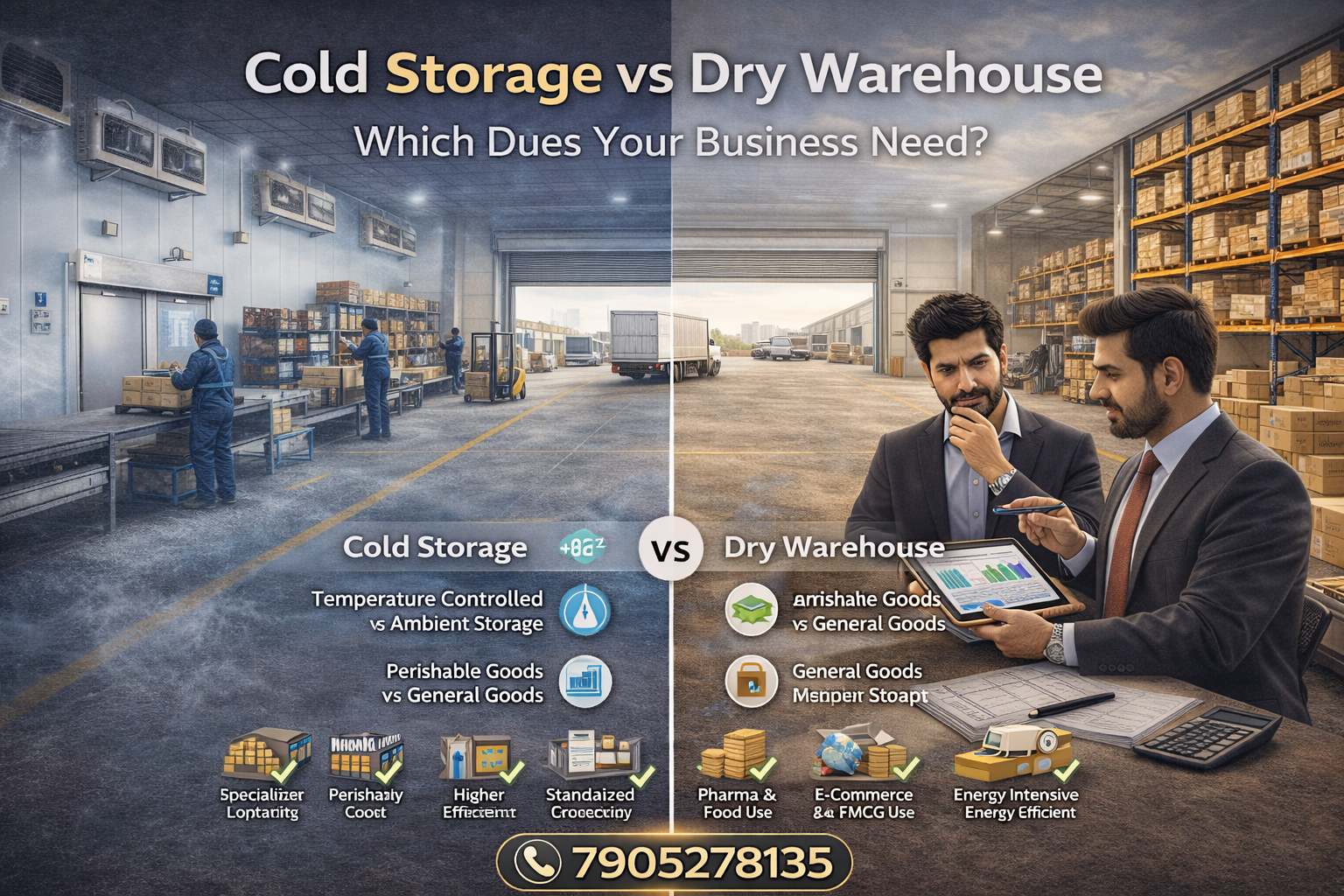
India wastes an estimated ₹92,000 crore worth of food every year — a staggering figure that represents roughly 16% of total agricultural output. A significant portion of this waste is directly attributable to inadequate and inappropriate storage. The right choice between cold storage and dry warehousing is not just a logistics decision for India’s food and FMCG businesses — it is a critical quality and profitability lever.
In 2026, with India’s organised food retail sector crossing ₹4 lakh crore and quick commerce platforms demanding same-hour delivery of fresh products, the pressure on food storage infrastructure has never been higher. Businesses that understand the distinction between cold storage and ambient warehousing — and deploy each correctly — run tighter operations, waste less product, and command better retailer relationships.
Matching Product Category to Storage Type — The FMCG Matrix
| Product Category | Storage Type | Temperature Req. | Shelf Life (correct storage) | Risk if Wrong Storage |
| Fresh dairy (milk, curd, paneer) | Cold — Chilled | +2°C to +6°C | 5–21 days | Spoilage within 24–48 hrs at ambient |
| Processed dairy (UHT milk, cheese) | Dry — Ambient | 15°C–25°C | 6–12 months | None at ambient (sealed) |
| Fresh fruits & vegetables | Cold — Chilled/CA | +2°C to +10°C | 2–8 weeks | Rapid wilting, browning, microbial growth |
| Frozen foods (meat, seafood, veg) | Cold — Frozen | −18°C to −25°C | 6–24 months | Complete loss within hours at ambient |
| Packaged FMCG (biscuits, snacks) | Dry — Ambient | 15°C–30°C | 6–18 months | Moisture damage if humidity not controlled |
| Chocolate & confectionery | Dry — Climate Controlled | 18°C–22°C | 6–12 months | Bloom, melting, texture degradation |
| Beverages (packaged, carbonated) | Dry — Ambient | 10°C–30°C | 3–24 months | Label damage from condensation if too cold |
| Pharmaceuticals & nutraceuticals | Cold — Chilled | +2°C to +25°C (by product) | 12–36 months | Potency loss, regulatory non-compliance |
| Cut flowers | Cold — Chilled | +2°C to +4°C | 7–21 days | Wilting within hours at Indian ambient |
Cold Chain Compliance for FMCG — What FSSAI Now Requires
The Food Safety and Standards Authority of India (FSSAI) has progressively tightened cold chain compliance requirements for food businesses. As of 2024–25, FSSAI’s Food Safety and Standards (Food Products Standards and Food Additives) Regulations mandate temperature documentation for all licensed food businesses dealing in temperature-sensitive products.
- Temperature monitoring logs: Continuous digital records of storage temperature — spot checks are no longer sufficient for high-risk products
- Calibrated equipment: All thermometers, data loggers, and refrigeration controls must be calibrated with NABL-accredited lab certificates
- SOP for temperature excursions: Written procedures for what happens when temperature goes out of range — and proof that the procedure was followed
- Clean room and hygienic design standards: For dairy and ready-to-eat products, storage areas must meet GMP (Good Manufacturing Practice) facility standards
- Vehicle cold chain continuity: FSSAI increasingly requires cold chain documentation from factory to point of sale — not just the warehouse portion
Why Lucknow’s NH-24 Corridor Is Emerging as an FMCG Distribution Hub
Lucknow’s strategic position at the heart of Uttar Pradesh — India’s most populous state with 240 million consumers — makes it a natural FMCG distribution hub. The NH-24 (now NH-9) corridor connecting Lucknow to Delhi is one of India’s busiest freight arteries, and businesses located on this corridor benefit from superior connectivity in all directions.
For FMCG businesses dealing in dry goods — packaged foods, personal care products, household items, agri-inputs, and consumer durables — quality dry warehouse space on NH-24 provides the distribution backbone to service hundreds of towns and districts across central and eastern UP efficiently.
| 🏭 ASHOKA WAREHOUSING — LUCKNOW
Premium Dry Warehouse / Godown Available for Rent 📍 Location: Sitapur Road, NH-24 National Highway — just 20 minutes from Lucknow Junction 💰 Rent: ₹18 per sq. ft. — Highly Competitive Market Rate ✅ Ideal For: Manufacturers · Importers · Exporters · Wholesalers · Transport Companies · Logistics & Distribution Businesses 🛣️ Highway Access: Direct NH-24 frontage — seamless connectivity to Delhi NCR, Kanpur, Gorakhpur, and all major UP trade corridors |
Ashoka Warehousing on Sitapur Road, NH-24 is purpose-built for exactly this distribution function. At ₹18/sq ft with direct national highway access, this facility gives FMCG businesses the storage capacity and connectivity to serve the vast UP interior market without the operational complexity or cost of cold storage — which is the right choice for the vast majority of packaged FMCG products that do not require temperature control.
FAQs for Food & FMCG Businesses
Q: Does packaged processed food need cold storage in India?
Most packaged processed food does not require cold storage — but temperature and humidity control still matter. Products like chocolates, premium biscuits, spices, coffee, and certain nutraceuticals require climate-controlled ambient storage (18°C–22°C, 50–60% RH) rather than refrigerated cold storage. This is achievable in a well-constructed dry warehouse with insulation and controlled ventilation. The key distinction is between temperature-sensitive (requires climate control) and perishable (requires active refrigeration). FMCG businesses should categorise their SKUs carefully rather than defaulting to either standard dry storage or expensive cold storage without analysis.
Q: What government subsidies are available for cold storage investment in India?
The Government of India offers significant capital subsidies for cold chain infrastructure under several schemes: (1) PMKSY (Pradhan Mantri Kisan Sampada Yojana) — 35% capital subsidy for cold stores in general areas and 50% in NE/hilly states; (2) NABARD’s Cold Chain Scheme — loans at concessional interest rates for integrated cold chain projects; (3) NHB (National Horticulture Board) — back-ended subsidies for CA cold stores for horticulture produce; (4) State government schemes — UP, Maharashtra, and Punjab offer additional state-level subsidies for agri cold chain infrastructure. Total subsidy can range from 35–50% of project cost — making cold storage construction an attractive investment for serious agri-business entrepreneurs.
Q: How do I find FSSAI-compliant cold storage in UP for my dairy business?
FSSAI-licensed cold storage facilities can be identified through: (1) FSSAI’s FoSCoS portal (foodlicensing.fssai.gov.in) — searchable by state, district, and business type; (2) NIC’s Agmarknet portal — lists APMC-registered cold stores; (3) Industry associations like CIFTI (Cold Industry and Trade Association of India) maintain member directories; (4) State FSSAI offices in Lucknow maintain lists of licensed cold store operators in UP. For pharmaceutical cold storage in UP, the State Drug Controller’s office (Lucknow) maintains a register of licensed cold chain drug distributors with approved storage facilities.
Promote your articles nowCheck for details
Choose a promotion package
Choose a package below, scan the QR code and pay the displayed amount for 20 days.
After payment, email your article title and payment screenshot to info@yourneeds.asia. Once confirmation is received, one of our administrators will activate the promotion.

Choose where your promoted article receives extra visibility
Promotion changes presentation and placement for the selected period. It does not guarantee traffic, enquiries, search ranking or sales.
Priority visibility in the VIP Lounge, promoted shelves and highlighted article areas.
Top-style highlighting in article directories, homepage feeds and promoted article blocks.
Premium styling across supported article feeds, recommendations and directory placements.
Featured presentation in supported homepage, category, directory and related-article areas.
Build a stronger online presence for your business
Get Your Website for ₹15,000
Are you listed and don't have a website for your business? We can plan, design and launch a responsive website that makes your business easier to understand and contact.
Get My WebsiteSEO Starts from ₹10,000/Month
Improve how your business is presented across Google, local listings and AI-powered search results with ongoing SEO, content and authority-building work.
Improve My VisibilitySuggested Articles
View all articles
Apartment for Sale in Porvorim Goa: What to Check During a Property Visit
Finding an apartment for sale in Porvorim Goa can look simple when you browse listings online. The real decision starts when you visit the…

What Makes the Best Real Estate Developers in Delhi Stand Out?
[caption id="attachment_8264" align="alignnone" width="300"] best real estate developers in delhi[/caption] Buying property in Delhi is a significant financial decision, and choosing the right developer…

Velvet Vista Goa: A Practical Choice for a Second Home in North Goa
Velvet Vista Goa Porvorim offers an option worth considering for buyers who want a second home in North Goa without choosing a location based…

How Can You Find the Right Property for Sale in Calangute Goa?
Are you searching for a home, holiday residence, or investment opportunity in North Goa? Calangute is a popular choice because it offers a mix…
Latest Blog Posts
View all articles
Flats for Rent in Hyderabad: Apartments, Tolet, Villas & Independent Houses 2026
Flats for Rent in Hyderabad: Apartments, To-Let Homes, Villas & Independent Houses – Complete 2026 Rental Guide Finding the right Flats for rent in…
Sara777 – Satta Matka Results and Chart Latest Records
Welcome to Sara777, an online platform created to provide easy access to Satta Matka results, charts, market records, and related information in one place.…

How to deposit on allpanel777?
Here is some steps to deposit on allpanel777 are:- Step 1: Start With Your Account To deposit, users should have an active AllPanel777 account.…

How Rhythm & Royalty Fitness Makes Dance Classes in Zirakpur Fun for Every Age Group
Dance has a unique way of bringing people together, no matter their age, fitness level, or experience. With everyone seeking a workout that doesn't…

Free JPG to PES Tools and Their Limitations
Turning a picture into an embroidery file sounds simple until you see what happens inside the machine. A JPG shows an image, while a…
Getting to Know Ciprofloxacin 500 mg: Uses, Safety and Important Information
[caption id="attachment_8302" align="alignnone" width="300"] Ciprofloxacin 500 mg: Understanding the basics in a simple way.[/caption] Ciprofloxacin 500 mg: Some Basic Points to Consider When one…