
Published: |Last updated:
Listen to this article
Show Quick ReadConcise summary from this article
Electronic devices need a reliable power source to work safely and efficiently. Many devices operate using direct current (DC), while the electricity supplied to homes and offices is alternating current (AC). A power adapter converts electricity from an AC outlet into the DC power required by a compatible device. Choosing the correct adapter helps maintain stable performance, reduce power-related problems, and protect electronic equipment. Whether you need an adapter for…
Ask AI About This Article
Answers are limited to information in this article.
Electronic devices need a reliable power source to work safely and efficiently. Many devices operate using direct current (DC), while the electricity supplied to homes and offices is alternating current (AC). A power adapter converts electricity from an AC outlet into the DC power required by a compatible device. Choosing the correct adapter helps maintain stable performance, reduce power-related problems, and protect electronic equipment.
Whether you need an adapter for a CCTV camera, router, LED device, or another electronic product, understanding voltage, current, connector type, and safety features can help you make an informed decision.
What Is an AC to DC Power Adapter?
An AC to DC Power Adapter is an electrical device that converts alternating current from a wall socket into direct current for compatible electronic equipment. Most household electrical outlets supply AC power, but many electronic devices require DC power to operate.
The adapter performs this conversion and provides the output voltage and current specified for the connected device. Depending on its design, it may also regulate the output and include protection against electrical faults.
Power adapters are available in different voltage ratings, current capacities, connector types, and sizes. Selecting one that matches your device is essential for reliable operation.
How Does an AC to DC Adapter Work?
An adapter generally performs several electrical functions to deliver suitable power to a connected device.
- Input connection: The adapter receives AC electricity from a compatible wall outlet.
- Voltage conversion: Internal circuitry adjusts the electrical voltage to the required level.
- Rectification: The circuit converts AC into DC.
- Filtering and regulation: Additional components help smooth the output and maintain a suitable voltage.
- Power delivery: The DC output travels through the adapter’s cable and connector to the device.
The exact design varies between linear and switch-mode adapters. Modern switch-mode designs are widely used because they can offer good efficiency in a compact enclosure.
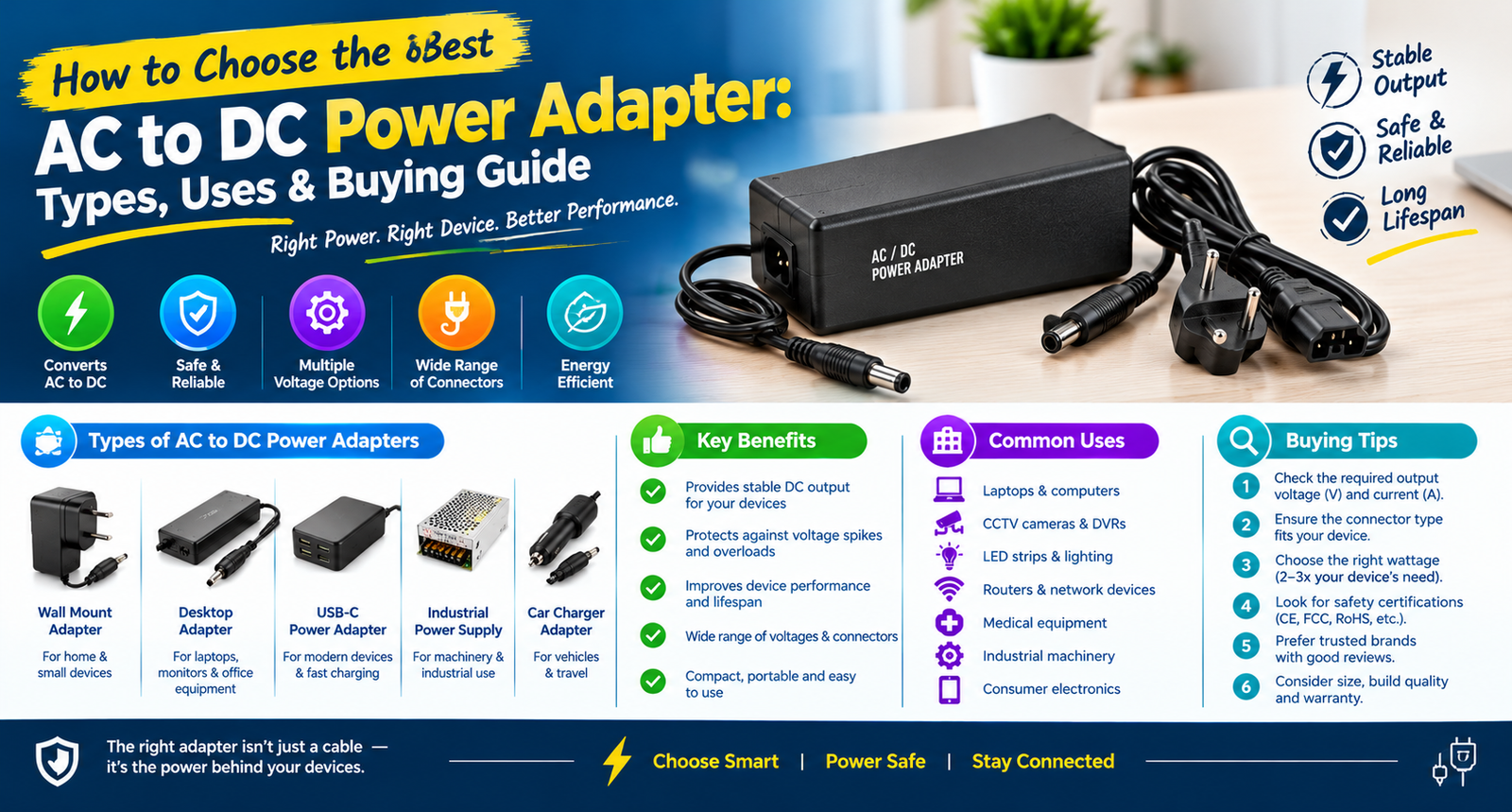
Types of AC to DC Power Adapters
Different devices have different power requirements. Understanding the main adapter types makes it easier to select a suitable option.
1. Fixed-Voltage Power Adapters
Fixed-voltage adapters provide a specified output, such as 5V, 9V, 12V, or 24V. They are commonly used with routers, CCTV equipment, LED products, and other electronics designed for a particular voltage.
Before choosing one, check the device’s label or manufacturer documentation to confirm the required output.
2. Regulated Power Adapters
A Regulated DC Power Supply is designed to keep its output voltage within specified limits as input voltage or load conditions change. This can help electronic equipment receive more consistent power.
Regulation is especially useful for sensitive electronics that require a stable supply. However, the adapter must still match the device’s voltage, current, polarity, and connector requirements.
3. Switching Power Adapters
Switching adapters use high-frequency electronic circuits to convert power efficiently. They are commonly found in modern consumer electronics because they can be lightweight, compact, and suitable for a wide range of input conditions.
Their actual performance depends on the design, component quality, load, and applicable safety standards.
4. Linear Power Adapters
Linear adapters use a transformer and linear regulation circuitry to provide the required output. Some designs are simple and can produce low electrical noise, but they may be larger and less efficient than switching alternatives.
They remain useful in specific applications where their electrical characteristics are appropriate.
5. Universal and Adjustable Adapters
Some adapters provide multiple selectable output voltages or interchangeable connectors. These can support different devices when the electrical specifications match.
Always verify the selected voltage, maximum current, connector compatibility, and polarity before connecting a universal adapter. Never assume that a connector fitting physically means the adapter is electrically compatible.
Common Uses of AC to DC Power Adapters
Power adapters are used across homes, offices, retail environments, and industrial installations.
CCTV Cameras and Security Systems
A Power Adapter for CCTV Camera supplies the DC power required by compatible surveillance equipment. Some cameras use 12V DC, while others may require different voltages or power arrangements.
Check the camera’s specifications and current requirements before selecting an adapter. For multi-camera installations, calculate the total power demand and follow the system manufacturer’s recommendations.
Wi-Fi Routers and Networking Equipment
A DC Adapter for Router supplies power to compatible routers, modems, and networking devices. An incorrect voltage or connector can prevent the equipment from operating properly.
For uninterrupted connectivity, select an adapter that meets the router’s specified voltage, current, polarity, and connector requirements.
LED Lights and Electronic Devices
Many LED products, small electronic controllers, audio accessories, and development boards require DC power. Their power requirements can vary significantly, so check the specifications instead of choosing an adapter based only on its physical size.
Industrial and Communication Equipment
Certain control systems, communication devices, and monitoring equipment use dedicated DC supplies. These applications may require additional considerations, including continuous-duty operation, environmental protection, and electrical noise performance.
Understanding Voltage, Current, and Wattage
Three important specifications determine whether an adapter can supply suitable power.
Output Voltage
Voltage is measured in volts (V). The adapter’s output voltage should match the value specified by the device manufacturer. For example, a 12V DC Power Adapter is appropriate only for equipment designed to accept a compatible 12V DC input.
Using an adapter with an incorrect voltage can cause malfunction or damage.
Output Current
Current is measured in amperes (A) or milliamperes (mA). The adapter must be capable of supplying at least the current required by the device.
For example, if a device requires 12V and 2A, an appropriate adapter generally needs a 12V output and a rated current capacity of at least 2A, provided all other specifications match. A higher current rating can be acceptable when the voltage, polarity, connector, and power requirements are compatible; the device draws the current it needs.
Power Rating
Power is measured in watts (W) and can be calculated using:
Power (W) = Voltage (V) × Current (A)
For example, a 12V, 2A adapter has a nominal output rating of 24W.
Do not choose an adapter by wattage alone. Its voltage and other electrical specifications must also be suitable for the connected equipment.
AC to DC Converter vs. Power Adapter
An AC to DC Converter is a broad term for equipment that changes alternating current into direct current. A power adapter is a common type of converter packaged for convenient connection to electronic devices.
The terms are sometimes used interchangeably, but a converter may also refer to a component or power-conversion circuit installed inside larger equipment. A complete external adapter typically includes an enclosure, input connection, conversion circuitry, and output cable or connector.
When shopping, focus on the actual input and output specifications rather than the product name alone.
How to Choose the Best AC to DC Adapter
Choosing the right adapter involves more than matching a connector. Review the following factors before purchasing.
1. Confirm the Device’s Voltage
Check the device label, original adapter, or official manual. The output voltage must match the manufacturer’s requirements unless the device explicitly supports a voltage range.
2. Check the Required Current
Find the device’s current requirement and choose an adapter with sufficient rated capacity. For devices with high startup or peak power demand, consider the manufacturer’s recommendations.
3. Verify Connector Size and Polarity
Barrel connectors come in different diameters and lengths. Some devices use centre-positive connections, while others use different arrangements. Check the connector dimensions and polarity symbol carefully.
4. Review Input Voltage Compatibility
If the adapter will be used in different regions, check its input rating. Some models support a wide AC input range, while others have more limited input specifications. Use the appropriate plug and electrical supply for the destination.
5. Look for Safety and Protection Features
Depending on the application, useful features may include short-circuit protection, overcurrent protection, overvoltage protection, thermal protection, and appropriate electrical isolation.
Check the product’s documented safety certifications and compliance claims rather than relying solely on marketing language.
6. Consider Build Quality and Cable Length
A durable enclosure, properly insulated cable, secure connector, and suitable strain relief can support dependable everyday use. Select a cable length that suits the installation without creating unnecessary tension or trip hazards.
7. Choose a Suitable Supplier
Purchase from a reliable seller that provides clear specifications, warranty information, and product support. A well-documented adapter makes it easier to verify compatibility and address problems if they occur.
Common Mistakes to Avoid
A few common selection errors can lead to unreliable operation or equipment damage.
- Choosing the wrong voltage: An incompatible voltage can cause malfunction or damage.
- Ignoring polarity: A connector with the wrong polarity may damage the connected device.
- Selecting insufficient current capacity: An under-rated adapter may overheat, shut down, or fail to operate the equipment correctly.
- Assuming every connector is compatible: Similar-looking connectors may have different dimensions or wiring.
- Ignoring heat and ventilation: Keep adapters away from excessive heat and follow the manufacturer’s ventilation instructions.
- Using damaged cables or enclosures: Replace equipment that shows exposed wires, cracks, burning smells, or other signs of damage.
- Overlooking safety information: Avoid unverified products with unclear ratings or missing manufacturer details.
Safety Tips for Using Power Adapters
Always inspect the adapter before use and keep it away from water, excessive heat, and locations where ventilation is obstructed. Do not open or modify an adapter unless you are qualified to service that equipment.
Disconnect the power supply before changing connections where appropriate. If the adapter becomes unusually hot, produces a burning smell, makes abnormal noises, or shows visible damage, stop using it and replace it with a compatible, properly rated product.
For permanent installations, high-power applications, or uncertain wiring requirements, consult a qualified electrician or technician.
Benefits of Choosing the Right Adapter
Selecting an appropriate adapter offers several practical benefits:
- Reliable operation: Supplies power according to the device’s requirements.
- Equipment protection: Helps avoid problems associated with incorrect voltage or unsuitable power delivery.
- Consistent performance: Suitable regulation can help maintain a stable output.
- Convenient installation: The correct connector and cable length simplify setup.
- Long-term value: A properly specified adapter can reduce avoidable replacements and downtime.
The benefits depend on the adapter’s quality, design, correct use, and compatibility with the equipment.
Conclusion
Choosing a suitable power adapter starts with understanding the device’s electrical requirements. Check voltage, current capacity, wattage, connector dimensions, polarity, input range, and safety features before making a purchase. These checks help you identify a compatible supply for networking equipment, CCTV cameras, LED products, and other electronics.
Use this AC to DC Adapter Buying Guide to compare product specifications carefully instead of relying only on appearance or price. A correctly matched adapter can support safe, dependable operation and help your electronic equipment perform as intended.
15 Frequently Asked Questions About AC to DC Power Adapters
1. What is an AC to DC power adapter?
An AC to DC power adapter converts alternating current (AC) from an electrical outlet into direct current (DC) required by compatible electronic devices.
2. How does an AC to DC power adapter work?
It uses internal electronic circuits to convert AC electricity into DC power and deliver the required output voltage to a connected device.
3. How do I choose the best AC to DC power adapter?
Check your device’s required voltage, current, connector size, polarity, input range, and safety specifications before selecting an adapter.
4. What is the difference between AC and DC power?
AC periodically changes direction, while DC flows in one direction. Many electronic devices require DC power to operate.
5. Can I use a 12V DC power adapter for any device?
No. Use a 12V adapter only with devices designed for 12V DC input, and verify current capacity, polarity, and connector compatibility.
6. What happens if I use an adapter with the wrong voltage?
An incorrect voltage can cause malfunction, overheating, or permanent damage. Always follow the device manufacturer’s specified voltage requirements.
7. Can I use an adapter with a higher amp rating?
Generally, yes, if the voltage, polarity, connector, and other electrical specifications match. The adapter must provide sufficient current capacity for the device.
8. What is a regulated DC power supply?
A regulated DC power supply is designed to maintain its output voltage within specified limits as the input voltage or connected load changes.
9. Which power adapter is suitable for a CCTV camera?
Choose an adapter that matches the camera’s specified voltage, current requirement, connector, and polarity. Many cameras use 12V DC, but requirements vary by model.
10. How do I choose a DC adapter for a router?
Check the router’s original adapter or manufacturer manual for output voltage, current, connector dimensions, and polarity before purchasing a replacement.
11. What is the difference between a power adapter and an AC to DC converter?
An AC to DC converter is a general term for equipment that changes AC into DC. A power adapter is a commonly used external power-conversion device.
12. How can I calculate an adapter’s wattage?
Multiply the output voltage by the output current. For example, a 12V, 2A adapter has a nominal output rating of 24W.
13. Are all AC to DC power adapters compatible with each other?
No. Adapters can differ in voltage, current capacity, connector size, polarity, and electrical characteristics. Compatibility must be verified before use.
14. What safety features should I look for in a power adapter?
Look for suitable short-circuit, overcurrent, overvoltage, and thermal protection where applicable, along with documented safety certifications and proper electrical isolation.
15. How can I maintain an AC to DC power adapter?
Keep it dry, ensure proper ventilation, avoid pulling or bending the cable excessively, and stop using it if you notice damage, unusual heat, or a burning smell.
Promote your articles nowCheck for details
Choose a promotion package
Choose a package below, scan the QR code and pay the displayed amount for 20 days.
After payment, email your article title and payment screenshot to info@yourneeds.asia. Once confirmation is received, one of our administrators will activate the promotion.

Choose where your promoted article receives extra visibility
Promotion changes presentation and placement for the selected period. It does not guarantee traffic, enquiries, search ranking or sales.
Priority visibility in the VIP Lounge, promoted shelves and highlighted article areas.
Top-style highlighting in article directories, homepage feeds and promoted article blocks.
Premium styling across supported article feeds, recommendations and directory placements.
Featured presentation in supported homepage, category, directory and related-article areas.
Build a stronger online presence for your business
Get Your Website for ₹15,000
Are you listed and don't have a website for your business? We can plan, design and launch a responsive website that makes your business easier to understand and contact.
Get My WebsiteSEO Starts from ₹10,000/Month
Improve how your business is presented across Google, local listings and AI-powered search results with ongoing SEO, content and authority-building work.
Improve My VisibilitySuggested Articles
View all articles
How to Choose the Best Trolley Stand: Types, Uses, Benefits & Buying Tips
Introduction Choosing the right stand for your home appliances can help improve stability, simplify cleaning, and make better use of available space. Whether you…
How to Choose the Best CCTV Cable: Types, Uses, Benefits & Installation Tips
A reliable CCTV system depends on more than cameras and recording equipment. The cable connecting each component plays an important role in video transmission,…

Farmvale Psyllium | Global Psyllium Husk, Powder & Seeds Manufacturer, Supplier and Exporter
Farmvale Psyllium, a division of Veerral Agro Tech and Organic Products India, is a leading Psyllium Husk Manufacturer, Supplier, and Exporter in India, based…
Power Strips Explained: Types, Benefits, Uses, and How to Choose the Right One
Modern homes and offices use multiple electrical devices every day, including laptops, computers, televisions, routers, chargers, printers, and other appliances. When wall outlets are…
Latest Blog Posts
View all articles
Halla Gulla Farm House – A Perfect Spot for Family Picnics and Private Events in Karachi
Planning a family picnic, friends’ gathering, birthday celebration, or relaxing day out? Halla Gulla Farm House in Karachi offers a private getaway where guests…

Embroidery Accessories to Budget For Before Your First Project
Looking for the best embroidery machine for beginners? Plan ahead for extras like snips, bobbin cases, and temporary spray so costs don’t surprise you.

Digital Marketing Freelancer in Malappuram
If you run a shop, clinic, restaurant, institute or online store, you have probably asked yourself the same question: why are people not finding…
5 Effective SEO Strategies to Improve Your Website’s Google Ranking
Freelance digital marketer in kochi; https://zainabraham.com/ In today’s competitive online world, having a website is not enough. Businesses need to make sure their websites…

Your Easy Guide to Understanding Small Business Insurance Ontario
Entrepreneurship is a brave step to take in Ontario, but it's a more strategic step to sustain. Rent, payroll, inventory and taxes are all…

Sair Sapata Farm House Karachi – A Perfect Spot for Family Picnics and Events
Planning a family picnic, friends’ gathering, birthday party, or corporate outing? Sair Sapata Farm House Karachi offers a relaxing setting for people looking to…