
Published: |Last updated:
Listen to this article
Show Quick ReadConcise summary from this article
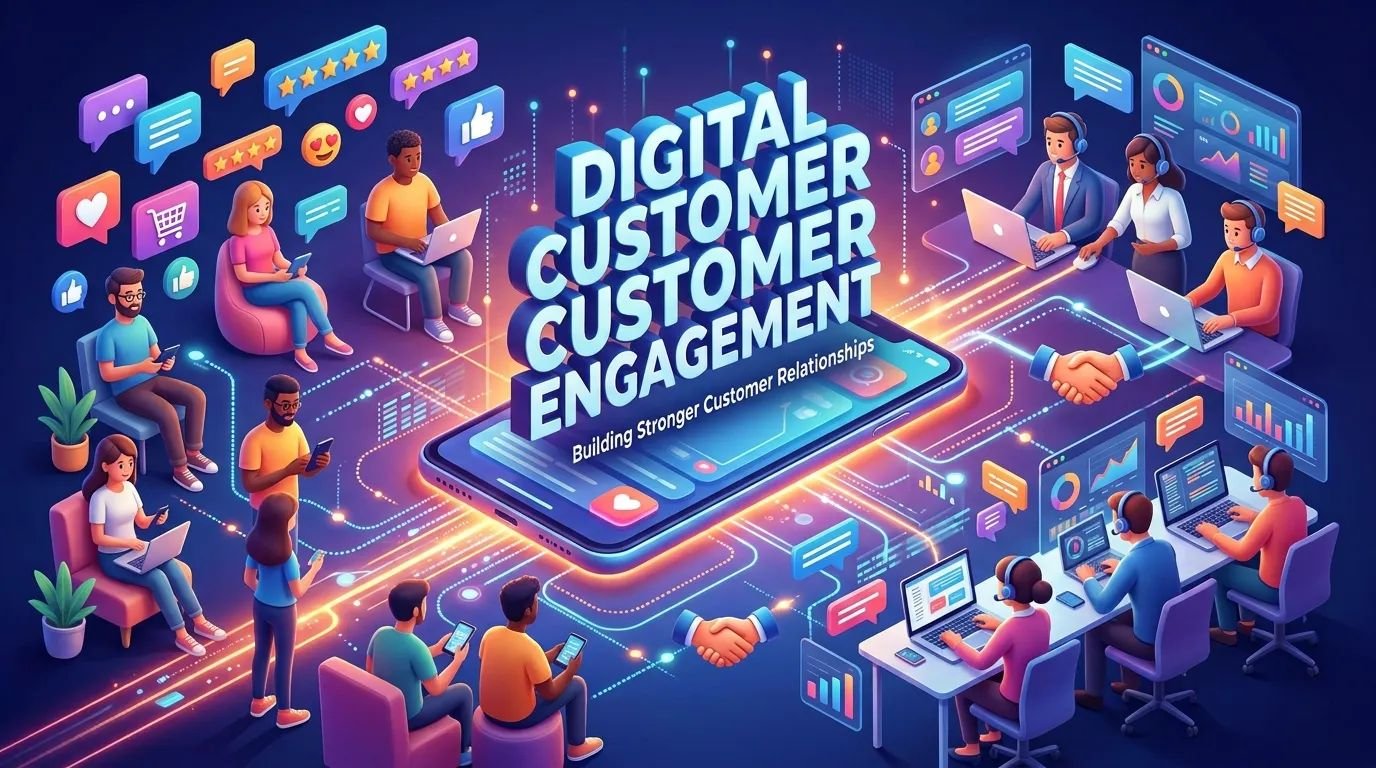
Digital customer engagement is the process of creating meaningful and ongoing interactions between businesses and their customers through digital channels. Websites, social media, email, mobile applications, messaging platforms, online communities, chatbots, and personalized content all provide opportunities for businesses to communicate with their audiences. Modern customers often interact with a company several times before making a purchase. They may discover a business through search, visit its website, read an article,…
Ask AI About This Article
Answers are limited to information in this article.
Digital customer engagement is the process of creating meaningful and ongoing interactions between businesses and their customers through digital channels. Websites, social media, email, mobile applications, messaging platforms, online communities, chatbots, and personalized content all provide opportunities for businesses to communicate with their audiences.
Modern customers often interact with a company several times before making a purchase. They may discover a business through search, visit its website, read an article, follow its social media account, receive an email, ask a question through live chat, and eventually become a customer. The quality of these interactions can influence how customers perceive the business and whether they choose to continue the relationship.
Effective digital engagement is therefore about more than sending promotional messages. It involves providing useful information, responsive communication, personalized experiences, and convenient ways for customers to interact with a brand. When these experiences are managed consistently, businesses can build stronger relationships and encourage long-term loyalty.
Understanding Digital Customer Engagement
Digital customer engagement describes the interactions that take place between a business and its customers through online and digital channels. These interactions can happen before a purchase, during the buying process, and long after a transaction has been completed.
A customer might interact with a business by commenting on a social media post, reading a blog article, signing up for an email newsletter, using a chatbot, downloading a resource, submitting feedback, or contacting customer support.
What makes digital engagement different from traditional communication is its ability to support continuous interaction. Customers can respond to messages, ask questions, share opinions, and return to a business whenever they need additional information.
For businesses, this creates opportunities to understand customers more closely. Instead of treating every interaction as an isolated marketing activity, companies can use digital engagement to build a more connected customer journey.
Why Digital Customer Engagement Matters
Customers increasingly expect businesses to provide convenient digital experiences. They want information to be easy to find, questions to receive timely responses, and communication to feel relevant to their needs.
A strong engagement approach can help build customer confidence. When a business consistently provides useful information and responds appropriately, customers may become more comfortable interacting with it.
Engagement can also contribute to customer retention. The relationship does not end when someone completes a purchase. Follow-up communication, helpful resources, product information, customer support, and relevant recommendations can keep customers connected with the business.
Another important advantage is feedback. Digital channels make it easier to collect reviews, comments, survey responses, support questions, and other forms of customer feedback. These insights can reveal what customers value and where improvements may be necessary.
Businesses can also measure many aspects of digital engagement. Website interactions, email activity, social conversations, repeat visits, conversions, and retention can provide useful signals about customer behavior.
Developing a Digital Customer Engagement Strategy
A successful digital customer engagement strategy begins with understanding the audience. Different customers have different expectations, communication preferences, problems, and levels of familiarity with a business.
A new visitor may need educational content explaining a product or service, while an existing customer may be more interested in support, product updates, recommendations, or loyalty benefits.
Businesses can improve engagement by identifying these different stages and creating communication that matches each situation.
Consistency is equally important. Customers should experience a recognizable brand across websites, email, social media, messaging platforms, and other digital touchpoints.
Businesses should also review performance regularly. Engagement data can reveal which content attracts attention, which messages generate responses, where customers leave the journey, and which experiences encourage repeat interaction.
Customer Engagement Solutions
Modern businesses have access to many customer engagement solutions, including customer relationship management systems, email platforms, live chat, chatbots, social media management tools, feedback systems, mobile applications, and personalization technology.
The value of these solutions depends on how effectively they support customer needs. Collecting customer information is not enough. Businesses need to use relevant information to make interactions more useful and connected.
For example, a company may identify whether a visitor is new, whether an existing customer has recently purchased something, or whether someone has repeatedly interacted with a particular service. These insights can help determine what communication would be most relevant.
Technology should support customer relationships rather than make them feel mechanical. Automation can improve speed and consistency, but human assistance remains important when customers have complicated questions or situations that require personal attention.
Creating Strong Online Customer Engagement
Online customer engagement can happen through websites, social media, email, search engines, online communities, messaging services, and other digital environments.
A website can encourage engagement through educational content, useful resources, reviews, interactive tools, product information, and easy navigation. Social media can provide opportunities for conversations, feedback, and community participation.
Online communities can create even deeper interaction by giving customers a place to ask questions and exchange experiences. Businesses can participate in these conversations while learning more about customer expectations.
Companies do not necessarily need to maintain an equally strong presence on every digital platform. A better approach is to focus on channels that are genuinely relevant to their target audience.
Customer Engagement Marketing and Personalization
Customer engagement marketing focuses on encouraging customers to interact with a business rather than simply exposing them to advertisements.
Content, email campaigns, social media posts, interactive experiences, useful resources, and personalized recommendations can all encourage customers to take part in the relationship.
Personalization can make these experiences more relevant. A business may use previous purchases, customer preferences, browsing behavior, or stated interests to provide information that is more closely connected to individual needs.
For example, an online store could recommend products related to a previous purchase, while a software company could provide educational resources based on the features a customer uses most frequently.
Personalization should always have a clear purpose. Communication that feels excessively targeted or intrusive can have the opposite effect. Businesses should focus on providing genuine value while handling customer information responsibly.
Digital interactions also contribute to the overall brand relationship. A consistent approach to Digital Brand Engagement can help businesses create stronger connections across different online touchpoints.
Connecting Customer Experience With Engagement
Customer experience engagement focuses on how individual interactions contribute to the customer’s broader perception of a business.
A company may have an active social media presence but still create a poor experience if customers cannot find information on its website or receive slow responses to questions. Similarly, an attractive website cannot compensate for an unnecessarily complicated checkout process.
Every digital touchpoint can influence customer perception. Website navigation, email communication, online support, payment experiences, mobile usability, and post-purchase communication can all contribute to the relationship.
This is why digital customer experience should be considered alongside engagement. Engagement creates opportunities for interaction, while the quality of those interactions determines whether customers want to continue engaging.
Using Customer Engagement Platforms
Customer engagement platforms help businesses organize interactions across different digital channels. Depending on the system, businesses may be able to manage customer profiles, email communication, messaging, support interactions, automation, analytics, and other activities from connected environments.
These platforms can make it easier to understand the broader customer journey. A support representative, for example, may be able to review previous customer interactions before responding to a question.
Marketing teams can use engagement information to create more relevant communication, while sales teams may identify customers who have shown interest in specific products or services.
The best platform depends on the organization’s size, goals, communication channels, customer expectations, and available resources. Businesses should select technology based on their actual engagement needs rather than simply choosing a system with the largest number of features.
Building a Customer Interaction Strategy
A customer interaction strategy establishes how a business communicates with customers throughout different stages of the relationship.
Early-stage prospects may need educational content and information about a company’s services. New customers may require onboarding support, while existing customers may benefit from product updates, recommendations, and helpful resources.
Communication should also be two-way whenever possible. Customers should have opportunities to ask questions, provide feedback, leave reviews, participate in discussions, and communicate their concerns.
A consistent digital identity is important throughout these interactions. Digital Branding can help businesses maintain a recognizable identity and message across different digital customer touchpoints.
Customer Engagement Automation
Customer engagement automation allows businesses to deliver certain communications automatically based on customer actions or predefined conditions.
Welcome emails, appointment reminders, abandoned-cart messages, post-purchase communication, product recommendations, and follow-up messages are common examples.
Automation can save time and help businesses respond more quickly. It can also provide customers with information at useful moments without requiring every communication to be handled manually.
However, automation needs careful management. Customers can become frustrated when they receive irrelevant, repetitive, or poorly timed messages.
Businesses should regularly review automated campaigns to ensure that their information remains accurate and that communication supports the customer’s actual journey.
Automation works best when it improves convenience rather than making the relationship feel impersonal.
Building Digital Communities
Customer engagement can become stronger when customers have opportunities to interact with one another.
Digital communities can allow customers to share experiences, ask questions, discuss products, provide suggestions, and learn from other members. Businesses can participate in these communities while gaining valuable insights into customer needs.
Building Brand Communities offers additional perspective on how communities can support stronger relationships between businesses and their audiences.
Successful communities require genuine participation. Customers are unlikely to remain engaged if every discussion becomes a sales message. Providing useful information, acknowledging customer contributions, and encouraging meaningful conversations can create a more valuable community environment.
Digital Engagement Through Events
Events can extend customer engagement beyond traditional online communication. Businesses can use digital channels before, during, and after events to maintain relationships with participants.
Pre-event emails, social media content, online registration, digital discussions, live updates, surveys, event resources, and follow-up communication can all contribute to a connected experience.
Event Branding Techniques can also help businesses understand how consistent event experiences contribute to stronger brand relationships.
Digital engagement does not need to stop when an event ends. Businesses can continue communication by sharing recordings, educational resources, highlights, feedback surveys, and personalized follow-up content.
Measuring Digital Customer Engagement
Measuring digital engagement allows businesses to determine whether their communication is producing meaningful results.
Website metrics can include returning visitors, interactions with important pages, content engagement, and conversions. Email performance can be assessed through clicks, responses, conversions, and other meaningful actions.
Social media engagement may include comments, shares, saves, direct messages, and conversations. Customer-focused metrics can include retention, repeat purchases, reviews, satisfaction, support outcomes, and customer feedback.
Businesses should avoid focusing only on surface-level metrics. A large number of impressions or likes does not automatically indicate a strong customer relationship.
The most useful measurements connect engagement activity with actual customer outcomes.
Challenges in Digital Customer Engagement
One of the biggest challenges is communication overload. Customers already receive large amounts of digital content, so sending too many messages can reduce attention and create frustration.
Inconsistent communication can create another problem. If the website, social media accounts, email campaigns, and customer support teams provide conflicting information, customers may lose confidence in the business.
Poor personalization can also damage engagement. Using outdated information or making irrelevant recommendations can make communication feel careless rather than helpful.
Data management is another important consideration. Businesses should have responsible processes for collecting, storing, and using customer information while respecting applicable privacy requirements.
Businesses should also avoid becoming completely dependent on automation. Technology can handle repetitive communication effectively, but human support remains important for complex issues and relationship-sensitive interactions.
Digital Customer Engagement and Brand Growth
Strong engagement can contribute to broader brand growth by creating repeated opportunities for customers to interact with a business.
When customers consistently receive valuable content, responsive support, personalized communication, and positive digital experiences, the business can become more familiar and trusted.
This can be particularly useful for businesses expanding their digital presence. Companies such as SanMo Bangladesh can support organizations working across areas such as digital marketing, content, SEO, online reputation, and other digital activities.
The important principle is that every digital interaction should reinforce the overall customer relationship. Marketing, customer service, content, and brand communication should work together rather than operate as completely separate activities.
The Future of Digital Customer Engagement
Digital engagement will continue to evolve as businesses adopt artificial intelligence, automation, predictive analytics, conversational technology, and increasingly integrated customer platforms.
These technologies can make communication faster and more personalized, but technology itself does not guarantee stronger relationships.
Customers still value relevance, convenience, transparency, responsiveness, and genuine assistance. Businesses that combine new technology with a clear understanding of customer expectations can create digital experiences that feel more useful and connected.
The future of engagement is therefore not simply about increasing the number of interactions. It is about improving the quality and relevance of those interactions.
Conclusion
Digital customer engagement has become an essential part of building strong relationships in an increasingly connected marketplace. Websites, social media, email, messaging, communities, automation, mobile experiences, and personalized communication provide businesses with numerous opportunities to remain connected with their audiences.
A successful approach begins with understanding customer needs and creating relevant interactions throughout the customer journey. Strong customer engagement solutions, personalized communication, consistent digital branding, responsive support, and meaningful content can all contribute to better customer relationships.
Businesses should also remember that engagement is not measured simply by how many messages they send or how many people see their content. Meaningful engagement happens when customers find value in the interaction and have a reason to continue the relationship.
When businesses combine useful technology with authentic communication and reliable customer experiences, digital engagement can become a long-term source of trust, satisfaction, retention, and brand growth.
Frequently Asked Questions
1. What is digital customer engagement?
Digital customer engagement is the process of interacting with customers through digital channels such as websites, email, social media, messaging platforms, mobile applications, online communities, and chat tools.
2. Why is digital customer engagement important?
It helps businesses maintain communication with customers throughout their journey. Effective engagement can improve customer satisfaction, retention, feedback, trust, and long-term relationships.
3. What are examples of digital customer engagement?
Examples include personalized emails, social media conversations, live chat, chatbot interactions, website content, online communities, customer surveys, mobile notifications, product recommendations, and post-purchase communication.
4. How does personalization improve customer engagement?
Personalization can make communication more relevant by considering information such as customer preferences, previous purchases, browsing behavior, or previous interactions. Relevant communication is more likely to encourage meaningful engagement.
5. What are customer engagement platforms?
Customer engagement platforms are systems that help businesses manage customer interactions across different channels. They may include tools for communication, customer profiles, automation, analytics, messaging, and support.
6. How does automation help customer engagement?
Automation can deliver appropriate communications based on customer actions or predefined conditions. Welcome emails, reminders, follow-ups, recommendations, and post-purchase messages are common examples.
7. What is the difference between customer engagement and customer experience?
Customer engagement focuses on interactions between customers and businesses, while customer experience represents the broader perception customers develop from all their interactions with a company.
8. How can businesses improve online customer engagement?
Businesses can improve engagement by providing valuable content, responding quickly, personalizing relevant communication, creating convenient digital experiences, encouraging feedback, and focusing on the channels their customers actually use.
9. How can digital customer engagement be measured?
Businesses can evaluate engagement through website interactions, email clicks, social conversations, responses, conversions, repeat purchases, customer retention, reviews, satisfaction scores, and other meaningful customer outcomes.
10. What role does social media play in customer engagement?
Social media provides businesses with opportunities to communicate directly with customers, answer questions, gather feedback, share content, encourage discussions, and develop communities around their brands.
11. Is customer engagement automation suitable for every business?
Most businesses can benefit from some form of automation, but the specific approach should depend on customer needs and business objectives. Automation is most effective when it improves convenience without removing necessary human interaction.
12. How can businesses build stronger digital customer relationships?
Businesses can build stronger relationships by providing useful information, responding to customers, maintaining consistent communication, personalizing relevant experiences, collecting feedback, and delivering reliable service across digital channels.
13. Why are digital communities useful for customer engagement?
Digital communities give customers opportunities to interact with one another and with the business. They can encourage discussions, provide feedback, strengthen relationships, and create a sense of participation around the brand.
14. How does digital branding support customer engagement?
Digital branding creates a consistent identity across websites, social media, content, email, and other online channels. Consistency can make interactions more recognizable and help customers develop stronger connections with the business.
15. What is the biggest mistake businesses make with digital customer engagement?
A common mistake is focusing on communication volume rather than communication quality. Sending too many irrelevant or repetitive messages can reduce trust and cause customers to disengage.
Promote your articles nowCheck for details
Choose a promotion package
Choose a package below, scan the QR code and pay the displayed amount for 20 days.
After payment, email your article title and payment screenshot to info@yourneeds.asia. Once confirmation is received, one of our administrators will activate the promotion.

Choose where your promoted article receives extra visibility
Promotion changes presentation and placement for the selected period. It does not guarantee traffic, enquiries, search ranking or sales.
Priority visibility in the VIP Lounge, promoted shelves and highlighted article areas.
Top-style highlighting in article directories, homepage feeds and promoted article blocks.
Premium styling across supported article feeds, recommendations and directory placements.
Featured presentation in supported homepage, category, directory and related-article areas.
Build a stronger online presence for your business
Get Your Website for ₹15,000
Are you listed and don't have a website for your business? We can plan, design and launch a responsive website that makes your business easier to understand and contact.
Get My WebsiteSEO Starts from ₹10,000/Month
Improve how your business is presented across Google, local listings and AI-powered search results with ongoing SEO, content and authority-building work.
Improve My VisibilitySuggested Articles
View all articles
Seasonal Promotions for E-commerce: A Complete Guide to Planning, Marketing, and Growth
Seasonal promotions are one of the most effective ways for e-commerce businesses to increase sales, attract new customers, and create stronger engagement throughout the…
Brand Messaging: Building a Strong and Consistent Brand Identity
Brand messaging gives businesses a clear and consistent way to communicate their identity, values, personality, purpose, and unique value. When messaging is carefully developed,…

Event Technology Trends: Transforming Experiences, Engagement, and Event Management
Event technology trends are changing how organizations design, operate, and evaluate modern events. Artificial intelligence, automation, real-time analytics, hybrid platforms, immersive tools, and personalized…
Emotion AI Chatbot Marketing: Building Empathetic Customer Connections
Emotion AI Chatbot Marketing is changing the way businesses approach automated customer communication. Traditional chatbots were primarily designed to answer questions, provide basic information,…
Latest Blog Posts
View all articles
Emerging Business Opportunities That Are Shaping the Future Market
Due to continuous growth and development in the global economy, entrepreneurs are finding many ways to innovate, utilize advanced technology, and leverage strategic acquisitions…

ISO 20000 Manual: A Complete Guide to Modern IT Service Management
Current businesses rely on efficient IT services for the successful functioning of day-to-day operations, customer requirements, communications, and growth of their business. In the…

Amit Malhotra: Simplifying Forex Trading for a New Generation of Investors
A new generation of investors is entering financial markets faster than ever before, driven by digital access, social media exposure, and a growing curiosity…
Everyday Play for Children: 7 Powerful Ways to Build Life Skills
Children can benefit from simple play activities, such as working with blocks, drawing, and solving puzzles. Through play, children can explore their world and…
Inventory Management for Small Hospitals and Clinics in India: Where to Start and What to Automate
This is a condition most every small hospital and clinic in India have experienced: when a patient requires a medicine and the shelf is…

Calgary Safest Neighborhoods for Families, Seniors and Newcomers: A 2026 Guide
Where you live affects your life, how you sleep, how your kids get to school and how comfortable you are walking home at…