

Published: |Last updated:
Listen to this article
Show Quick ReadConcise summary from this article
Children can benefit from simple play activities, such as working with blocks, drawing, and solving puzzles. Through play, children can explore their world and develop life skills, including choice-making, experimenting, communicating, and learning from mistakes. Sometimes children need only a few everyday activities and parental support to enjoy and benefit from play. 7 Benefits of Play: 1. Encouraging Curiosity Children are curious by nature, but they need opportunities and support…
Ask AI About This Article
Answers are limited to information in this article.
Children can benefit from simple play activities, such as working with blocks, drawing, and solving puzzles. Through play, children can explore their world and develop life skills, including choice-making, experimenting, communicating, and learning from mistakes.
Sometimes children need only a few everyday activities and parental support to enjoy and benefit from play.
7 Benefits of Play: 1. Encouraging Curiosity
Children are curious by nature, but they need opportunities and support to satisfy their curiosity.
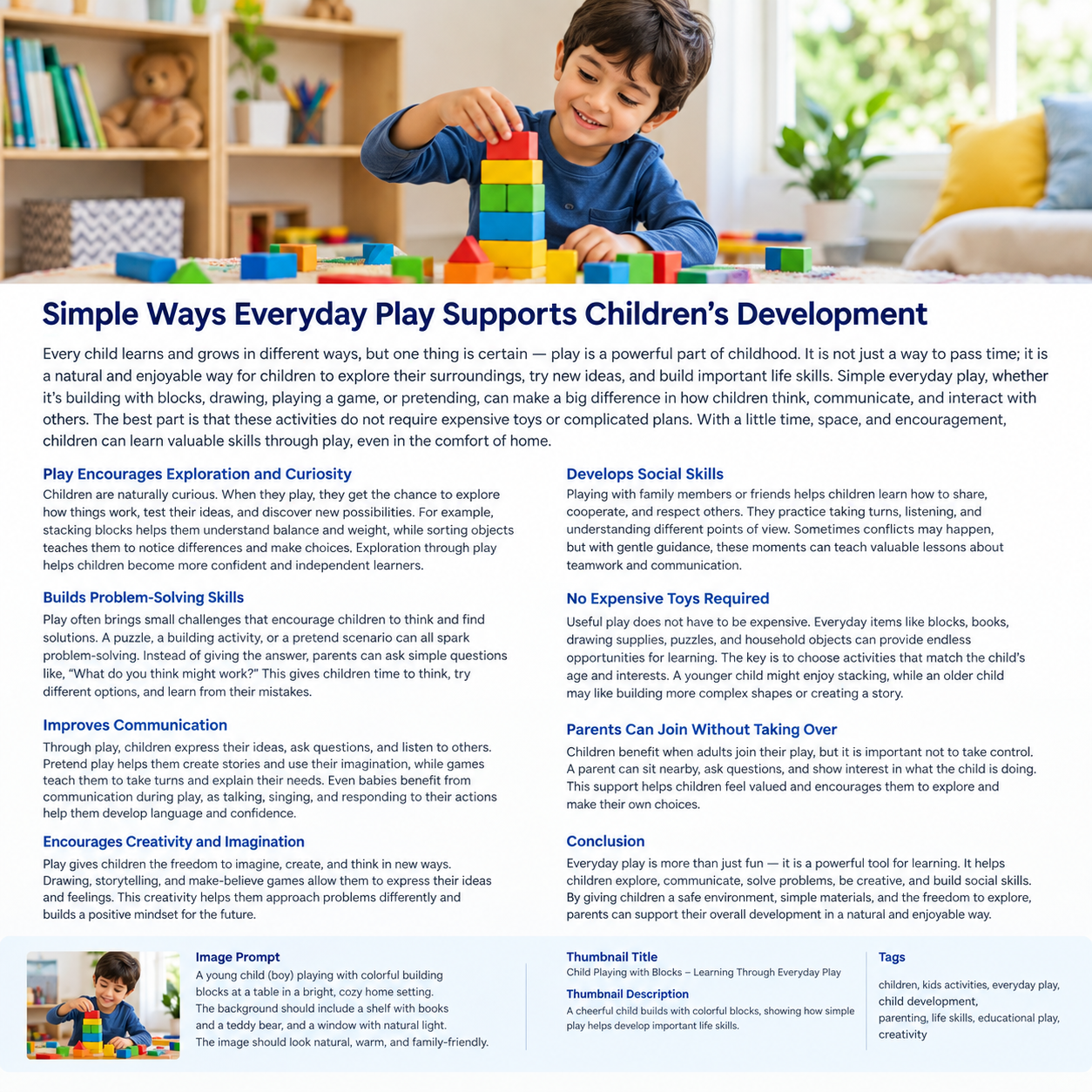
They like to explore, experiment, and test things. For instance, while building a tower, a child may find that one block does not stay on top of the others. Through trial and error, the child may find a solution. Sorting activities may inspire the child to find a rule.
A child may find a rule of thumb, or a unique pattern of shapes, colors, or sizes. Children may ask many questions, and instead of answering all of them, a parent may encourage the child to investigate certain questions.
According to UNICEF’s science of play, children can benefit from play, as it provides them with opportunities to explore and experiment with the world around them.
- Teaching Problem-Solving
Children encounter and solve simple problems during play.
A child tries to find the missing piece in a puzzle or a suitable foundation for a tower. A parent does not have to give the child answers; simple hints, such as „What could you try next?“ or „Which piece could you try?“ encourage the child to try and error until they find a solution.
Children do not always succeed at first, but they can benefit from new attempts.
Mistakes teach them that they do not have to be afraid of failure.
They also provide children with new knowledge that helps them solve a problem.
This is why everyday play activities are so valuable, as children can enjoy solving problems in a non-academic setting.
- Improving Communication Skills
Children can improve their communication skills during play.
They like to talk about their interests, such as their creations or stories during imaginative play. Games provide children with opportunities to share, ask, and respond to others’ questions. Parents can support and encourage children’s communication during play.
For instance, they can try to understand and respond to what the child is saying and ask them about their play.
Even babies can enjoy communicating during play with parents. They can babble, hum, sing, and react to facial expressions, gestures, and the movements of their caregivers.
These are just a few examples of how parental involvement and everyday simple activities can improve children’s communication skills.
7 Benefits of Play: 4. Encouraging Creativity
Children do not always have to create something beautiful. They enjoy having the freedom to decide and explore their options.
They can express their creativity through various means, such as drawing, painting, storytelling, music, imaginative play, building with blocks or any other materials. A child can build a castle, transform a box into a car, or invent a new story about their beloved toy. Adults can support children’s creativity by responding to their ideas rather than changing or completing them.
All children need is the freedom and encouragement to express themselves.
- Developing Social Skills
Children can develop their social skills through play. They can interact with siblings, friends, parents, and other children. During such interactions, they learn to share, cooperate, take turns, listen to each other, and negotiate.
Children do not necessarily know how to share and cooperate, but they can learn through repeated interactions with others.
They may also need guidance from an adult who can remain calm and patient during disagreements and help the children find a solution.
For instance, a parent can help two disappointed children find a compromise when they cannot share a toy.
Social interactions are a very important part of any play, but they do not have to overshadow other elements of play.
- Children Do Not Need Expensive Toys
Children can enjoy and benefit from play without expensive materials.
Books, blocks, paper and crayons, puzzles, games, and other household items provide children with numerous opportunities for creative and imaginative play. Parents only have to select toys and other materials according to the child’s age and developmental stage.
A young child may enjoy building blocks or sorting activities, while an older child may enjoy constructing bigger buildings with blocks.
They may also enjoy storytelling or solving puzzles. Adults also have to give children enough time and attention to encourage and enhance their play.
A few toys and activities can be enough for a child to explore and enjoy.
Moreover, providing children with fewer toys encourages them to be more creative with the items they have.
Parents can give children safe toys that interest them and support their development. They can also browse this page about kids’ toys and activities for inspiration, as the options may vary depending on the child’s age and personal interests.
- Adults Can Support Play
Adults can make playing more enjoyable for children by participating in it.
However, it is also important to give children enough freedom and let them be in charge sometimes.
A parent can sit and play beside the child or help them complete a challenging task.
They can also follow the child’s lead and provide support when the child wants to change the rules or find a different solution to a problem.
They can ask the child questions instead of giving them answers.
For instance, if the child is building a tower, the parent can ask them what they want to do with it next.
The parent’s involvement makes the child feel heard and respected.
This is also why some children do not enjoy playing with parents, as they have to constantly stop to explain what they want to do and why.
A parent can enjoy such moments of involvement, but they also have to give children enough freedom and space to explore their options.
Learning From Mistakes
Children make mistakes, and they will continue to do so during play.
They may find that their tower falls, their picture looks different from what they wanted, or their carefully created plan does not work.
An adult may feel the urge to explain what went wrong and how the child should do it differently.
However, they may want to let the child reflect on the outcome and try to repeat the activity.
A parent can support the child by asking them questions, such as „What went wrong?“ or „What could make it work this time?“
This encourages the child to think and gives them an opportunity to revisit their activity and try again.
They also help the child develop valuable life skills.
Of course, play is not only about failure and mistakes.
Children simply need time, space, and support to explore new things and be creative.
Different Children, Different Interests
Children have different interests, and they will choose different activities to play with. One child may like to build blocks, while another may prefer to draw or read a book.
A parent can provide children with various activities that suit their interests and developmental needs.
They also have to accept that children will not enjoy all activities.
One child may enjoy building blocks for hours, while another may prefer to invent new stories and act them out with their favorite stuffed animal.
They will also try different activities and become more interested in some of them. It is important to support them regardless of their preferences. One child will always want to build something bigger and higher, and the other will try to invent a new story every day. Both play activities are beneficial and safe in their own way.
Making Play Important to Your Child
Children should not feel like they have to accomplish anything during play.
They should rather enjoy and benefit from it without pressure.
A few simple suggestions can make play more meaningful and beneficial to a child:
Give them enough time. Try to select activities according to their developmental stage. Ask them questions and let them be in charge. Encourage them and praise their efforts. Provide them with support when something goes wrong. Sit and play with them, but do not take over.
Household activities, such as sorting objects, counting, reading picture books, organizing toys, or inventing a story can provide students with countless opportunities for exploration and communication.
Conclusion
Children can benefit from simple activities, such as drawing, building, and playing games. Play provides them with numerous life skills, including creativity, communication, and cooperation.
Parents do not have to spend much money on toys and special equipment. They can give children enough time and attention and let them explore their interests and abilities.
The most important thing is to support their play and give them the freedom and encouragement to create, try, and experiment.
Promote your articles nowCheck for details
Choose a promotion package
Choose a package below, scan the QR code and pay the displayed amount for 20 days.
After payment, email your article title and payment screenshot to info@yourneeds.asia. Once confirmation is received, one of our administrators will activate the promotion.

Choose where your promoted article receives extra visibility
Promotion changes presentation and placement for the selected period. It does not guarantee traffic, enquiries, search ranking or sales.
Priority visibility in the VIP Lounge, promoted shelves and highlighted article areas.
Top-style highlighting in article directories, homepage feeds and promoted article blocks.
Premium styling across supported article feeds, recommendations and directory placements.
Featured presentation in supported homepage, category, directory and related-article areas.
Build a stronger online presence for your business
Get Your Website for ₹15,000
Are you listed and don't have a website for your business? We can plan, design and launch a responsive website that makes your business easier to understand and contact.
Get My WebsiteSEO Starts from ₹10,000/Month
Improve how your business is presented across Google, local listings and AI-powered search results with ongoing SEO, content and authority-building work.
Improve My VisibilitySuggested Articles
View all articles
ISO 20000 Manual: A Complete Guide to Modern IT Service Management
Current businesses rely on efficient IT services for the successful functioning of day-to-day operations, customer requirements, communications, and growth of their business. In the…

Integrated HSE Documentation Kit: Complete Guide to ISO 14001 and ISO 45001
Business organizations nowadays emphasize more on environment-related responsibility, employee safety at the workplace, compliance with the law, and sustainable operations. The integration of ISO…

ISO 22301 Documentation Kit: Complete BCMS Manuals, Procedures & Records
Disruptions within a business can occur out of the blue, regardless of whether they stem from a problem associated with cybersecurity, IT, logistics, natural…

CE Mark Documentation Kit for Structural Steel Manufacturers: Complete Guide
Documentation is one of the essential elements in the management of production, welding, quality control, and certification of structural steel manufacturing…
Latest Blog Posts
View all articles
Emerging Business Opportunities That Are Shaping the Future Market
Due to continuous growth and development in the global economy, entrepreneurs are finding many ways to innovate, utilize advanced technology, and leverage strategic acquisitions…

Amit Malhotra: Simplifying Forex Trading for a New Generation of Investors
A new generation of investors is entering financial markets faster than ever before, driven by digital access, social media exposure, and a growing curiosity…

Seasonal Promotions for E-commerce: A Complete Guide to Planning, Marketing, and Growth
Seasonal promotions are one of the most effective ways for e-commerce businesses to increase sales, attract new customers, and create stronger engagement throughout the…

Inventory Management for Small Hospitals and Clinics in India: Where to Start and What to Automate
This is a condition most every small hospital and clinic in India have experienced: when a patient requires a medicine and the shelf is…

Calgary Safest Neighborhoods for Families, Seniors and Newcomers: A 2026 Guide
Where you live affects your life, how you sleep, how your kids get to school and how comfortable you are walking home at…

MedTripz Medical Tourism from Saudi Arabia to India
Your Trusted Partner for Medical Treatment in India For patients looking for Medical Tourism from Saudi Arabia to India, MedTripz provides comprehensive support to…