What Fashion Week 2026 Actually Told Us About the Sarees We’ll Be Wearing This Year

Published: |Last updated:
Listen to this article
Show Quick ReadConcise summary from this article
Fashion week runways are often treated as distant from everyday wardrobes, full of silhouettes few people would actually wear. This year's Lakmé Fashion Week, held at Mumbai's Jio World Convention Centre in March 2026, was a useful exception. Several of the saree-forward moments on the runway translated fairly directly into pieces that are now showing up in regular retail collections, including at a typical Saree Shop In Lucknow stocking for…
Ask AI About This Article
Answers are limited to information in this article.
Fashion week runways are often treated as distant from everyday wardrobes, full of silhouettes few people would actually wear. This year’s Lakmé Fashion Week, held at Mumbai’s Jio World Convention Centre in March 2026, was a useful exception. Several of the saree-forward moments on the runway translated fairly directly into pieces that are now showing up in regular retail collections, including at a typical Saree Shop In Lucknow stocking for the festive season ahead.
The Pre-Draped Moment on the Runway
Among the most talked-about looks this season was a bold, structured pre-draped saree paired with a corset-style blouse, worn by a Bollywood star as a showstopper look. The combination signalled something designers have been building toward for a few seasons now: the pre-draped saree treated not as a beginner’s shortcut, but as a legitimate silhouette choice for anyone who wants precision and drama without the unpredictability of traditional draping over a long event.
What made this particular showstopper moment stand out was how confidently it blurred the line between bridalwear and eveningwear, suggesting that pre-draped construction is now flexible enough to serve both categories depending on styling choices around it, from blouse structure to accessory pairing.
From Runway to Reception
This kind of structured pre-draped look has already begun appearing at Indian wedding receptions and cocktail parties, where the appeal lies in getting a fashion-forward silhouette without needing a draping expert on hand throughout the event. It removes the practical worry of pleats loosening mid-function, which matters more than people often admit when an event runs for several hours.
Fabric Choices That Stood Out
Organza and Sheer Layering
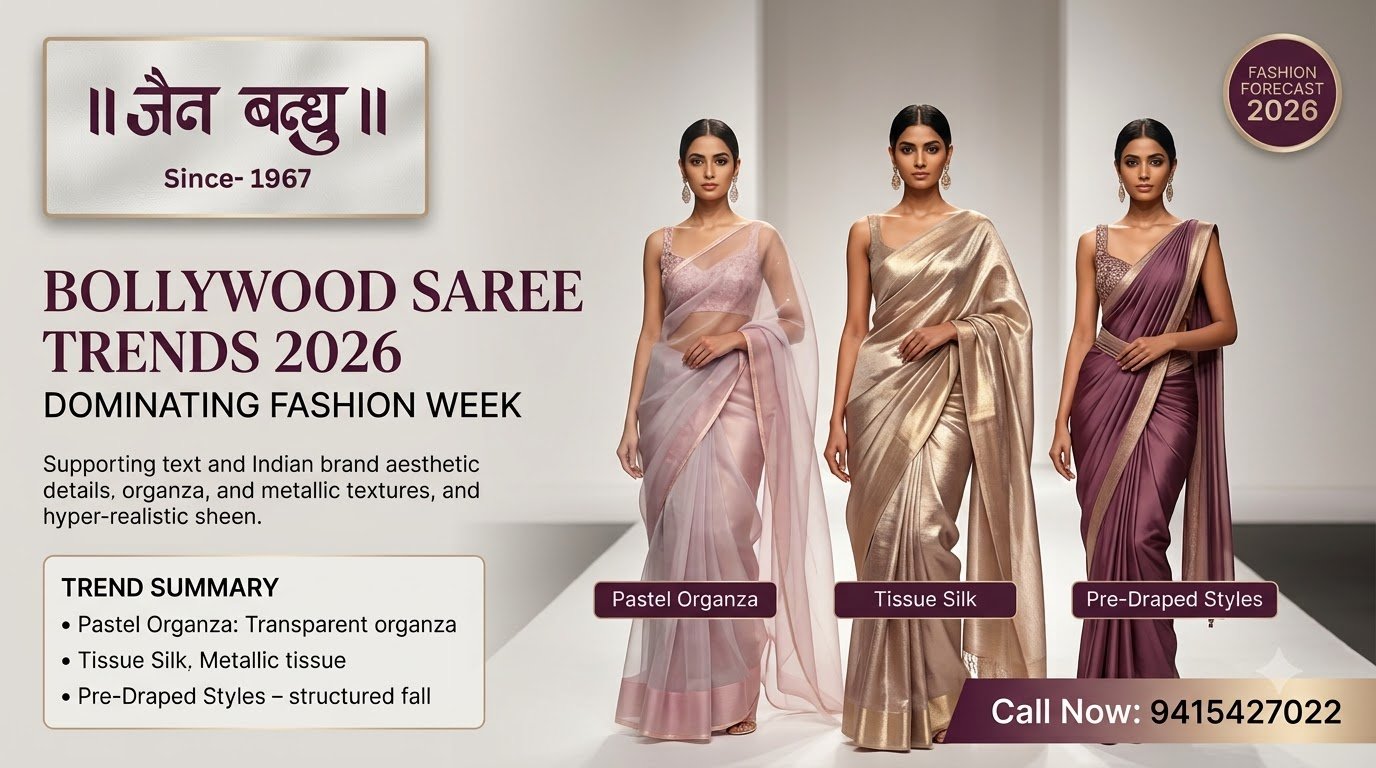
Multiple designers this season used organza and other sheer fabrics as a base for delicate embroidery, hand-painted detailing, and layered silhouettes, often in soft neutral or pastel tones. This approach let intricate craft work take visual priority while keeping the overall garment light enough to move easily, a balance that has clear appeal for festive and reception wear beyond the runway itself.
Tissue and Traditional Silks Reworked
Traditional weaves like Kanjeevaram and tussar silk also had a strong presence this season, though frequently reinterpreted through modern cuts and unconventional pairings rather than presented in strictly classic form. This reflects a broader pattern seen across fashion week: heritage textiles are not being replaced by newer fabrics like organza and tissue silk, but are instead being styled alongside them in the same collections.
Colour Stories From the Runway
Several designers this season worked with pared-back, restrained palettes rather than the maximalist, heavily embellished looks of previous years, with some collections built almost entirely around two or three tones. This restraint has filtered into festive shopping too, where buyers are increasingly drawn to sarees that rely on fabric quality and drape rather than dense embellishment to make an impression.
One presentation this season narrowed its entire palette to just blue and white, letting embroidery and craftsmanship carry the visual weight instead of colour variation, while another collection moved through fluid neutrals into deeper browns, reds, and blacks across a single showcase. This range demonstrates that the season’s restraint is less about a single fixed palette and more about intentional, considered colour choices generally, whether pastel or deep.
Menswear and Cross-Gender Silhouettes
An interesting side note from this year’s fashion week was the growing presence of draped and saree-inspired silhouettes within menswear collections, using fabrics like raw silk, Kanjeevaram, and organza in dhoti-style draping. While this trend is unlikely to directly affect saree retail, it reflects a broader cultural moment where draped textiles are being reconsidered across gender lines, adding to the overall visibility sarees and draped garments received this season.
Translating Runway Trends Into Real Wardrobes
The gap between what appears on a fashion week runway and what people actually buy has narrowed noticeably this year, partly because organza, tissue silk, and pre-draped construction were already familiar to Indian buyers before this season, rather than being introduced as entirely foreign silhouettes. That familiarity is exactly why local retailers have been able to respond quickly.
How Local Shops Are Responding
A Best Saree Showroom In Lucknow that keeps an eye on these seasonal shifts will typically update its organza and tissue silk stock ahead of the festive season, alongside offering at least a modest pre-draped selection for buyers who want that specific silhouette without custom tailoring. Jain Bandhu Saree Showroom In Lucknow, based in Daliganj Bazar, has been incorporating these season-specific pieces into its regular collection, positioned alongside its established range of traditional silk sarees rather than replacing them.
For shoppers who want to see how a runway-inspired organza or tissue silk piece actually drapes and moves, visiting in person remains the most reliable way to judge fit and fall, something photographs from a fashion week runway simply cannot convey.
What to Watch For Next
Designers at this year’s fashion week also showed early signs of heritage handloom techniques, like Jamdani, being reworked into non-traditional silhouettes such as jackets and structured separates rather than only sarees, suggesting the boundary between saree fabric and other garment types may continue to blur through the rest of the year. For now, though, the saree itself remains central, with organza, tissue silk, and pre-draped construction leading what buyers are actually asking for.
This kind of cross-pollination between traditional weaves and non-traditional silhouettes is worth watching, since it often signals where fabric availability and retail stock will shift over the following seasons. Buyers who keep half an eye on these runway signals, without feeling obligated to chase every one of them, tend to make more confident choices when it is actually time to shop for a specific event.
Frequently Asked Questions
- Do fashion week trends usually take long to reach retail markets like Lucknow?
It varies, but trends built around familiar fabrics like organza and tissue silk tend to reach local markets within a season or two, since retailers can adapt existing supply relationships rather than sourcing an entirely new textile.
- Are pre-draped sarees more expensive than traditional ones?
Pricing varies by fabric and construction complexity rather than the drape style alone, so a pre-draped saree can sit at a similar price point to a traditional one in the same fabric, though highly structured designer versions may cost more due to the additional stitching involved.
- Can heavily embroidered organza sarees still be considered part of this year’s understated trend?
Yes, since the trend is less about avoiding embellishment entirely and more about letting the fabric’s natural drape and sheerness remain visible, even when detailed embroidery or hand-painted work is layered onto it.
Promote your articles nowCheck for details
Choose a promotion package
Choose a package below, scan the QR code and pay the displayed amount for 20 days.
After payment, email your article title and payment screenshot to info@yourneeds.asia. Once confirmation is received, one of our administrators will activate the promotion.

Choose where your promoted article receives extra visibility
Promotion changes presentation and placement for the selected period. It does not guarantee traffic, enquiries, search ranking or sales.
Priority visibility in the VIP Lounge, promoted shelves and highlighted article areas.
Top-style highlighting in article directories, homepage feeds and promoted article blocks.
Premium styling across supported article feeds, recommendations and directory placements.
Featured presentation in supported homepage, category, directory and related-article areas.
Build a stronger online presence for your business
Get Your Website for ₹15,000
Are you listed and don't have a website for your business? We can plan, design and launch a responsive website that makes your business easier to understand and contact.
Get My WebsiteSEO Starts from ₹10,000/Month
Improve how your business is presented across Google, local listings and AI-powered search results with ongoing SEO, content and authority-building work.
Improve My VisibilitySuggested Articles
View all articles
The Timeless Appeal of Authentic Hand-Block Printed Ethnic Wear
As the global fashion industry continues to grapple with the environmental impact of mass-produced clothing, a beautiful resurgence of "slow fashion" is taking place.…

أفضل سلاسل ذهب في السعودية بتصاميم فخمة للمناسبات الخاصة
تحتاج المناسبات الخاصة إلى تفاصيل تمنح الإطلالة حضورًا مميزًا، وتأتي المجوهرات الذهبية في مقدمة العناصر التي تضيف لمسة من الفخامة والرقي بسهولة. وعند البحث…
Bridal Lehenga Colour Trends Every Modern Bride Needs to Know in 2026
Colour choice remains one of the most personal, significant decisions in bridal lehenga shopping, and 2026’s palette has genuinely expanded well beyond the traditional…

Reception Lehenga Trends on Any Budget: What 2026 Brides Should Know
The reception lehenga is often the single most expensive garment a bride will ever purchase, which makes understanding how to follow this year’s genuine…
Latest Blog Posts
View all articles
10 Best Neurosurgeons in Varanasi for Brain, Spine and Nerve Care
Choosing a neurosurgeon is an important decision when a person is dealing with a brain, spine, spinal cord, or nerve-related condition. Neurosurgeons diagnose and…
Getting a Cap Ready for a Fresh Embroidered Look
What Happens Inside the Fabric During Stitch Removal visit: https://xclonedemo.socialengine.com/blogs/8920/3281/svg-vs-eps-which-vector-format-should-needleworkers-use
Best ServiceNow ITAM Training in Pune at TechMyIndia
Best ServiceNow ITAM Training in Pune at TechMyIndia Technology has become an integral part of every modern business. From laptops and desktops to applications,…

Matka420 – Latest Results and Chart records
Introduction to Matka420 Matka420 is an online-focused information topic associated with Matka results, charts, historical records, and commonly used result terminology. Visitors searching for…
Five Reasons Why AllPanel777 Are Good for Online Betting
Allpanel777 sports book site gives you a great and simple platform to explore all available betting options without complicated navigation and confusing menus. 1.…
HIS Hospital Information System in India: Features, Benefits & Guide
Patient records, lab results, prescriptions, billing hospitals churn through a huge amount of information every single day, and without something holding it all together,…