

Published: |Last updated:
Listen to this article
Show Quick ReadConcise summary from this article
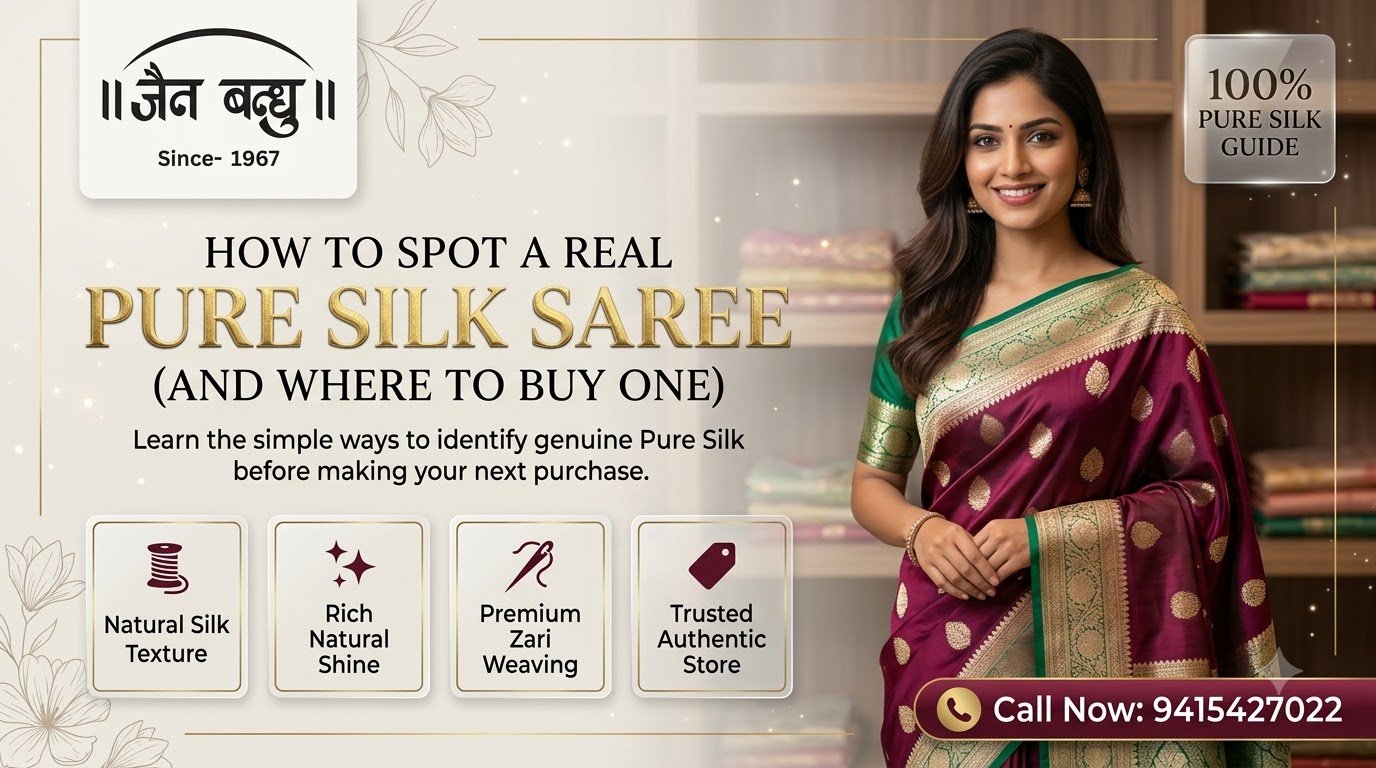
Buying a silk saree is rarely a small decision. Between the price, the occasion it is meant for, and the years you expect it to last, most buyers want more than a shopkeeper's word that a fabric is genuine. Fortunately, there are formal certification systems and simple documentation habits that can help you buy with confidence, in addition to the physical checks most people already know about. This article focuses…
Ask AI About This Article
Answers are limited to information in this article.
Buying a silk saree is rarely a small decision. Between the price, the occasion it is meant for, and the years you expect it to last, most buyers want more than a shopkeeper’s word that a fabric is genuine. Fortunately, there are formal certification systems and simple documentation habits that can help you buy with confidence, in addition to the physical checks most people already know about.
This article focuses on the trust side of the purchase — certification, seller transparency, and questions worth asking — rather than only the fabric tests, so you leave the store with both a beautiful saree and a reasonable degree of certainty about what you paid for.
Understanding Silk Mark Certification
The Silk Mark Organisation of India (SMOI) was set up by the Central Silk Board in 2004 specifically to address the problem of counterfeit and blended silk being sold as pure. A Silk Mark label on a saree indicates that the product has been verified as 100% natural silk under the Board’s quality framework. It is worth noting that the mark is advisory rather than a strict legal mandate, so its presence depends on whether a retailer has chosen to register and source certified stock.
Why Certification Still Matters
Even though Silk Mark is not compulsory, its presence tells you something about a seller’s priorities. Retailers who go through the process of certification are generally investing in long-term customer trust rather than one-time sales, which is a reasonable proxy for reliability when you cannot personally verify fibre content in a lab.
Geographical Indication Tags and Regional Silks
Several Indian silk varieties carry Geographical Indication (GI) status, including Kanchipuram silk from Tamil Nadu, Muga silk from Assam, Mysore silk from Karnataka, and Bhagalpuri Tussar from Bihar. A GI tag protects the name and, indirectly, supports authenticity because it restricts who can legally use that regional name for a textile. If a saree is being sold under one of these regional names, asking whether it carries the relevant GI documentation is a fair and increasingly common question among informed buyers.
Questions Worth Asking Before You Buy
About the Fabric
Ask whether the saree is pure silk, silk blend, or art silk, and get a straight answer rather than a vague one. A shop confident in its stock will not dodge this question.
About the Zari
Zari can be pure (silver wrapped and gold electroplated), tested (a mix with reduced precious metal content), or fully synthetic. All three exist in the market at different price points, and none of them is inherently wrong to buy — the issue is only when one is sold as another.
About Origin and Weave
Handloom and powerloom sarees both have a place in the market, but they are priced very differently. Knowing which one you are paying for avoids the disappointment of expecting handwoven craftsmanship and receiving a machine-made piece.
Combine Documentation With the Basic Physical Checks
Certification is useful, but it should not replace your own judgement entirely. A quick touch test — pure silk feels warm against the skin rather than cool and slippery — combined with a look at the reverse side of the weave for natural handloom irregularities, adds a practical layer of confirmation. If the seller offers to let you scratch a corner of the zari to check for a silk or silver base beneath the coating, that willingness itself is a good sign.
Why Buying From an Established Local Shop Helps
Statistics on India’s silk trade show real growth — production rising from around 31,900 metric tonnes in 2017-18 to close to 38,900 metric tonnes in 2023-24 — but growth in the market also means more sellers competing on price rather than quality. An established Saree Shop In Lucknow with a physical storefront and a long operating history has more at stake in maintaining its reputation than an anonymous online listing does, which is one reason many buyers still prefer visiting in person for high-value silk purchases.
Jain Bandhu Saree Showroom In Daliganj Bazar
Jain Bandhu Saree Showroom In Lucknow, located in Daliganj Bazar, is one of the local options where buyers can ask these documentation and sourcing questions directly and examine the fabric before committing. Daliganj Bazar itself has grown into a recognised textile shopping area in the city, partly due to its cluster of long-standing stores and ease of access for shoppers from across Lucknow.
For anyone comparing a Best Saree Showroom In Lucknow against smaller, less established outlets, the difference often shows up not in the first saree you are shown, but in how the shop responds when you ask harder questions about fabric and sourcing.
Common Certification Confusions to Avoid
Silk Mark vs. Store Guarantees
Some shops issue their own internal purity guarantees or handwritten notes on the bill, which is a reasonable added assurance but is not the same as third-party Silk Mark certification. Both are useful, but it helps to know which one you are actually being offered, since a store guarantee depends entirely on that store’s own standards rather than an external verification body.
GI Tags vs. Fibre Purity
It is worth remembering that a Geographical Indication tag protects a regional name and weaving tradition, such as Kanchipuram or Mysore silk, but it is a separate matter from confirming the fibre itself is pure silk rather than a blend. A saree can, in theory, carry regional design elements associated with a GI-protected style while still using partially synthetic yarn, which is exactly why the physical checks remain necessary even when a regional name is involved.
What Experienced Buyers Do Differently
Buyers who have purchased several silk sarees over the years tend to develop a habit of comparing multiple pieces side by side rather than evaluating one saree in isolation. Holding two sarees of similar price side by side often makes differences in weight, drape, and zari finish far more obvious than examining either one alone. This comparative approach is one of the simplest ways to sharpen your own judgement over time, and most established showrooms are happy to bring out a few pieces together for exactly this kind of comparison.
A Short Pre-Purchase Routine
Before paying, it helps to run through a brief mental sequence: check for a Silk Mark label if the price point suggests it should be there, ask directly whether the saree is pure silk or blended, examine the zari and the reverse weave, and note how comfortably the seller answers all of the above. None of these steps take more than a few minutes, and together they meaningfully reduce the chance of an unpleasant surprise later.
Frequently Asked Questions
- Is a saree without a Silk Mark label automatically fake?
No. Silk Mark certification is voluntary, so many genuine silk sarees, especially from smaller weaving clusters, may not carry the label even though the fabric is authentic. It is one useful signal among several, not the only proof.
- What is the difference between handloom and powerloom silk?
Handloom silk is woven manually, which typically shows small natural irregularities in the pattern and takes longer to produce, while powerloom silk is machine-woven, faster to make, and usually more uniform in appearance and lower in price.
- Should I always ask for a bill mentioning fabric composition?
It is a reasonable practice, particularly for higher-value purchases. A clear bill that specifies fabric type gives you a reference point if any concern about the saree’s authenticity comes up later.
Promote your articles nowCheck for details
Choose a promotion package
Choose a package below, scan the QR code and pay the displayed amount for 20 days.
After payment, email your article title and payment screenshot to info@yourneeds.asia. Once confirmation is received, one of our administrators will activate the promotion.

Choose where your promoted article receives extra visibility
Promotion changes presentation and placement for the selected period. It does not guarantee traffic, enquiries, search ranking or sales.
Priority visibility in the VIP Lounge, promoted shelves and highlighted article areas.
Top-style highlighting in article directories, homepage feeds and promoted article blocks.
Premium styling across supported article feeds, recommendations and directory placements.
Featured presentation in supported homepage, category, directory and related-article areas.
Build a stronger online presence for your business
Get Your Website for ₹15,000
Are you listed and don't have a website for your business? We can plan, design and launch a responsive website that makes your business easier to understand and contact.
Get My WebsiteSEO Starts from ₹10,000/Month
Improve how your business is presented across Google, local listings and AI-powered search results with ongoing SEO, content and authority-building work.
Improve My VisibilitySuggested Articles
View all articles
How to Choose Residential Apartments in Siolim for Everyday Living
Choosing a home in Goa is not only about finding a beautiful building. Your daily routine matters just as much. You need to think…

Best Real Estate Developers in Delhi NCR: What Should Buyers Consider?
[caption id="attachment_8324" align="alignnone" width="300"] best real estate developers in delhi ncr[/caption] Delhi NCR continues to attract homebuyers and investors because of its strong connectivity,…

Residential Plots Near Dholera SIR Boundary: A Smart Investment for a Promising Future
The real estate landscape of Gujarat is evolving rapidly, and the Dholera region has emerged as an area attracting growing interest from homebuyers, investors,…

Apartment for Sale in Porvorim Goa: What to Check During a Property Visit
Finding an apartment for sale in Porvorim Goa can look simple when you browse listings online. The real decision starts when you visit the…
Latest Blog Posts
View all articles
Matka420 – Latest Results and Chart records
Introduction to Matka420 Matka420 is an online-focused information topic associated with Matka results, charts, historical records, and commonly used result terminology. Visitors searching for…

Five Reasons Why AllPanel777 Are Good for Online Betting
Allpanel777 sports book site gives you a great and simple platform to explore all available betting options without complicated navigation and confusing menus. 1.…
HIS Hospital Information System in India: Features, Benefits & Guide
Patient records, lab results, prescriptions, billing hospitals churn through a huge amount of information every single day, and without something holding it all together,…

10 Best Neurosurgeons in Varanasi for Brain, Spine and Neurological Care
The brain and spine are among the most complex parts of the human body, and problems affecting them can influence movement, sensation, balance, speech,…

What are the advantages of choosing a management recruiters agency for employees?
Here are the advantages of choosing a management recruiters agency: - 1. Better Job Opportunities Access to relevant job opportunities is one of the…
Computer Vision Solutions for Robotics: AI Vision Systems | Kivo.ai
Computer vision solutions for robotics help machines see, understand, and respond to their surroundings using AI powered visual intelligence. These systems can support robots…