
Published: |Last updated:
Listen to this article
Show Quick ReadConcise summary from this article
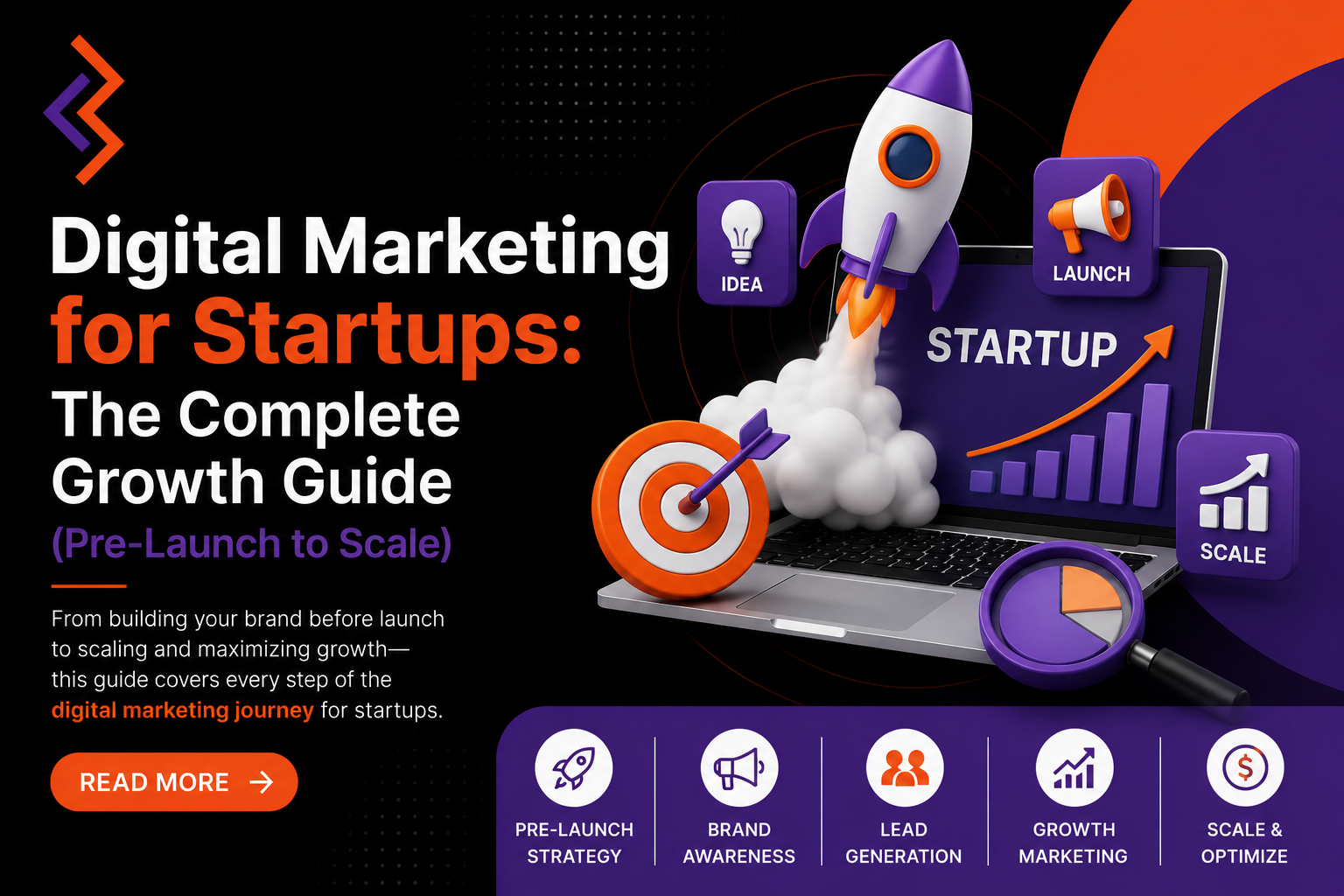
Digital marketing for startups is the process of using SEO, paid advertising, content, social media, and branding to acquire early customers, validate product-market fit, and build sustainable, repeatable growth typically structured around clear stages: pre-launch, launch, growth, and scale. Most startups don't fail because the product is bad. They fail because nobody who needed the product ever heard about it. Founders pour months into building something great, then treat marketing…
Ask AI About This Article
Answers are limited to information in this article.
Digital marketing for startups is the process of using SEO, paid advertising, content, social media, and branding to acquire early customers, validate product-market fit, and build sustainable, repeatable growth typically structured around clear stages: pre-launch, launch, growth, and scale.
Most startups don’t fail because the product is bad. They fail because nobody who needed the product ever heard about it. Founders pour months into building something great, then treat marketing as an afterthought a few social posts here, a boosted ad there and wonder why growth never takes off.
Digital marketing for startups isn’t about doing everything at once. It’s about doing the right things in the right order, with a budget that actually matches your stage. This guide walks through exactly how to do that, stage by stage, with real frameworks you can apply starting today.
Why Startups Fail in Marketing
Before fixing the problem, it helps to name it. The most common reasons startup marketing fails:
- No clear ICP (Ideal Customer Profile) — trying to market to “everyone” instead of a specific buyer
- Random acts of marketing — a Facebook ad here, an Instagram reel there, with no strategy tying it together
- Underinvesting in the founding message — if your positioning is unclear, no channel will save you
- Chasing virality instead of conversions — impressions don’t pay salaries
- No tracking — spending money without knowing what’s actually working
- Impatience — abandoning SEO or content after six weeks because “it’s not working yet”
Expert tip: Early-stage startups don’t need more channels — they need more clarity. One well-targeted channel executed properly beats five channels executed poorly.
Pre-Launch Marketing
This is where most founders under-invest. Pre-launch marketing builds the audience you’ll sell to on day one, instead of starting from zero at launch.
Checklist for pre-launch:
- Build a simple landing page with a clear value proposition
- Set up an email waitlist with an incentive (early access, discount, exclusive content)
- Start a founder-led presence on LinkedIn or X/Twitter to build credibility
- Create a private community (Discord, WhatsApp, Slack) for early adopters
- Run small-scale audience validation ads to test messaging before launch
Real-world pattern: Many successful SaaS and D2C brands generate their first hundred to a few thousand sign-ups purely through pre-launch waitlists and founder storytelling — before spending a rupee on paid ads.
Launch Marketing
Launch day is a moment, not a strategy — but it needs to be engineered.
Key launch tactics:
- PR and startup directories (relevant listing platforms, local press, industry blogs)
- Paid ad bursts on Meta/Google to capture initial demand
- Referral incentives — early users bring more users when incentivized correctly
- Influencer or micro-influencer seeding in your niche for authentic early buzz
- Founder-led content explaining the “why” behind the product
Expert tip: Don’t spread your launch budget thin across ten channels. Pick two or three where your actual audience spends time, and go deep.
Growth Marketing
Once you have initial traction, the goal shifts to finding repeatable, scalable acquisition channels.
This stage typically combines:
- SEO for compounding, low-cost-per-acquisition traffic over time
- Performance marketing (Google Ads, Meta Ads) for immediate, measurable pipeline
- Content marketing to build authority and support both SEO and sales
- Email marketing to nurture leads who aren’t ready to buy yet
This is also when most startups should start tracking Customer Acquisition Cost (CAC) and Lifetime Value (LTV) seriously — growth without unit economics is just expensive noise.
Scaling Strategies
At the scale stage, the question isn’t “what works?” — you already know. The question is “how much can we pour into it before returns diminish?”
Scaling tactics include:
- Increasing budgets on already-proven paid campaigns
- Expanding SEO into new keyword clusters and content categories
- Building out marketing automation and lifecycle email flows
- Investing in brand marketing to reduce reliance on paid acquisition alone
- Exploring new channels (influencer, affiliate, partnerships) once core channels are optimized
Startup SEO Roadmap
Startup SEO should be built in phases, not attempted all at once:
- Foundation (Month 1–2): Technical SEO audit, site speed, keyword research, competitor analysis
- Content Build (Month 2–4): Publish core landing pages and pillar blog content targeting high-intent keywords
- Authority Building (Month 4–6): Backlinks, guest content, PR mentions, Google Business Profile optimization (if local/hybrid)
- Compounding (Month 6+): Expand into supporting topics, refresh underperforming content, scale link building
Statistic to know: Organic search consistently ranks among the top sources of B2B and D2C website traffic for companies that invest in it consistently but it typically takes several months of consistent effort before compounding gains become visible, which is why most startups give up too early.
Content Marketing, Branding & Email
Content marketing builds long-term authority blogs, case studies, comparison pages, and how-to guides that answer real questions your ICP is searching for.
Branding isn’t just a logo it’s the consistent story, tone, and visual identity that makes your startup recognizable and trustworthy, especially important in crowded categories like FinTech and D2C.
Email marketing remains one of the highest-ROI channels for startups, particularly for nurturing leads who visited but didn’t convert, and for retaining existing customers through onboarding and lifecycle flows.
Influencer Marketing for Startups
You don’t need celebrity influencers you need the right micro-influencers with an engaged, relevant audience.
Pros:
- Cost-effective compared to traditional advertising
- Builds authentic trust faster than brand ads
- Great for D2C, healthtech, and consumer app launches
Cons:
- Harder to measure direct ROI
- Requires careful vetting to avoid audience mismatch
- Results vary significantly by creator quality
KPIs Every Startup Should Track
- CAC (Customer Acquisition Cost)
- LTV (Customer Lifetime Value)
- Conversion rate (visitor to lead, lead to customer)
- Organic traffic growth
- Cost per lead (CPL)
- Email open and click-through rates
- Churn rate (especially for SaaS)
- ROAS (Return on Ad Spend)
If you’re not tracking these monthly, you’re flying blind regardless of how much content you’re publishing or how many ads you’re running.
Common Marketing Mistakes
- Marketing to everyone instead of a defined ICP
- Starting paid ads before the landing page/offer is validated
- Ignoring SEO because “it’s too slow” then needing it a year later and starting from zero
- No consistent brand voice across channels
- Measuring vanity metrics (likes, followers) instead of pipeline metrics
- Underfunding growth right when early traction starts building
Why Creative Buffs is Ideal for Startups
Creative Buffs works with startup founders who need more than generic marketing they need a strategy built around their actual growth stage, runway, and category, whether that’s SaaS, D2C, EdTech, FinTech, or healthcare.
What makes the approach different for startups specifically:
- Tailored 90-day growth plans built around your stage, not a one-size-fits-all package
- Performance-focused campaigns tied to real business metrics CAC, LTV, and pipeline, not vanity numbers
- Full-stack capability — SEO, performance marketing, branding, content, social, and lead generation under one team
- Startup-speed execution — lean, fast turnarounds instead of slow enterprise-style processes
- Experience across sectors including SaaS, D2C, tech, EdTech, FinTech, and healthcare startups
Whether you’re still pre-launch or ready to scale a channel that’s already working, Creative Buffs builds the plan around where you actually are — not where a template assumes you should be.
Ready to turn your startup’s marketing into a repeatable growth engine? Talk to Creative Buffs today and get your custom 90-day startup growth plan.
Frequently Asked Questions
1. What is digital marketing for startups? It’s the use of SEO, paid ads, content, social media, and branding to acquire customers and build sustainable growth, tailored to a startup’s specific stage and budget.
2. What’s the best marketing channel for a new startup? There’s no universal answer — it depends on your ICP. B2B SaaS often starts with LinkedIn and SEO; D2C brands often start with Instagram and paid social.
3. Should startups focus on SEO or paid ads first? Most startups benefit from starting with paid ads for quick learnings and immediate leads, while building SEO in parallel for long-term, compounding growth.
4. How long does startup SEO take to show results? Typically 3–6 months for initial movement, with stronger compounding results after 6–12 months of consistent effort.
5. What is a 90-day startup marketing plan? A structured plan broken into foundation, activation, and optimization phases — designed to build, test, and scale marketing efforts systematically.
6. Do pre-launch startups need marketing? Yes — pre-launch marketing (waitlists, landing pages, community building) creates an early audience so you’re not starting from zero at launch.
7. What KPIs matter most for startup marketing? CAC, LTV, conversion rate, cost per lead, and ROAS are the core metrics every startup should track monthly.
8. Is influencer marketing worth it for startups? Yes, especially micro-influencers in your niche, which tend to offer better ROI and more authentic engagement than large-scale influencer deals.
9. How is startup marketing different from traditional business marketing? Startup marketing typically operates with tighter budgets, faster iteration cycles, and a heavier focus on validated, measurable acquisition channels.
10. What’s the biggest marketing mistake startups make? Marketing to a vague, undefined audience instead of a clear Ideal Customer Profile — this weakens every channel built on top of it.
11. Can Creative Buffs help startups with limited budgets? Yes – Creative Buffs builds tailored growth plans around a startup’s actual budget and stage, prioritizing the highest-impact channels first.
12. What industries does Creative Buffs support for startup marketing? SaaS, D2C, tech, EdTech, FinTech, healthcare startups, and new entrepreneurs across various sectors.
Final Thoughts
Digital marketing for startups isn’t about doing more. it’s about doing the right things at the right stage, with a budget and strategy that match where your business actually is. From pre-launch waitlists to scaling proven acquisition channels, every stage requires a different playbook.
Creative Buffs builds exactly that: tailored 90-day growth plans and performance-focused campaigns designed for startups that need real, measurable results not marketing for marketing’s sake.
Talk to Creative Buffs today and turn your startup’s next 90 days into your most impactful quarter yet.
Promote your articles nowCheck for details
Choose a promotion package
Choose a package below, scan the QR code and pay the displayed amount for 20 days.
After payment, email your article title and payment screenshot to info@yourneeds.asia. Once confirmation is received, one of our administrators will activate the promotion.

Choose where your promoted article receives extra visibility
Promotion changes presentation and placement for the selected period. It does not guarantee traffic, enquiries, search ranking or sales.
Priority visibility in the VIP Lounge, promoted shelves and highlighted article areas.
Top-style highlighting in article directories, homepage feeds and promoted article blocks.
Premium styling across supported article feeds, recommendations and directory placements.
Featured presentation in supported homepage, category, directory and related-article areas.
Build a stronger online presence for your business
Get Your Website for ₹15,000
Are you listed and don't have a website for your business? We can plan, design and launch a responsive website that makes your business easier to understand and contact.
Get My WebsiteSEO Starts from ₹10,000/Month
Improve how your business is presented across Google, local listings and AI-powered search results with ongoing SEO, content and authority-building work.
Improve My VisibilitySuggested Articles
View all articles
What Is the Difference Between SEO and Digital Marketing?
SEO is an important part of digital marketing, but digital marketing covers a much broader range of online promotional activities. SEO focuses primarily on…
Multi-Branch Jewellery Stores How to Rank Each Location Separately
Managing a jewellery business with multiple branches creates significant opportunities for growth, but it also introduces new challenges when it comes to local search…

How Sponsorship Campaigns Drive Audience Engagement and Growth
Sponsorship Campaigns have become an effective way for businesses to connect with audiences, strengthen brand visibility, and support long-term growth. Instead of relying only…

How Intelligent Chatbots Drive Better Customer Engagement
Intelligent Chatbots are transforming the way businesses communicate with customers across websites, social media, messaging platforms, and digital services. Unlike traditional chatbots that follow…
Latest Blog Posts
View all articles
Emerging Business Opportunities That Are Shaping the Future Market
Due to continuous growth and development in the global economy, entrepreneurs are finding many ways to innovate, utilize advanced technology, and leverage strategic acquisitions…

ISO 20000 Manual: A Complete Guide to Modern IT Service Management
Current businesses rely on efficient IT services for the successful functioning of day-to-day operations, customer requirements, communications, and growth of their business. In the…

Amit Malhotra: Simplifying Forex Trading for a New Generation of Investors
A new generation of investors is entering financial markets faster than ever before, driven by digital access, social media exposure, and a growing curiosity…

Everyday Play for Children: 7 Powerful Ways to Build Life Skills
Children can benefit from simple play activities, such as working with blocks, drawing, and solving puzzles. Through play, children can explore their world and…

Seasonal Promotions for E-commerce: A Complete Guide to Planning, Marketing, and Growth
Seasonal promotions are one of the most effective ways for e-commerce businesses to increase sales, attract new customers, and create stronger engagement throughout the…

Inventory Management for Small Hospitals and Clinics in India: Where to Start and What to Automate
This is a condition most every small hospital and clinic in India have experienced: when a patient requires a medicine and the shelf is…