Introduction
Leasing a warehouse is one of the biggest, if not the biggest, financial responsibilities a company has to take on. Regardless of whether you’re a starting company expanding its business, an e-commerce business that needs to add a warehouse to its business, or an established manufacturer needing to add a warehouse, the lease you sign will affect your finance’s bottom line, operational, and growth potential for many years to come.
The warehouse rental market is the most competitive it has ever been in 2026. Because of the increasing flow of e-commerce, there are also increasing opportunities in last-mile delivery and supply chain restructuring. Because of these changes, and due to the increased control by landlords in the market, it has become immensely important for tenants to find out what lease options are available to them before they sign a lease.
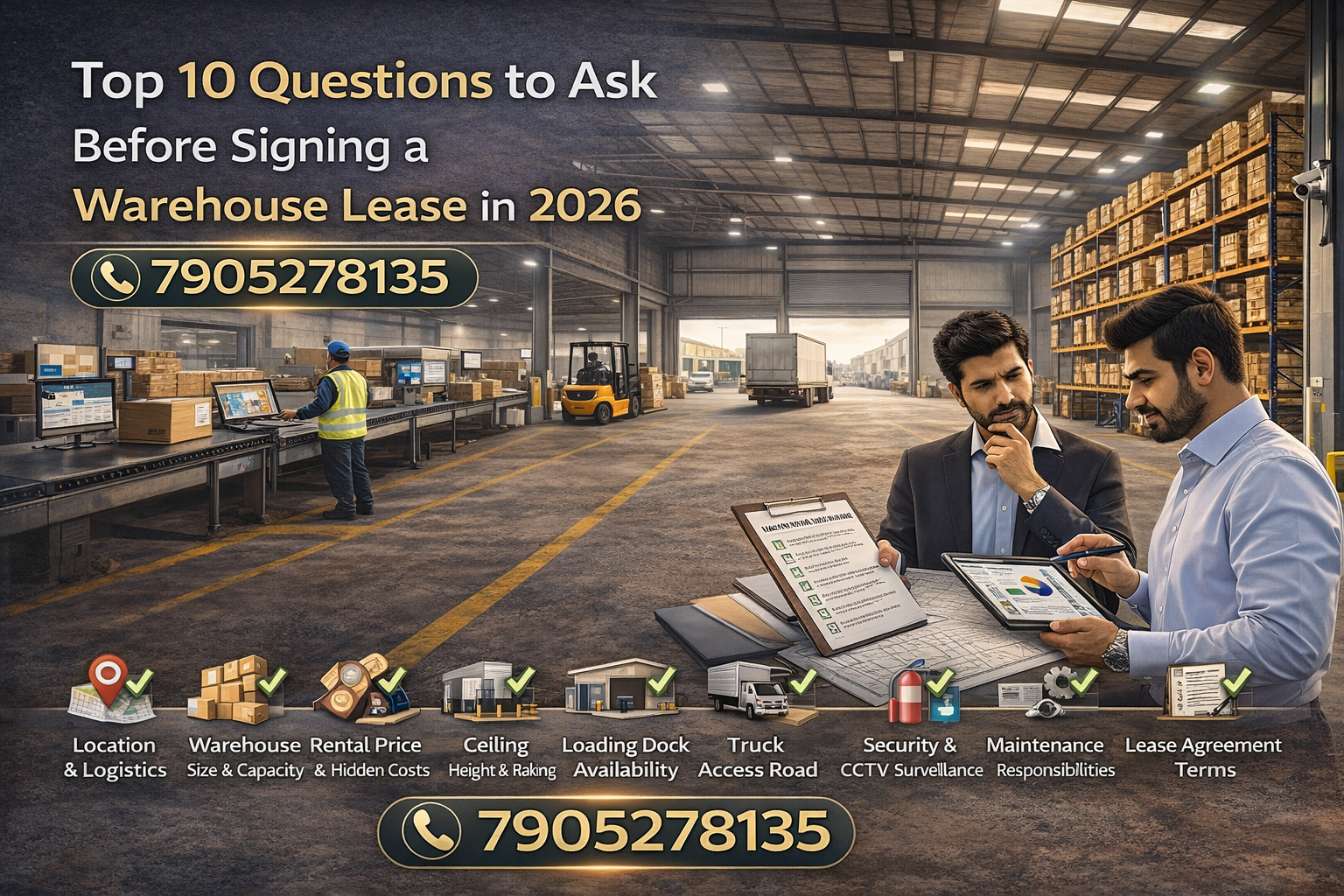
This guide will detail the Top 10 Questions to ask any warehouse lease in the year 2026. By the end of this guide, you will know what warehouse leases to avoid, what warehouse leases to look for to identify and avoid negative impacts on your business, and what lease options to choose to enable you to best protect your business.
Key Takeaway
Warehouse leases are typically 3-10 years. Take the time to identify any financial risks before signing a lease.
The Importance of Strategic Queries for the Year 2026
Considerable changes to the warehouses rental industry have rendered unnecessary to consider which questions to ask, the most important questions are which are the least important. Here are the warehouse lease considerations for 2026:
- In metropolitan areas, the warehouse vacancy rate remains below 4% in Dallas, Chicago, and Los Angeles.
- It is standard now to have triple-net (NNN) lease agreements, which means tenants must pay additional charges on top of their base rent.
- The costs of four hidden lease costs (energy, insurance, and labor) have all increased.
- E-commerce expansion continues to fuel demand for fulfillment centers in the last and the middle miles.
- Landlords are offering lease agreements with aggressive escalation clauses, which means rent increases of 3 to 5% per year.
If you fail to ask the most relevant questions, you could find yourself committed to a lease that is a cash flow, operational, and unpredicted buildout burden.
The Top 10 Questions to Ask Before Signing a Warehouse Lease
Q1. What is included in the total monthly cost?
Tenants are often surprised by the cost of a warehouse lease when they see the invoice for the first time. Many do not understand that in 2026, a majority of commercial warehouse leases will be Triple Net (NNN) leases, meaning that in addition to base rent, tenants will need to pay a portion of the property taxes, building insurance, and Common Area Maintenance (CAM) fees. Multiple invoices for the same lease are bound to confuse tenants, but asking for a cost breakdown of a lease can help mitigate that confusion.
Base rent (per sq. ft. per year or month)
- – Property taxes
- – Building insurance premiums
- – Distributions for CAM (Common Area Maintenance) for the parking lot, landscaping, security, and lighting
- – Utilities (e.g. electricity, water, gas)
- – HVAC maintenance
- – Trash removal and pest control
Cam charges are one of the biggest unknowns of a lease. To mitigate that unknown, ask to see the actual CAM reconciliation from the last 2 years. That will show you (tenants) what you actually (tenants) paid vs. what were (management) estimates, which is crucial for budgeting.
Q2. What Is the Lease Term and Renewal Options?
Lease terms can either be advantageous or disadvantageous. For example, a shorter lease gives you the flexibility to leave easily. But, if you get a longer lease, you would be committing to the lease and giving up your business’ flexibility while most likely securing a rate of rent that is lower than the market rate at the time of lease renewal. Large commercial spaces are seeing a lot of demand, and the market is urging landlords to get 5-10 year lease terms starting in 2026. Before agreeing to a long lease term, you need to analyze your business’s projected growth at the 3-5 year mark.
- What’s the initial lease term going to look like? (1 year, 3 years, 5 years, 10 years)
- Are renewal options available and if so, at what rent increase?
- If you expand, are there adjacent units that you have the right of first refusal on?
- What is the notice period required to exercise the renewal options? (Typically 6-12 months)
- If your business changes, can you sublease or assign the lease?
Pro Tip
If you have the option to renew the lease, you can negotiate for a fixed rate increase on the lease. For example, to have a cap of 3% on the rent. This way, you are protected from the market increases at the time of lease renewal.Q3. What Activities Can Be Done in the Space?
Warehouse leases include very specific permitted use clauses. What activities are allowed in the space are defined. Engaging in activities outside permitted use clauses could result in immediate termination of the lease. This is particularly critical if you plan to conduct any manufacturing activities, storage of hazardous materials, or any retail-linked pick-up activities.
- Is each space equipped and zoned for the type of business you operate (either industrial, commercial, or mixed-use)?
- Can you store the specific goods your business requires?
- What are the restrictions, if any, regarding the operational hours (shifts, 24/7 access)?
- Are you allowed to store hazardous materials, including flammables, or refrigerated items?
- Are customers, drivers, or third-party carriers permitted access to the space?
- Are there any restrictions regarding signage or branding?
Q4. Who Is Responsible for Repairs and Maintenance?
Responsibilities for maintenance in warehouse leases are frequently misunderstood. In NNN leases, the landlord is responsible for the maintenance of structural components of the roof and foundation, while tenants are responsible for maintenance of the interior, including the HVAC systems. However, this is very lease-dependent.Who is responsible for the upkeep of the HVAC systems — the tenant or the landlord?
- Who is responsible for roof repairs, parking lot repaving, and structural repairs?
- Are there any deferred maintenance issues in the building that you are aware of?
- What are the steps and how long does it take for the landlord to respond to repair requests?
- Are there maintenance caps ( i.e. tenant is responsible for the HVAC system up to $5,000 per year?)
Pro Tip
Before you sign anything, ensure that you have hired a licensed commercial property inspector. Finding issues (old roofs, antiquated wiring, broken dock equipment) allows you to negotiate repair credits or for the landlord to do the work before you move in.
What are the specifications for the loading dock and its access?
For most warehouse tenants, the loading dock is the operational heartbeat of the facility. Poor dock specifications can cripple your logistics efficiency and increase labor costs significantly. This is one of the most overlooked questions — don’t skip it.
- How many dock doors are included and are they adequate for your volume?
- Are dock levelers included? If so, what are their conditions?
- What is the clear height of the warehouse? (Modern logistics needs 28–36 ft clear height)
- Is there sufficient truck court depth for semi-truck maneuvering? (Ideal depth is 120+ ft)
How many drive-in grade-level doors are there and what are their sizes?
- What is the floor load capacity (PSI rating)?
- Is there sufficient parking for employees and visiting carriers?
- What are the lease rent escalation terms?
Almost all long-term warehouse leases include rent escalation and one of the biggest sources of cost surprises for tenants. As inflation remains a concern for 2026, landlords are proposing 3-5% increases annually. This clause has the potential to save you tens of thousands over a 5-year lease.
- What is the annual increase in rent? (Fixed Percentage / tied to CPI?)
- Is there any room to negotiate the CPI cap? (Always negotiate for a cap between 2% to 3%, even if it is CPI related)
- Are there rent-free periods at the beginning of the lease?
- Is there a tenant improvement (TI) allowance that will offset some of the buildout expenses?
- If market rates drop significantly, what will happen to the rent?
Example
If you have a 10,000 sq ft space at $8/sq ft with 4% annual increases, you will pay $80,000 in Year 1, and $118,000 by Year 10. Negotiating it to 2.5% will save you over $120,000 in total.
Frequently Asked Questions (FAQs)
These are the questions most frequently asked by businesses in the year 2026 when renting a warehouse:
Q: For how long do you expect to have a warehouse lease in 2026?
Those are the expectations warehouse leases would be in the year 2026. For smaller spaces (under 5,000 sq ft) leases would be for a term of 1–3 years, while leases for bigger industrial facilities (of 25,000 sq ft+), there would be a minimum of a 5-year lease. Landlords in high-demand markets often prefer 5–7 year terms. As a tenant, you would want to have the longest term possible with 5–7 years.
Q: What does a Triple Net (NNN) warehouse lease mean?
A Triple Net (NNN) lease means the tenant pays (1) Base Rent, (2) Property taxes (proportionate share), and (3) Building insurance and CAM charges. It is also the most common commercial warehouse lease structure. Unlike a gross lease where one flat rate covers everything, with an NNN lease these costs are broken out separately. This means your monthly payment is base rent + NNN charges, which can be an additional 20–40% to the base rent amount. Always ask about NNN charges before considering your leasing options.
Q: What does clear height mean, and what should I look for in a warehouse lease?
In the context of a warehouse lease, clear height refers to the amount of usable space (the vertical space) from the floor all the way to the lowest obstruction, (i.e. beams, sprinklers, lights, etc.) and is very critical for vertical operations, racking systems, or for the use of a forklift; Standard warehouses constructed before the year 2000 typically range between 18 to 24 ft. In contrast, the more modern distribution centers are designed to provide relevant clear height of 28 to 36 ft and this significantly increases the amount of vertical storage available. In case your operation involves the use of pallet racking, it is advisable to look for a warehouse with at least 24 to 28 ft clear height to be able to maximize the storage capacity.
Q: Can I negotiate the rent on a warehouse lease?
Yes, you can negotiate rent on a warehouse lease. Although landlords have asking rates, they are more flexible on rates depending on the market, lease term, and the creditworthiness of the tenant. Additionally, you can negotiate rent-free periods, tenant improvement allowances, caps on common area maintenance charges, parking, signage, renewal options, and early termination rights. The best way to negotiate effectively is to hire a tenant representative broker.
Q: What is a personal guarantee in a warehouse lease and should I sign one?
A personal guarantee clause in a lease means that the business owner promises to personally fulfill the lease obligations should the business fail. This is typically required by landlords for new businesses that lack a credit history. If you are required to sign a personal guarantee, negotiate for (a) an end date on the guarantee, (b) a limit on the amount of the guarantee, or (c) a burn-down clause in which the guarantee reduces after a certain number of on-time payments.
Q: How should I calculate my business’ required warehouse space?
For an initial estimate, you could take your annual inventory volume and multiply it by 1.5 for surge season, receiving docks, and office space. If you store around 500 pallets, you will need about 5,000 to 8,000 ft squared depending on the height of your racks. Always add 20 to 25% for growth. An experienced tenant representative and a logistics consultant can help you estimate space requirements with respect to SKU count, order volume, and fulfillment workflow.
Q: I’m leasing the space and the landlord sells the building. What happens to my lease?
Your lease will transfer over to the new landlord, a principle referred to as ‘lease runs with the land’. The new landlord will have to abide by all of the lease terms, including the lease amount, renewal options, and tenant improvement (TI) allowances. You want to have an \textit{Attorn and Non-Disturbance Agreement (SNDA)} in your lease as that will help you maintain your lease rights in the event the building sells or the landlord’s lender forecloses. You will want to make that clear to your lawyer before you sign the lease.
Q: Which is better, renting a warehouse in an industrial park or a standalone building?
Both options have benefits. Standalone buildings tend to have larger square footage, offer truck access, and can even have lower square foot pricing. This is beneficial for businesses who want designing and heavy branding, large outdoor storage. While an industrial park is preferred for businesses who want a space to plug-and-play, industrial parks have professional management and a community.
Conclusion
Leasing warehouses shouldn’t be taken lightly. Every business must take ample time with their due diligence to analyze any aspect of the deal before signing an industrial lease.
In 2026, the competitive lease market will be knowledge-based. Experienced landlords will know the market and the well-prepared tenants will negotiate for the value adding tenants, the right questions, lease structure, and the represented tenants.
Prior to signing any warehouse lease, use the following guide. Take notes, ask questions, and ensure that you walk away from any deal that does not fit your needs or the needs of your business financially.