

Published: |Last updated:
Listen to this article
Show Quick ReadConcise summary from this article
Lead routing plays an important role in helping businesses manage incoming prospects and improve sales performance. When a company receives leads from multiple channels, distributing them to the right sales representatives becomes essential. Without a clear assignment process, valuable opportunities may be delayed, overlooked, or handled by employees who lack the right expertise. Lead routing rules establish how incoming leads are assigned based on specific business conditions, such as location,…
Ask AI About This Article
Answers are limited to information in this article.
Lead routing plays an important role in helping businesses manage incoming prospects and improve sales performance. When a company receives leads from multiple channels, distributing them to the right sales representatives becomes essential. Without a clear assignment process, valuable opportunities may be delayed, overlooked, or handled by employees who lack the right expertise.
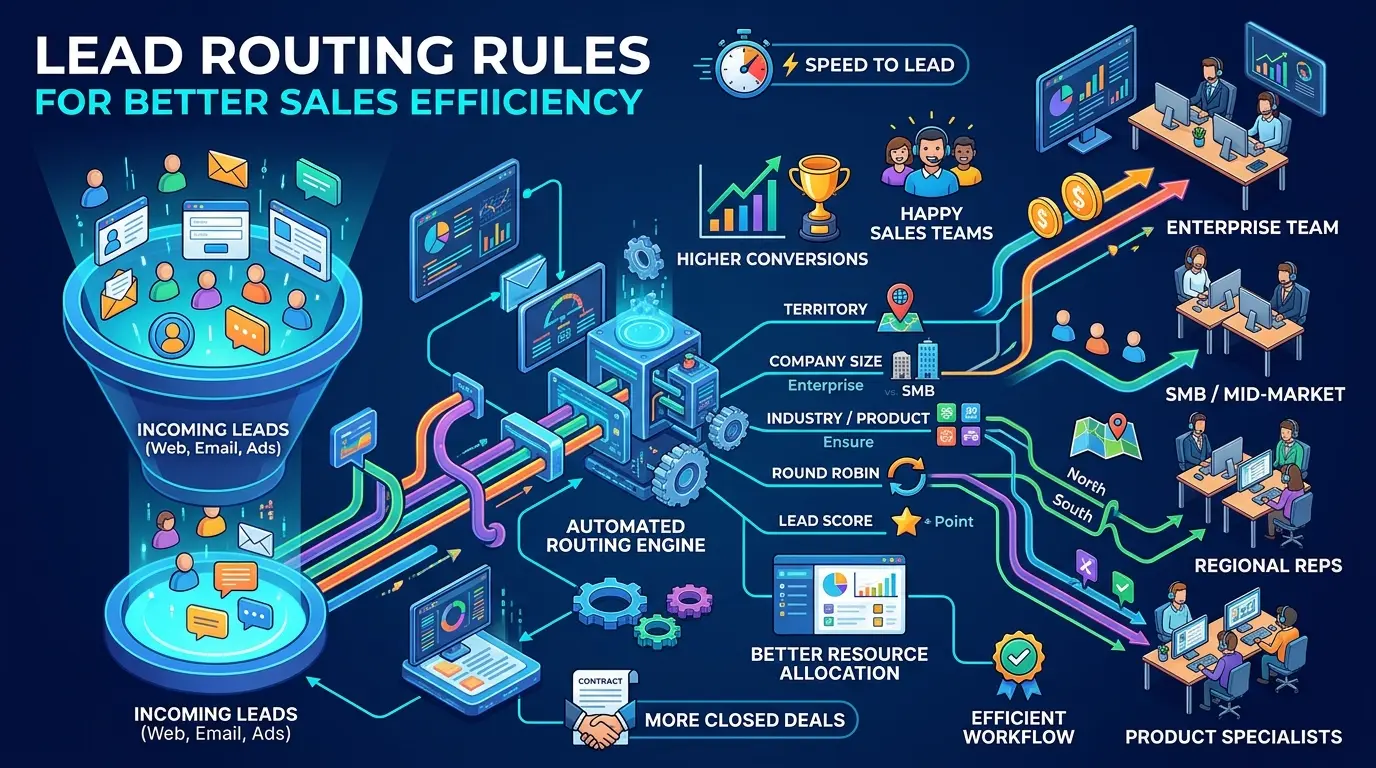
Lead routing rules establish how incoming leads are assigned based on specific business conditions, such as location, industry, product interest, lead source, company size, and sales representative availability. A well-organized routing process helps sales teams respond faster, maintain balanced workloads, and provide more relevant communication to potential customers.
As businesses expand their marketing activities, the volume and complexity of incoming leads often increase. A structured distribution system makes it easier to manage this growth while maintaining consistency across the sales process.
Understanding How Lead Routing Works
Lead routing is the process of directing incoming prospects to the appropriate sales representative or department. It begins when a lead enters the business through a website form, advertising campaign, social media platform, referral, email inquiry, or another acquisition channel.
Once the lead is captured, the system evaluates its available information against predefined conditions. Based on those conditions, the lead is assigned to an appropriate team member. The assigned representative can then review the prospect’s information and begin communication.
For example, a company serving multiple geographic markets may distribute prospects according to their locations. Leads from one region can be assigned to a representative responsible for that territory, while inquiries from another market go to a different team.
Other businesses may use product interest or industry specialization to determine assignments. This approach allows representatives to handle inquiries that match their experience and knowledge.
The effectiveness of lead routing depends on the quality of the information collected and the accuracy of the assignment conditions. When these elements work together, businesses can create a more organized and responsive sales operation.
Why Businesses Need Structured Lead Routing Rules
Without an organized distribution process, sales teams may experience inconsistent workloads and delayed follow-ups. Multiple representatives might contact the same prospect, while other inquiries remain unattended. These problems can negatively affect customer experiences and reduce the chances of converting interested prospects.
Structured routing rules help prevent these situations by establishing clear responsibilities for every incoming lead. Each prospect follows a defined assignment process, making it easier for managers to understand who is responsible for the next interaction.
A consistent system also improves accountability. Sales managers can monitor assignment activity, identify unclaimed leads, and evaluate whether representatives are responding within expected timeframes.
Another important advantage is improved customer communication. When prospects are connected with representatives who understand their requirements, conversations can become more relevant and productive. Customers do not need to repeatedly explain their needs to different employees, which creates a smoother experience.
Common Lead Routing Methods
Businesses can use several distribution methods depending on their sales structure, customer base, and operational requirements. Selecting the right approach requires understanding how leads differ and how the sales team handles incoming opportunities.
Round-Robin Lead Distribution
Round-robin routing distributes incoming leads among available sales representatives in a rotating sequence. Each representative receives an assignment before the system moves to the next person.
This method is useful for businesses where team members have similar responsibilities and experience levels. It can help maintain a balanced workload and reduce the possibility of one representative receiving most of the incoming inquiries.
However, round-robin distribution may not be suitable when leads require specialized knowledge. A prospect interested in a complex enterprise solution, for example, may need to speak with a representative who has experience handling larger accounts.
Geographic Lead Routing
Geographic routing assigns leads according to their location. Businesses operating across different cities, regions, or countries can use this method to connect prospects with representatives responsible for specific territories.
Local representatives may have a stronger understanding of regional customer expectations, market conditions, and communication preferences. They may also be better positioned to arrange meetings or provide location-specific information.
Accurate location information is important for this approach. Incomplete addresses or incorrect geographic data can cause leads to reach the wrong sales team.
Skill-Based Lead Routing
Skill-based routing considers the experience, knowledge, and specialization of individual sales representatives. Leads are directed to employees who are best equipped to handle particular products, industries, or customer requirements.
This method is particularly useful for businesses offering multiple services or technically complex products. A representative specializing in software solutions, for instance, can receive inquiries from prospects interested in software development, while another employee handles marketing-related opportunities.
Matching leads with the right expertise can improve communication quality and help customers receive more relevant information during the buying process.
Source-Based Lead Routing
Source-based routing assigns prospects according to the channel through which they entered the business. Website inquiries, social media leads, referral contacts, and advertising responses can follow different assignment paths.
This approach is valuable when particular channels generate leads with different requirements or levels of buying interest. It also helps businesses understand which teams are responsible for handling prospects from specific marketing activities.
For organizations managing several acquisition channels, connecting routing rules with accurate lead source information can make the sales process easier to monitor.
Important Factors to Consider When Creating Routing Rules
An effective routing system should reflect the company’s actual sales operations rather than relying on arbitrary assignment conditions. Businesses need to identify which lead characteristics influence the assignment decision and how those characteristics connect with team responsibilities.
Lead quality and intent are important considerations. A prospect demonstrating strong buying interest may require faster attention than someone who is still researching available solutions. Businesses can use behavioral information and Lead Intent Signals to understand which prospects are showing meaningful interest.
Sales representative availability also matters. Assigning leads to employees who are unavailable or already managing too many opportunities can delay communication. Routing conditions should account for working schedules, workload limits, and temporary availability changes.
Customer requirements should influence assignment decisions as well. Product interest, industry, company size, and expected service needs can help determine which representative is most suitable for a particular prospect.
Lead information accuracy is another essential factor. Incorrect contact details, missing company information, or incomplete location records can prevent routing systems from making appropriate decisions. Businesses should maintain reliable records and regularly review the information used by their assignment processes.
The Role of Lead Data in Accurate Distribution
Lead routing depends heavily on the information available when a prospect enters the sales system. If the collected data is incomplete or outdated, even well-designed rules may produce incorrect assignments.
For example, a business using geographic routing needs reliable location details. A company applying industry-based assignments needs accurate information about each prospect’s organization. Similarly, product-based distribution requires a clear understanding of what the prospect wants to purchase.
Maintaining organized Lead Records helps businesses preserve essential prospect information and make it available to the right employees. Consistent data management also reduces confusion when several departments interact with the same customer.
Lead enrichment can further improve assignment accuracy by adding useful details to existing records. Information about company size, industry, location, and professional roles can provide a clearer picture of each prospect. Businesses that invest in Lead Enrichment can make better-informed distribution decisions and reduce dependence on incomplete form submissions.
Connecting Lead Routing With Marketing Channels
Marketing channels influence the type of prospects entering a business. Different platforms may attract customers with different interests, budgets, and purchasing intentions. A routing system should account for these differences when distributing incoming opportunities.
For instance, a business receiving inquiries through professional networking platforms may encounter prospects who are researching business services or looking for industry-specific solutions. Understanding Lead Generation Through LinkedIn can help companies connect their social acquisition activities with a more organized sales assignment process.
Startups may have different routing requirements because their sales teams are often smaller and employees handle multiple responsibilities. A flexible process can help growing companies manage new inquiries without creating unnecessary operational complexity. Businesses developing Lead Generation for Startups can benefit from establishing clear assignment responsibilities as their prospect volume increases.
Website inquiries also deserve careful attention. Contact forms, service pages, and product inquiries can reveal what a visitor wants from the business. A structured Lead Generation from a Website process helps ensure that captured prospects enter the appropriate sales workflow.
For companies serving specific geographic markets, local visibility can influence the quality and relevance of incoming inquiries. Improving local search performance through strategies to Improve Local SEO Rankings can help attract prospects whose locations align with the business’s service areas.
Automation and CRM Integration
Manual lead assignment can become difficult when businesses receive a high volume of inquiries. Sales managers may need to review each prospect, identify the correct representative, and communicate assignment details. This process consumes time and increases the possibility of human error.
CRM platforms can simplify distribution by applying predefined routing conditions automatically. When a new lead enters the system, the software evaluates its available information and assigns it according to the configured rules.
Automation can also support notifications and follow-up activities. Representatives can receive alerts when new prospects are assigned, while managers can monitor leads that remain unclaimed or have not received timely attention.
CRM integration is especially useful when a business collects leads through multiple marketing platforms. Connecting these sources with a central customer management system helps maintain consistent records and reduces the need for manual data transfers.
However, automation should not replace regular monitoring. Businesses need to review routing performance, update outdated conditions, and ensure that assignment logic reflects changes in team structure and customer demand.
Measuring Lead Routing Performance
Evaluating routing performance helps businesses determine whether their distribution process is supporting sales objectives. Assignment volume alone does not provide enough information to understand the effectiveness of a routing system.
Response time is one important measurement. It shows how quickly representatives contact prospects after receiving an assignment. Consistently delayed responses may indicate workload problems, notification issues, or unclear responsibilities.
Lead distribution balance is another useful measurement. Managers can examine whether assignments are shared appropriately across the team and whether certain employees regularly receive more opportunities than others.
Businesses should also monitor conversion rates across different routing categories. Comparing results by territory, lead source, product interest, or representative can reveal which assignment methods are producing stronger outcomes.
Unassigned and reassigned lead volumes deserve attention as well. A high number of reassigned prospects may suggest that the original routing conditions are inaccurate or that certain team members are not suitable for specific lead categories.
Regular performance reviews allow businesses to identify these issues and make adjustments before they create larger problems.
Common Lead Routing Challenges
Even carefully planned routing systems can experience operational difficulties. One common challenge is incomplete lead information. When prospects submit forms without providing essential details, the system may not have enough information to determine the correct assignment.
Another problem occurs when routing rules become outdated. A business may introduce new services, expand into different markets, or reorganize its sales team. If the existing conditions are not updated, leads may continue reaching inappropriate representatives.
Overlapping rules can also create confusion. When multiple assignment conditions apply to the same prospect, the system needs a clear priority structure to determine which rule takes precedence.
Businesses should also avoid creating unnecessarily complicated routing processes. Too many conditions can make the system difficult to maintain and troubleshoot. A simpler structure with clearly defined priorities is often easier to manage.
To address these challenges, organizations should regularly audit their lead information, review assignment logic, and gather feedback from sales representatives. These activities help maintain a reliable distribution process as business requirements change.
Conclusion
Lead routing rules help businesses distribute incoming prospects according to relevant customer information, sales responsibilities, and team availability. By establishing clear assignment conditions, organizations can improve response times, balance workloads, strengthen accountability, and create more consistent customer experiences.
Successful routing requires more than automation. Businesses need accurate lead information, appropriate distribution methods, reliable CRM integration, and regular performance monitoring. When these elements work together, sales teams can spend less time managing assignments and more time developing meaningful customer relationships.
As lead generation activities expand, a flexible and well-maintained routing system becomes increasingly valuable. Businesses that treat lead distribution as an important part of their sales process can manage opportunities more effectively and build a stronger foundation for long-term growth.
Frequently Asked Questions
1. What are lead routing rules?
Lead routing rules are predefined conditions that determine how incoming prospects are assigned to sales representatives or departments. These conditions may consider location, industry, product interest, lead source, company size, or representative availability.
2. Why is lead routing important for sales teams?
Lead routing helps sales teams respond to inquiries efficiently, distribute workloads fairly, and connect prospects with suitable representatives. It also reduces assignment confusion and supports better sales accountability.
3. What is the most common lead routing method?
Round-robin routing is a common method because it distributes leads among available representatives in a rotating sequence. However, geographic, skill-based, and source-based routing may be more suitable for businesses with specialized sales responsibilities.
4. Can CRM software automate lead routing?
Yes. Many CRM platforms support automated lead assignment based on predefined conditions. These systems can evaluate incoming lead information, assign prospects to appropriate representatives, and send notifications when new assignments are created.
5. How can businesses improve lead routing accuracy?
Businesses can improve routing accuracy by maintaining complete lead records, verifying contact information, defining clear assignment conditions, and reviewing routing performance regularly. Lead enrichment and CRM integration can also help provide the information needed for more appropriate assignments.
Promote your articles nowCheck for details
Choose a promotion package
Choose a package below, scan the QR code and pay the displayed amount for 20 days.
After payment, email your article title and payment screenshot to info@yourneeds.asia. Once confirmation is received, one of our administrators will activate the promotion.

Choose where your promoted article receives extra visibility
Promotion changes presentation and placement for the selected period. It does not guarantee traffic, enquiries, search ranking or sales.
Priority visibility in the VIP Lounge, promoted shelves and highlighted article areas.
Top-style highlighting in article directories, homepage feeds and promoted article blocks.
Premium styling across supported article feeds, recommendations and directory placements.
Featured presentation in supported homepage, category, directory and related-article areas.
Build a stronger online presence for your business
Get Your Website for ₹15,000
Are you listed and don't have a website for your business? We can plan, design and launch a responsive website that makes your business easier to understand and contact.
Get My WebsiteSEO Starts from ₹10,000/Month
Improve how your business is presented across Google, local listings and AI-powered search results with ongoing SEO, content and authority-building work.
Improve My VisibilitySuggested Articles
View all articles
How Chatbot Marketing Is Transforming Digital Public Relations
Building a strong online reputation requires businesses to communicate consistently, share valuable information, and maintain meaningful relationships with their audiences. Traditional public relations activities…

France’s Tyre Industry Adapts to Electric Mobility and Sustainability Trends
France’s tyre industry is influenced by its extensive vehicle fleet, established automotive manufacturing base, and demand for reliable road transportation. Passenger cars, light commercial…

How to Make Your Chatbot More Engaging With Gamification
Businesses are constantly looking for ways to make digital interactions more interesting and encourage customers to stay connected with their brands. Chatbot gamification provides…

How to Create an Influencer Marketing Strategy That Delivers Better Results
An effective influencer marketing strategy helps businesses connect with relevant audiences, build brand credibility, and achieve measurable marketing goals through creator partnerships. Rather than…
Latest Blog Posts
View all articles
CLEP French Language Exam Guide 2026: What’s Tested and How to Pass
Earning college credits through examinations can be a practical way to save time and reduce the cost of completing a degree. For students who…

Best Event Planner in Lahore – How to Choose the Right Event Management Company
Finding the Best Event Planner in Lahore is important when planning a memorable wedding, corporate gathering, birthday celebration, or private event. A successful…

How Television Advertising Helps Businesses Reach More Customers and Increase Brand Value
In a competitive marketplace, attracting customer attention is one of the biggest challenges for any business. Companies continuously search for promotional methods that can…

What Is Driving Premium Beauty and Personal Care Choices Across the UK?
The UK premium beauty and personal care sector brings together skincare, haircare, cosmetics, fragrances, and other products positioned around quality, specialized formulations, presentation, and…

Affordable Press Release Distribution Middle East: Grow Your Brand with MENAWireNOW
Businesses looking to expand their presence in the Middle East need effective ways to share company news, reach media audiences, and build brand awareness.…

Europe Biocides Advance with Safer Protection Solutions
Biocides play an important role in protecting people, materials, products, and industrial systems from harmful organisms. Their applications span disinfectants, preservatives, pest-control products, antifouling…