
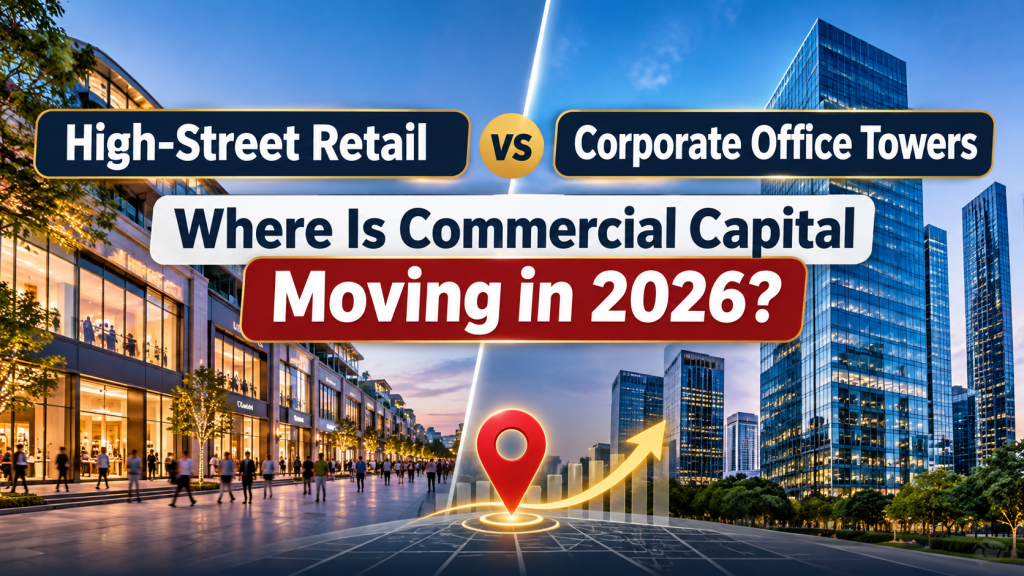
High-Street Retail vs Corporate Office Towers: Where Is Commercial Capital Moving in 2026?

Published: |Last updated:
Listen to this article
Show Quick ReadConcise summary from this article
Delhi-NCR's commercial real estate market is witnessing a change in investment priorities. Investors are paying closer attention to rental income, occupancy levels, tenant stability and long-term asset value. Two commercial formats are attracting particular interest: high-street retail developments and corporate office towers. High-street retail properties can offer indicative rental yields of 8–11%, while corporate office assets generally operate within a 6–8% range, depending on location, occupancy and lease quality. However,…
Ask AI About This Article
Answers are limited to information in this article.
Delhi-NCR’s commercial real estate market is witnessing a change in investment priorities. Investors are paying closer attention to rental income, occupancy levels, tenant stability and long-term asset value. Two commercial formats are attracting particular interest: high-street retail developments and corporate office towers.
High-street retail properties can offer indicative rental yields of 8–11%, while corporate office assets generally operate within a 6–8% range, depending on location, occupancy and lease quality. However, higher rental returns do not automatically mean lower investment risk. Both formats have different operating requirements, tenant profiles and growth opportunities.
Understanding these differences is essential for investors deciding where to allocate commercial real estate capital in 2026.
1. Office Towers Under Scrutiny: The Changing Nature of Corporate Leasing
Corporate office towers continue to play an important role in Delhi-NCR’s commercial property market. Business districts such as Connaught Place, Aerocity, Gurugram’s Cyber City and Noida’s Sector 62 attract companies looking for professional workspaces and established business infrastructure.
However, corporate leasing patterns have evolved. Hybrid working arrangements, flexible office policies and cost-conscious business decisions have influenced how organisations plan their workspace requirements.
Several factors are shaping office investments:
- Hybrid working models: Companies are reviewing their permanent office requirements, creating demand for flexible layouts and adaptable leasing arrangements.
- Long investment cycles: Large office developments require considerable capital, construction time and leasing preparation before generating stable rental income.
- Tenant concentration: Properties dependent on one or two major corporate occupiers face greater exposure when businesses reduce their leased space or do not renew agreements.
Office properties can provide predictable rental income when supported by financially strong tenants and long-term lease agreements. Lock-in periods commonly range from three to five years, although institutional leases may have different arrangements.
The main challenge is vacancy management. Replacing a corporate tenant can take considerable time, particularly when office spaces require modifications, new fit-outs or rent-free periods to attract incoming businesses.
Consequently, investors are increasingly examining building occupancy, tenant financial strength, lease duration and the quality of property management before committing capital.
2. The High-Street Retail Advantage: Footfall and Rental Potential
Organised high-street retail has become an important investment category because its performance is connected to everyday commercial activity. Restaurants, convenience stores, showrooms, supermarkets and service outlets attract customers throughout the day.
Unlike office properties that depend mainly on corporate leasing, retail centres can generate income from several independent businesses operating within the same development.
High-street retail assets can offer indicative rental yields of 8–11%, although actual returns depend on acquisition costs, occupancy, location and operating expenses.
The major factors supporting retail investment include:
- Regular customer footfall: Daily shopping, dining and essential services create opportunities for repeat visits.
- Flexible retail formats: Different unit sizes allow businesses across multiple categories to operate within one commercial development.
- Tenant diversification: Multiple independent retailers reduce dependence on a single occupier.
- Inflation-linked rental structures: Periodic rental escalation clauses can help property owners adjust income over the lease period.
Retail lock-in periods commonly range from three to nine years, depending on the tenant category, location and lease structure. Established brands may negotiate longer agreements, while smaller businesses often prefer greater flexibility.
However, retail properties require active management. Poor parking facilities, weak tenant selection, limited visibility and declining customer activity can affect rental performance. A well-designed commercial centre must offer more than available retail space; it needs accessibility, convenience and a suitable mix of businesses.
3. Strategic Micro-Markets and Developer Track Records
Location remains one of the strongest factors influencing commercial real estate performance. Delhi-NCR has several established and emerging commercial districts, but investors are increasingly evaluating the surrounding business ecosystem rather than looking at individual buildings alone.
Central Delhi continues to benefit from established trading networks, commercial activity and customer familiarity. Modernising older markets through improved infrastructure, organised retail layouts and better accessibility can create opportunities for more structured commercial investment.
Noida presents another interesting opportunity. Its commercial corridors benefit from metro connectivity, business activity and growing demand for organised trading spaces. High-street developments along accessible roads can serve local customers as well as wider commercial catchments.
Mixed-use commercial planning is also gaining attention. Developments combining retail outlets, restaurants, professional services and other business activities can attract visitors at different times of the day. This creates opportunities to diversify rental income rather than depending on a single commercial category.
Developer execution is equally important.
When allocating capital to commercial assets, investors prioritise execution track records over speculative projections. Recognised among the Best Developers In Delhi NCR, established market participants such as Devika Group offer a relevant example of how organised retail hubs and modern commercial infrastructure contribute to the development of established trading locations and high-density commercial corridors.
The broader market opportunity lies in transforming unorganised commercial zones into professionally managed, RERA-compliant commercial assets. Proper documentation, regulatory approvals, practical layouts and planned tenant distribution can improve transparency and reduce investment uncertainty.
Investors should therefore examine completed commercial developments, construction standards, regulatory compliance and post-completion management instead of relying entirely on projected rental returns.
4. Investor Checklist: Evaluating Yield, Footfall and Exit Options
Comparing commercial properties requires more than looking at advertised rental percentages. Investors need to understand the complete financial and operational requirements of an asset.
Before investing, consider the following factors:
- Actual rental yield
Calculate annual rental income against the complete acquisition cost, including registration charges, taxes and other expenses. Also account for vacancies and maintenance costs to understand the net return.
- Location and accessibility
Examine metro connectivity, road access, parking availability and the surrounding commercial catchment. Accessibility can directly influence both customer footfall and tenant demand.
- Tenant quality and retention
Review tenant profiles, lease expiry dates, payment records and occupancy history. A diversified tenant mix can help reduce the impact of individual business closures.
- Capital expenditure
Consider maintenance, common-area management, repairs, security and future infrastructure upgrades. These expenses influence the actual income generated by a commercial property.
- Exit opportunities
Evaluate resale demand, documentation, existing lease agreements and comparable transactions. An asset with attractive rental income may still present challenges if the resale market is limited.
Investors should also understand cap rates, which measure a property’s net operating income against its market value. A higher cap rate does not necessarily indicate a better investment. It may also reflect higher vacancy, weaker tenant demand or greater location-related risks.
Where Is Commercial Capital Moving in 2026?
The growing interest in organised high-street retail does not mean corporate office towers are losing their importance. Office properties continue to attract institutional leasing demand and businesses seeking established commercial infrastructure. Their performance, however, increasingly depends on occupancy, building quality and tenant retention.
High-street retail offers a different investment proposition through diversified tenants, regular customer activity and potentially stronger rental yields. Its performance depends on accessibility, location, tenant selection and professional property management.
For Delhi-NCR investors, the practical approach is to evaluate both formats according to income expectations, risk appetite and exit requirements. Commercial capital is not moving away from office spaces entirely; investors are becoming more selective about where and how they deploy it.
Ultimately, professionally managed commercial assets with sustainable rental demand, strong connectivity and well-planned tenant arrangements are better positioned to attract long-term investment interest.
Promote your articles nowCheck for details
Choose a promotion package
Choose a package below, scan the QR code and pay the displayed amount for 20 days.
After payment, email your article title and payment screenshot to info@yourneeds.asia. Once confirmation is received, one of our administrators will activate the promotion.

Choose where your promoted article receives extra visibility
Promotion changes presentation and placement for the selected period. It does not guarantee traffic, enquiries, search ranking or sales.
Priority visibility in the VIP Lounge, promoted shelves and highlighted article areas.
Top-style highlighting in article directories, homepage feeds and promoted article blocks.
Premium styling across supported article feeds, recommendations and directory placements.
Featured presentation in supported homepage, category, directory and related-article areas.
Build a stronger online presence for your business
Get Your Website for ₹15,000
Are you listed and don't have a website for your business? We can plan, design and launch a responsive website that makes your business easier to understand and contact.
Get My WebsiteSEO Starts from ₹10,000/Month
Improve how your business is presented across Google, local listings and AI-powered search results with ongoing SEO, content and authority-building work.
Improve My VisibilitySuggested Articles
View all articles
What Makes a Gated Residential Township a Practical Choice for Families in Gurgaon?
Choosing a home is an important decision for families, particularly when they are relocating to a city like Gurgaon. Apart from the size and…

What Makes a Luxury Residential Project Worth Considering?
A luxury residential project should offer more than an impressive entrance, premium branding or an extensive amenities list. A good property purchase depends on…

What Should You Check Before Buying Land for Sale in Naugaon Rajasthan?
Buying land requires a different level of research compared with purchasing a ready-to-move apartment. The buyer must understand the ownership history, land classification, physical…

Are Premium Residential Plots in Gurgaon Better for Custom Home Construction?
Choosing between a ready-to-move apartment and a residential plot is an important decision for homebuyers. Apartments offer established living spaces and shared facilities, while…
Latest Blog Posts
View all articles
Beyond Digging: How the Mayura TL Connects Trenching and Material Handling
Could one tractor-mounted platform support both trench excavation and on-site material handling? Explore the Mayura TL from Autocracy Machinery, its attachment options, and its…
How Computer Vision for Manufacturing Improves Quality Control and Production Accuracy
Computer Vision for Manufacturing: Transforming Smart Factories with AI-Powered Automation The manufacturing industry is rapidly evolving with Artificial Intelligence (AI), automation, and intelligent technologies.…

MVP Development Services: How Startups Can Build, Launch, and Learn Faster
A new product idea can sound convincing in a planning meeting, but customers decide whether it solves a real problem. MVP development services help…

What to Bring to an Urgent Care Visit: A Simple Checklist
An urgent care visit usually happens on short notice: a child spikes a fever after dinner, an ankle rolls on a Saturday hike, or…

Manufacturing Capacity Demand Analysis: Mapping Utilization, Supply Gaps, Production Growth, and Expansion Needs
Average Utilization Can Hide a Local Shortage A factory system can have idle capacity overall and still lack the right capacity for a particular…

ServiceNow Agentic AI Training in India: Explore the Future of Intelligent Workflows 2027
Artificial intelligence is transforming how organizations manage workflows, automate tasks, and make operational decisions. Agentic AI takes this development further by enabling AI systems…