

Published: |Last updated:
Listen to this article
Show Quick ReadConcise summary from this article
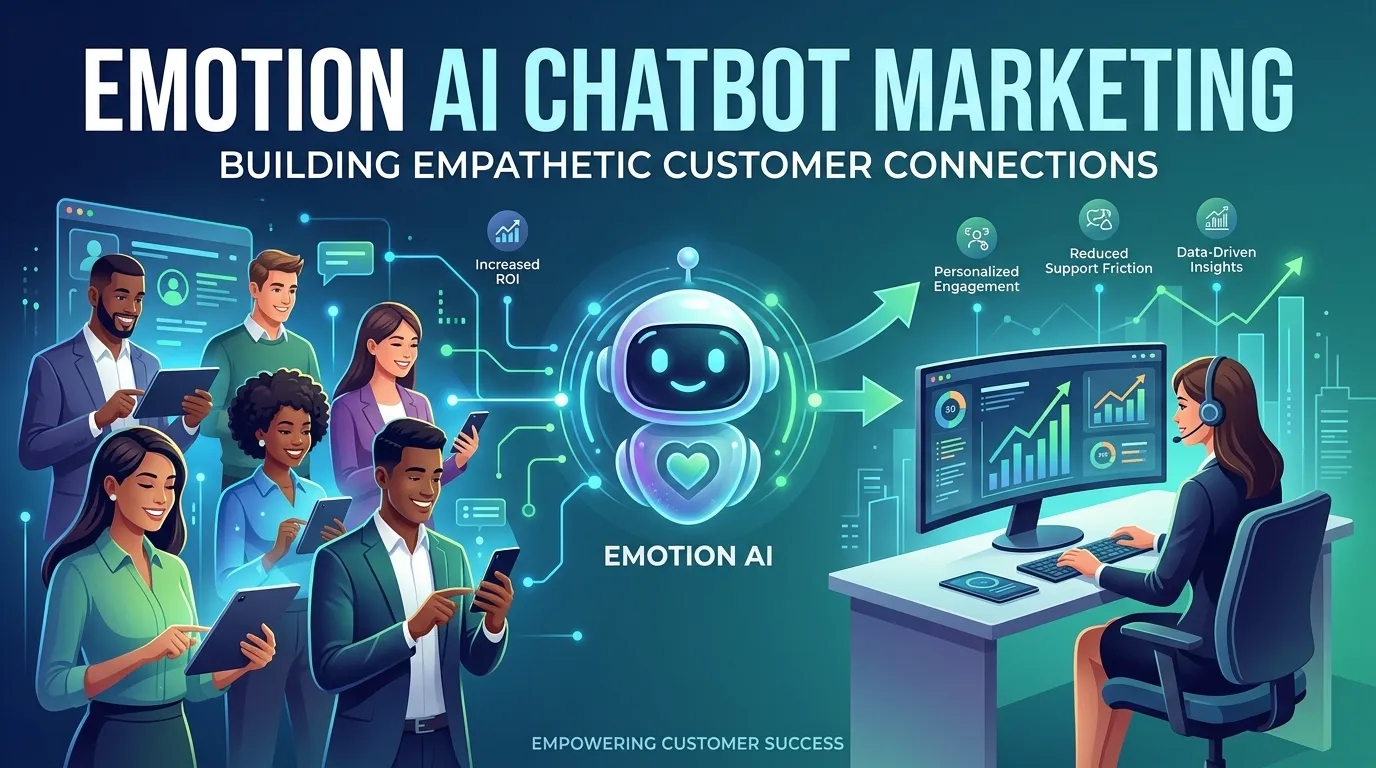
Emotion AI Chatbot Marketing is changing the way businesses approach automated customer communication. Traditional chatbots were primarily designed to answer questions, provide basic information, or direct users toward specific pages. While useful, these systems often treated every customer interaction in the same way. Emotion AI introduces another layer of intelligence by helping chatbots recognize emotional signals and adjust their responses according to the customer's situation. Customers do not communicate only…
Ask AI About This Article
Answers are limited to information in this article.
Emotion AI Chatbot Marketing is changing the way businesses approach automated customer communication. Traditional chatbots were primarily designed to answer questions, provide basic information, or direct users toward specific pages. While useful, these systems often treated every customer interaction in the same way. Emotion AI introduces another layer of intelligence by helping chatbots recognize emotional signals and adjust their responses according to the customer’s situation.
Customers do not communicate only through facts and questions. Their words can also reveal frustration, excitement, hesitation, confusion, urgency, or satisfaction. When conversational systems can recognize these signals, businesses can create interactions that feel more relevant and considerate. Instead of simply responding to what a customer says, an emotionally aware chatbot can also consider how the customer may be feeling during the conversation.
This creates opportunities for brands to improve customer satisfaction, strengthen engagement, reduce unnecessary support escalations, and encourage conversions. When implemented responsibly, Emotion AI can make automated conversations more useful without removing the human element from customer experiences.
Understanding Emotion AI in Chatbot Marketing
Emotion AI refers to artificial intelligence technologies that analyze different signals to identify potential emotional states. Depending on the system, these signals can come from written language, voice characteristics, facial expressions, behavioral patterns, or combinations of several inputs.
In chatbot marketing, text and voice are among the most practical sources of emotional information. Natural language processing can examine word choice, sentence structure, context, and sentiment to identify possible emotions. A customer repeatedly using words associated with dissatisfaction may be experiencing frustration, while enthusiastic language may indicate strong interest.
Voice-enabled systems can consider additional characteristics such as tone, pitch, speaking speed, pauses, and changes in vocal intensity. Multimodal systems can combine several sources of information to create a broader understanding of the interaction.
However, emotion detection is not perfect. Sarcasm, slang, cultural differences, language variations, and individual communication styles can make emotional interpretation difficult. For this reason, businesses should treat Emotion AI as a decision-support capability rather than an unquestionable measurement of how a person feels.
Why Emotional Awareness Matters in Marketing
Marketing is not simply about delivering information. Customer emotions can influence how people perceive brands, evaluate products, respond to offers, and decide whether to continue a conversation.
A customer who is frustrated with a delayed order may react negatively to an aggressive promotional message. The same customer may respond much more positively if the chatbot first acknowledges the problem, provides useful information, and offers an appropriate solution.
This is where emotionally aware communication becomes valuable. A chatbot can adapt the conversation to the customer’s situation instead of delivering a fixed response regardless of context.
Empathetic communication can also help reduce friction. When users feel that their concerns are being recognized, they may be more willing to continue interacting with the business. Over time, these positive experiences can contribute to stronger trust, loyalty, and customer relationships.
How Emotion AI Chatbots Work
Emotion-aware chatbot systems typically involve several layers of technology. The process begins when the system receives customer input through text, voice, or another supported interface.
For text-based interactions, natural language processing can identify important words, phrases, intent, context, and sentiment. An emotion classification model may then estimate whether the conversation contains signals associated with emotions such as frustration, excitement, confusion, or satisfaction.
Voice systems can analyze audio characteristics and identify patterns that may indicate changes in emotional state. More advanced systems can combine text and voice signals to produce a broader interpretation.
After identifying the relevant signals, the chatbot’s dialogue system determines how the conversation should continue. A frustrated customer may receive a more supportive response, while a customer showing strong purchasing interest may receive additional product information.
In situations involving complex problems or strong negative sentiment, the system can also escalate the conversation to a human representative. This hybrid approach allows automation to handle routine interactions while human employees remain available for situations requiring judgment and empathy.
Emotion AI Chatbot Marketing and Personalization
Emotional intelligence becomes even more powerful when combined with personalization. Customers have different preferences, histories, and expectations, so providing the same conversation to everyone can limit engagement.
Emotion AI Chatbot Marketing can consider both the customer’s current emotional signals and available behavioral information. For example, a returning customer may have previously viewed several products in the same category. If the customer now expresses uncertainty about choosing between two options, the chatbot can use previous activity to provide a more relevant comparison.
This creates a deeper form of personalization. The chatbot is not only determining what information may interest the customer but also considering how that information should be communicated.
Businesses can strengthen this approach through Chatbot Personalization Strategies, using customer history, preferences, interaction patterns, and behavioral information to create more relevant conversations.
Creating More Empathetic Customer Conversations
Empathy in chatbot communication does not mean pretending that the system has human feelings. Instead, it means designing responses that acknowledge customer circumstances and provide appropriate assistance.
Suppose a customer says that they have already contacted support several times without receiving a solution. A generic chatbot response may simply ask for the order number. An emotionally aware system can recognize the frustration in the message and respond by acknowledging the previous difficulty before moving toward a solution.
This small change can make the interaction feel more considerate. The customer receives both practical assistance and recognition of the problem.
Similarly, customers who express excitement can receive encouraging responses and relevant recommendations. A user who appears confused can receive simpler explanations instead of being overwhelmed with technical information.
Emotional Personalization Across Different Cultures
Emotion does not look exactly the same across languages and cultures. Expressions of enthusiasm, frustration, politeness, disagreement, and urgency can vary considerably.
A phrase that sounds strongly negative in one context may be relatively mild in another. Certain cultures may communicate dissatisfaction directly, while others may express it indirectly. Slang, idioms, humor, and regional language can also change how a message should be interpreted.
Businesses operating internationally therefore need to consider cultural context when implementing Emotion AI. Training data should represent the languages and audiences the system is expected to serve.
Culturally aware emotional intelligence can help businesses create more inclusive chatbot experiences. It can also reduce the risk of inappropriate responses caused by interpreting communication through a narrow cultural perspective.
Emotion AI in Retail and E-Commerce
Retail and e-commerce are natural environments for emotion-aware chatbots because purchasing decisions often involve uncertainty and emotional reactions.
A shopper may be excited about a new product but unsure about the price. Another customer may hesitate because they cannot determine which product is suitable for their needs. Instead of immediately displaying another sales message, an emotionally aware chatbot can respond to the underlying concern.
For an enthusiastic customer, the system may suggest complementary products or relevant premium options. For a hesitant customer, it may provide reviews, comparisons, specifications, sizing information, or return policies.
This can make upselling and cross-selling feel more relevant because the recommendations are connected to the customer’s actual conversation rather than being delivered randomly.
Emotion AI can also assist with abandoned-cart situations. If a customer previously expressed concern about shipping or product suitability, the follow-up message can address that specific issue rather than simply asking the customer to return to checkout.
Emotion AI for Financial Services
Financial decisions can involve significant uncertainty and stress. Customers researching loans, insurance, investments, or other financial products may need clear information and reassurance before taking action.
An emotionally aware chatbot can recognize signals of confusion or anxiety and adjust the conversation accordingly. Instead of immediately presenting another promotional message, it can provide educational information, explain terminology, or direct the customer toward appropriate support.
Human escalation is particularly important in financial environments. When a customer has a complex issue or requires professional assistance, the chatbot should provide a clear path to an appropriate human representative.
The goal is not to replace financial professionals but to make initial digital interactions more useful and responsive.
Emotion AI in Healthcare and Wellness
Healthcare and wellness applications require especially careful consideration because conversations can involve sensitive personal information and emotional situations.
Emotion-aware systems can potentially help users navigate wellness platforms, appointment experiences, educational content, or routine support. A chatbot may recognize that a user appears discouraged and provide encouraging information or suggest an appropriate resource.
However, businesses must avoid presenting Emotion AI as a replacement for professional medical or psychological care. Emotion detection can be uncertain, and sensitive situations should be handled with appropriate safeguards and human oversight.
Privacy and consent are also particularly important in healthcare-related applications because the information involved can be highly sensitive.
Improving Lead Generation Through Emotional Signals
Emotion-aware chatbots can also support lead-generation activities. Not every visitor arrives with the same level of purchase intent.
Some visitors are simply researching. Others may be comparing products, while some are ready to speak with a sales representative. Conversation patterns can provide useful signals about these different stages.
A visitor asking detailed questions and showing strong interest may be ready for a sales-oriented conversation. Another visitor repeatedly expressing uncertainty may need additional educational content first.
By recognizing these differences, the chatbot can adjust its approach. This can make lead qualification more useful and help sales teams prioritize conversations where human involvement is most valuable.
Combining Emotion AI With Customer Journey Personalization
Customer journeys are rarely linear. A person may discover a brand through search, interact with social media, visit a website, compare products, leave, and return days later.
Emotion AI can become more valuable when emotional signals are considered alongside customer journey information. A returning visitor who previously expressed frustration should not necessarily receive the same welcome message as a first-time visitor.
A connected system can use relevant interaction history to create greater continuity. However, businesses should carefully manage the amount of information used to personalize conversations. Customers should receive useful continuity without feeling that the brand is tracking them excessively.
Measuring Emotion AI Chatbot Marketing Performance
Businesses need measurable objectives when introducing emotional intelligence into chatbot marketing. Simply identifying emotions does not automatically mean the technology is improving business performance.
Customer satisfaction can show whether emotionally adaptive conversations are creating better experiences. Engagement duration can indicate whether customers find conversations useful. Conversion rates can reveal whether emotional personalization contributes to purchasing actions.
Businesses can also monitor escalation rates, resolution times, repeat purchases, lead quality, abandoned-cart recovery, and customer retention.
Sentiment changes can provide another useful measurement. If a customer begins a conversation frustrated but ends it satisfied after receiving assistance, that change can provide valuable information about the effectiveness of the chatbot experience.
A/B testing different responses can also reveal which communication styles work best for particular situations.
Responsible Use of Emotional Customer Data
Emotion AI introduces important privacy and ethical considerations. Emotional information can be sensitive, especially when systems analyze voice characteristics, facial expressions, behavioral patterns, or other personal signals.
Businesses should clearly communicate how emotional information is collected and used. Where consent is required, users should have an understandable way to provide or refuse permission.
Transparency is important because customers should not feel that emotional analysis is happening secretly. Businesses should also avoid using emotional vulnerability as a reason to apply manipulative marketing techniques.
For example, detecting that a customer is anxious should lead to better support and clearer information rather than aggressive pressure to purchase.
Responsible use of Emotion AI protects customers while also helping brands maintain long-term trust.
Reducing Bias in Emotion Detection
Emotion detection models can inherit biases from their training data. If the training information does not adequately represent different languages, cultures, age groups, communication styles, or demographics, the system may perform unevenly.
Businesses should therefore evaluate models across diverse datasets and regularly review incorrect classifications.
A low-confidence emotion prediction should not trigger an aggressive or highly specific response. In ambiguous situations, a neutral response or human escalation may be more appropriate.
Continuous testing can help businesses identify these weaknesses and improve chatbot behavior over time.
The Role of Human Support
Emotion AI should complement human support rather than eliminate it. Some situations are simply too complicated or sensitive for automation.
A customer dealing with a serious complaint, complicated financial issue, or highly emotional situation may require human assistance. The chatbot should recognize when the conversation has reached that point and make the transition as smooth as possible.
The best customer experience often comes from combining the speed of automation with the judgment and empathy of human employees.
Emotion AI and Multichannel Customer Experiences
Customers communicate with brands through websites, messaging applications, social platforms, mobile apps, and other channels. Emotion-aware chatbot experiences can become more useful when these interactions are connected.
For example, a customer who expresses frustration through a social messaging channel may later visit the website. If the appropriate information can be carried forward responsibly, the customer does not have to explain the entire issue again.
This type of continuity can reduce friction and create a more consistent brand experience. However, businesses should balance convenience with privacy and avoid collecting more information than is necessary.
The Future of Emotion AI Chatbot Marketing
Emotion AI is likely to become more sophisticated as conversational AI, machine learning, voice technology, and multimodal systems continue to develop.
Future systems may combine text, voice, visual information, behavioral signals, and historical interactions to create a more complete understanding of customer context.
Instead of waiting for a customer to explicitly express frustration, a chatbot may recognize early signs of hesitation and offer assistance proactively. Similarly, strong purchase interest could trigger relevant recommendations at the right moment.
This could transform chatbots from simple automated support tools into broader customer-experience systems capable of adjusting communication throughout the customer journey.
The technology will still require careful oversight. Better emotion detection does not eliminate uncertainty, and businesses will need to continue prioritizing transparency, privacy, fairness, and human involvement.
Building a Strong Emotion AI Strategy
A successful Emotion AI strategy begins with a clear business objective. Businesses should determine whether they want to improve customer support, increase conversions, reduce abandonment, improve lead qualification, or strengthen customer retention.
The next step is selecting appropriate emotional signals. Text-based sentiment analysis may be sufficient for many businesses, while voice or visual analysis may be appropriate for specific applications.
Once the technology is selected, businesses can develop response flows that connect emotional states with appropriate actions. Positive signals might support recommendation opportunities, while frustration could trigger additional assistance or human escalation.
Testing should continue after launch. Customer feedback, conversation analysis, and performance metrics can reveal where the chatbot is helping and where additional improvements are needed.
Conclusion
Emotion AI Chatbot Marketing is helping businesses create more responsive and empathetic digital experiences. By analyzing language, sentiment, voice characteristics, behavioral patterns, and other available signals, chatbots can adapt their communication to better reflect customer circumstances.
The value of this technology extends beyond making conversations sound more human. Emotion-aware systems can support personalization, lead generation, e-commerce, customer service, retention, and conversion optimization when they are integrated thoughtfully into the broader customer journey.
At the same time, businesses must recognize the limitations and responsibilities associated with emotional AI. Emotion detection is not always accurate, customer data must be handled carefully, and sensitive situations should remain accessible to human support.
The strongest implementations will combine artificial intelligence with responsible data practices, personalization, cultural awareness, and human oversight. When these elements work together, Emotion AI can help brands build customer interactions that are more useful, respectful, and meaningful.
Frequently Asked Questions
What is Emotion AI Chatbot Marketing?
Emotion AI Chatbot Marketing uses artificial intelligence to identify emotional signals during customer conversations and adapt chatbot responses accordingly. It can analyze text, voice, behavioral patterns, and other available information to create more personalized interactions.
How does Emotion AI detect customer emotions?
Emotion AI can use natural language processing, sentiment analysis, machine learning, voice analysis, and in some cases computer vision. These technologies identify patterns that may indicate emotions such as frustration, excitement, confusion, satisfaction, or hesitation.
Why is emotional intelligence important for chatbots?
Basic chatbots may provide technically correct answers while ignoring how a customer feels. Emotional intelligence allows chatbots to respond more appropriately to frustration, uncertainty, enthusiasm, or other emotional signals, potentially creating a more satisfying experience.
Can Emotion AI increase conversions?
It can contribute to higher conversions by reducing friction and making conversations more relevant. For example, a chatbot can respond to purchasing hesitation with useful product information rather than immediately pushing another promotional message.
Is Emotion AI useful for e-commerce?
Yes. E-commerce businesses can use Emotion AI to understand purchasing hesitation, personalize product recommendations, support abandoned-cart recovery, answer questions, and provide more context-aware assistance.
Can Emotion AI be used for customer support?
Yes. Emotion-aware chatbots can identify signals of frustration or dissatisfaction and adjust their responses. When a problem is too complex or sensitive, the chatbot can escalate the conversation to a human support representative.
What are the privacy concerns with Emotion AI?
Emotion AI may process sensitive information such as voice characteristics, behavioral patterns, facial signals, and conversational data. Businesses should provide appropriate transparency, follow applicable privacy requirements, use secure systems, and obtain consent where necessary.
Is Emotion AI accurate?
Accuracy varies depending on the technology, training data, language, context, and type of emotional signal being analyzed. Sarcasm, cultural differences, slang, and ambiguous language can make emotion detection difficult, so businesses should avoid treating predictions as absolute facts.
Can Emotion AI work across different languages and cultures?
It can, but multilingual and multicultural implementation requires carefully selected training data and cultural consideration. Emotional expressions and communication styles can differ significantly between regions, so models should be evaluated across the audiences they serve.
What is the future of Emotion AI in chatbot marketing?
Future systems are likely to combine text, voice, visual, behavioral, and contextual signals to create more adaptive customer experiences. Emotion-aware chatbots may become more proactive while continuing to require privacy protections, human oversight, and responsible implementation.
Promote your articles nowCheck for details
Choose a promotion package
Choose a package below, scan the QR code and pay the displayed amount for 20 days.
After payment, email your article title and payment screenshot to info@yourneeds.asia. Once confirmation is received, one of our administrators will activate the promotion.

Choose where your promoted article receives extra visibility
Promotion changes presentation and placement for the selected period. It does not guarantee traffic, enquiries, search ranking or sales.
Priority visibility in the VIP Lounge, promoted shelves and highlighted article areas.
Top-style highlighting in article directories, homepage feeds and promoted article blocks.
Premium styling across supported article feeds, recommendations and directory placements.
Featured presentation in supported homepage, category, directory and related-article areas.
Build a stronger online presence for your business
Get Your Website for ₹15,000
Are you listed and don't have a website for your business? We can plan, design and launch a responsive website that makes your business easier to understand and contact.
Get My WebsiteSEO Starts from ₹10,000/Month
Improve how your business is presented across Google, local listings and AI-powered search results with ongoing SEO, content and authority-building work.
Improve My VisibilitySuggested Articles
View all articles
Conversational AI Chatbot: Transforming Customer Communication and Support
A conversational AI chatbot helps businesses communicate with customers faster and more effectively. By combining artificial intelligence, natural language processing, automation, and virtual assistance,…

Picnic Catering in Karachi
Planning a picnic in Karachi is a great way to enjoy quality time with family, friends, colleagues, or a larger group in an outdoor…

The Best Trade Show and Exhibition Planner in Karachi Prevents This Mistake
Every exhibitor has attended one. A trade show floor full of polished booths, a steady stream of visitors, and an event beautifully photographed. And…

How to Actually Choose a Conference Event Planner in Karachi
How to Actually Choose a Conference Event Planner in Karachi Choosing a conference event planner in Karachi can be difficult when several proposals look…
Latest Blog Posts
View all articles
ISO 17065 Manual: A Complete Guide to Product Certification Body Documentation
Product certification is very useful in proving compliance with the set requirements of products, processes, and services. A management system is very important for…

When Google Ads Optimizes for Conversions, What About Their Value?
A campaign can generate hundreds of conversions and still leave a business wondering why the return does not look as strong as expected. The…

VFS Switzerland Dubai: A Practical Guide for UAE Residents Applying for a Swiss Visa
VFS Switzerland Dubai: A Practical Guide for UAE Residents Applying for a Swiss Visa Planning a trip to Switzerland from the UAE can be…
How Brands Can Create a Strong Digital Community
A strong Digital Community can help brands build meaningful relationships with their audience, improve customer engagement, and create long-term loyalty. Instead of relying only…

How Walk-Behind Trenchers Improve Underground Installation Work
Underground installations are a regular part of agriculture, construction, landscaping, telecom work, and utility maintenance. Water pipes, irrigation lines, electrical conduits, communication cables, drainage…

Best Catering Packages in Karachi: How to Choose the Right One
Choosing between catering packages in Karachi isn't really about finding the single best option on the market, since what works well for a two…