
How Expensive Is a Hip Replacement Surgery? India Cost Guide 2026

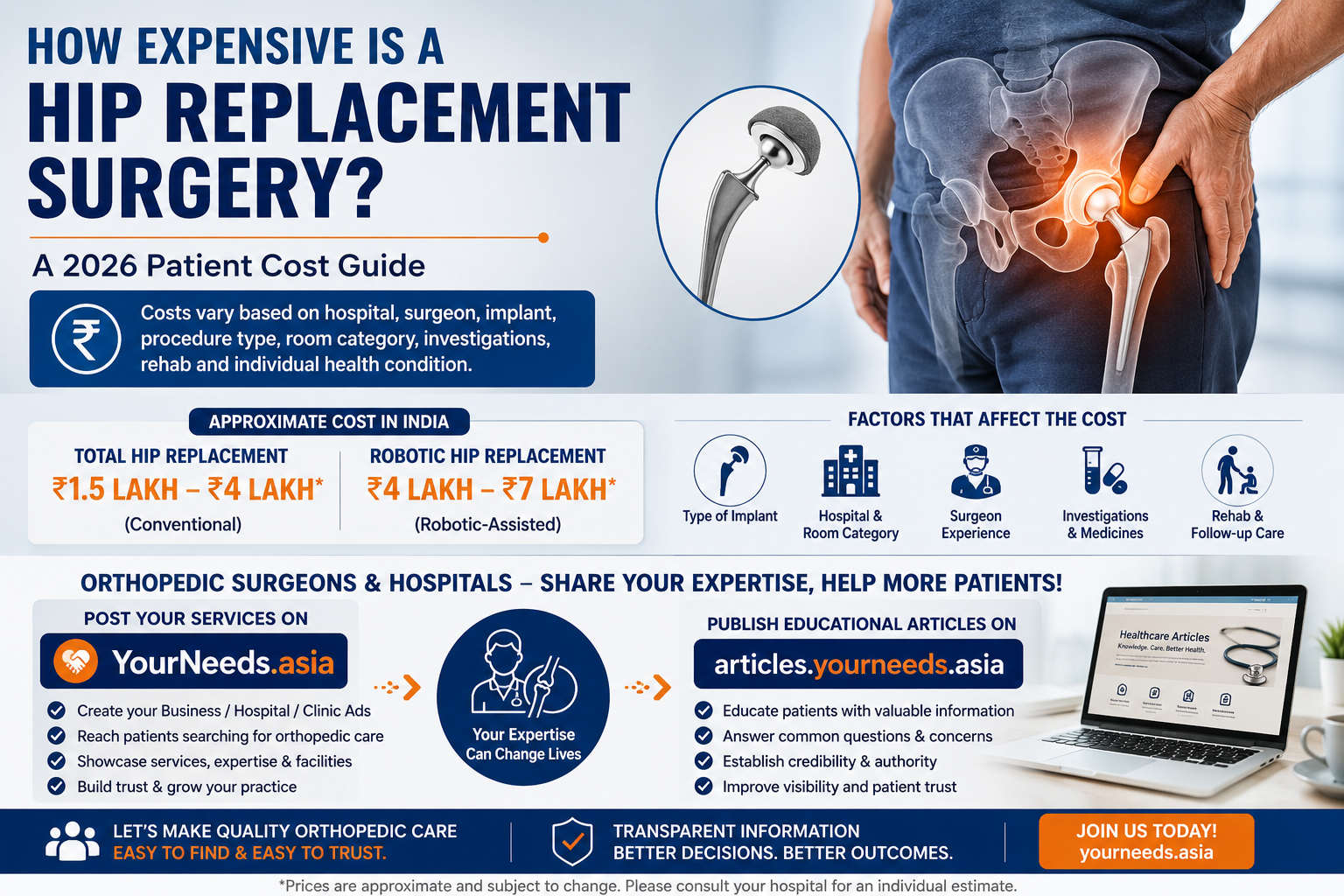
How Expensive Is a Hip Replacement Surgery? A 2026 Patient Cost Guide—and Why Orthopedic Surgeons Should Explain Costs Online
Hip replacement can be life-changing for appropriately selected patients with severe hip-joint disease, but one of the first questions patients and families ask is straightforward:
How expensive is a hip replacement surgery?
There is no single price that applies to every patient. The cost can change according to the hospital, city, surgeon, type of implant, whether one or both hips require surgery, room category, surgical technique, investigations, length of hospital stay, rehabilitation and whether complications or additional medical care occur.
For patients, this makes transparent information extremely valuable.
For orthopedic surgeons, orthopedic clinics and hospitals, it also creates an important digital opportunity: instead of waiting for patients to telephone the hospital with basic questions, healthcare providers can publish informative advertisements and educational articles explaining their hip-replacement services, expertise, facilities and consultation process.
Healthcare providers can create business/service listings through YourNeeds.asia and contribute educational healthcare content through YourNeeds Articles.
Quick Answer: In India, one major hospital group currently quotes an average total hip replacement cost of approximately ₹1.5 lakh to ₹4 lakh, while robotic hip replacement may be substantially more expensive; Apollo currently cites approximately ₹4 lakh to ₹7 lakh for robotic procedures. These figures are only broad reference ranges—not quotations for an individual patient. Actual costs depend on the patient’s condition, implant, hospital, surgeon, procedure and care required.
What Is Hip Replacement Surgery?
Total hip replacement, also called total hip arthroplasty, involves replacing damaged portions of the hip joint with artificial components.
The hip is essentially a ball-and-socket joint. During total hip replacement, damaged joint surfaces are replaced with prosthetic components intended to restore joint function and reduce symptoms caused by severe joint damage.
Hip replacement may be considered for conditions including advanced osteoarthritis, rheumatoid arthritis, avascular necrosis and certain hip fractures.
The important point is that hip pain does not automatically mean someone needs hip replacement.
The decision requires an individualized orthopedic assessment. The patient’s symptoms, examination, imaging, general health, response to non-surgical treatment and expected benefits and risks all matter.
How Much Does Hip Replacement Surgery Cost in India?
As a broad reference point, Apollo Hospitals currently publishes an average Indian total hip replacement cost range of approximately:
₹1,50,000 to ₹4,00,000
for total hip replacement.
However, patients should not interpret that figure as a guaranteed package price.
A person searching for hip replacement surgery cost in India should ask the hospital for an individualized written estimate.
Two patients undergoing what sounds like the same operation can receive different estimates because their medical requirements may be different.
Why Can Hip Replacement Surgery Be Expensive?
Hip replacement is not simply the cost of spending a few hours in an operating theatre.
The total treatment journey can involve several components.
These may include preoperative orthopedic consultations, blood investigations, imaging, medical or anesthesia assessment, implant costs, surgeon and surgical-team charges, operating-theatre expenses, anesthesia, medicines, consumables, hospital room charges, nursing care and postoperative rehabilitation.
That is why asking only:
“What is the surgery charge?”
may not tell you what the entire treatment will cost.
A more useful question is:
“What is included in the complete estimated cost, and what expenses could be additional?”
1. The Hip Implant Can Affect the Cost
The prosthetic implant is an important component of hip-replacement surgery.
Different implant systems and configurations may have different prices and clinical considerations.
Patients should discuss implant selection with their orthopedic surgeon rather than assuming that the most expensive implant is automatically the best option.
Useful questions include:
What implant is being recommended?
Why is it appropriate for me?
Are there alternatives?
What are the expected benefits and limitations?
Is the implant included in the quoted package?
A hospital or surgeon publishing information online can explain these concepts without claiming that one implant is universally appropriate for every patient.
2. Hospital Choice Influences the Final Bill
A large tertiary-care or specialty hospital may have a different cost structure from a smaller orthopedic hospital.
Facilities, infrastructure, nursing, intensive-care availability, operating-theatre technology, room category and other services can influence the overall price.
Therefore, patients comparing hip replacement surgery costs should compare what each quotation actually includes rather than looking only at the lowest headline figure.
A ₹2 lakh quote and a ₹3 lakh quote may not necessarily cover identical services.
3. Surgeon Experience Is Part of the Decision—But Price Alone Shouldn’t Decide
Patients naturally search for phrases such as:
best orthopedic surgeon for hip replacement
hip replacement surgeon near me
best hip replacement hospital
orthopedic hospital near me
But healthcare decisions should not be based solely on promotional superlatives.
Patients can ask about the surgeon’s relevant training, experience with the recommended procedure, hospital facilities, expected recovery pathway, potential complications and follow-up care.
Healthcare providers should likewise avoid unsupported “No.1” or “best surgeon” claims.
Detailed, verifiable professional information is more useful than exaggerated advertising.
4. Conventional vs Robotic Hip Replacement Costs
Technology can influence cost.
Robotic-assisted hip replacement, where appropriate and available, may involve additional equipment and hospital expenses.
Apollo currently publishes an approximate ₹4,00,000 to ₹7,00,000 range for robotic hip replacement surgery in India and notes that hospital choice, location, room type and complications can influence overall expense.
This does not mean robotic surgery is automatically the right choice for every patient.
Patients should ask:
Why are you recommending robotic-assisted surgery in my case?
What benefit do you expect for me?
What would conventional surgery cost?
What additional expense is specifically associated with robotic technology?
The choice of technique should remain a clinical discussion between the patient and appropriately qualified medical professionals.
5. Single-Hip vs Bilateral Hip Replacement
Replacing one hip and treating both hips are obviously different clinical situations.
If both hips are affected, the orthopedic surgeon must determine whether both require surgery and, if so, whether they should be treated during the same admission or at different times.
Cost comparisons should therefore clearly distinguish:
Unilateral hip replacement — one hip
from
Bilateral hip replacement — both hips
Patients should not assume that doubling a single-hip package gives an accurate bilateral estimate.
6. Room Category Can Change Hospital Costs
Hospital accommodation can materially affect the final bill.
Depending on the hospital, patients may be offered general wards, shared rooms, private rooms or higher-category rooms.
Before admission, ask whether changing room category affects only the room charge or also other components of the hospital bill.
Insurance policy conditions should also be checked carefully.
7. Pre-Surgery Tests Add to the Overall Expense
Before major surgery, patients commonly undergo investigations and preoperative assessment.
Exactly what is required depends on the individual.
Older patients or people with diabetes, hypertension, cardiac disease, respiratory disease or other medical conditions may require additional evaluation.
Therefore, the cost calculation should start before the day of surgery.
Ask whether preoperative investigations are included in the hospital package.
8. Hospital Stay Matters
The duration of hospitalization can influence total cost.
A straightforward recovery may fit within the expected package or hospitalization period.
Additional medical issues or complications may require a longer stay and therefore increase expenses.
When requesting an estimate, ask:
How many hospital days does this estimate include?
That one question can make different quotations much easier to compare.
9. Rehabilitation and Physiotherapy Should Be Part of Your Budget
The operation is only one stage of recovery.
Rehabilitation and physiotherapy can be important parts of the postoperative pathway.
Depending on individual requirements, there may be expenses for physiotherapy sessions, mobility aids, home assistance, follow-up visits and medications after discharge.
Patients budgeting for surgery should therefore think in terms of:
Total treatment and recovery cost
rather than simply:
Operation cost.
10. Complications Can Increase Costs
Every surgical procedure carries risks.
A patient’s individual risk profile depends on many factors, and these should be discussed with the treating team.
If additional investigations, treatment, procedures or hospitalization become necessary, the final expense may exceed an initial package estimate.
Patients should ask the hospital how unexpected medical expenses are handled.
What Should a Hip Replacement Cost Estimate Include?
Before choosing a hospital based on price, request a detailed estimate.
Ideally, it should make clear whether the quotation includes or excludes items such as the implant, surgeon charges, assistant charges where applicable, anesthesia, operating theatre, hospital stay, room category, medicines, consumables, investigations, physiotherapy and follow-up.
Also ask about exclusions.
A transparent estimate is much more useful than an advertisement simply saying:
“Hip Replacement Package ₹X.”
Is the Cheapest Hip Replacement Surgery the Best Choice?
Not necessarily.
Affordability matters, particularly for families paying substantial medical expenses themselves.
But price should be considered alongside clinical appropriateness, surgeon qualifications and experience, hospital facilities, implant choice, rehabilitation arrangements, infection-control practices, follow-up and transparency.
Similarly, a higher price does not automatically prove better medical care.
Patients should compare value, suitability and quality, not simply the highest or lowest number.
Does Health Insurance Cover Hip Replacement Surgery?
Coverage depends on the individual insurance policy and circumstances.
Patients should contact their insurer or third-party administrator before admission and determine whether the proposed procedure is covered, whether preauthorization is required, what room-rent restrictions apply, whether there are co-payments or sub-limits, and what expenses are excluded.
Do not assume that “cashless hospital” means every expense will be paid by the insurer.
Request written clarification wherever possible.
Questions to Ask an Orthopedic Surgeon Before Hip Replacement
A patient preparing for consultation can make the appointment more useful by asking focused questions:
- Why are you recommending hip replacement in my case?
- Are reasonable non-surgical options still available?
- Do I need total hip replacement or another procedure?
- What implant do you recommend and why?
- What are the important risks in my individual case?
- What type of anesthesia is expected?
- How long might I remain in hospital?
- When might I begin walking?
- What rehabilitation may be required?
- What is included in the estimated cost?
- Which expenses are excluded?
- What follow-up will I require?
- What symptoms after discharge should prompt urgent medical attention?
The treating surgeon should answer these questions according to the patient’s actual condition.
Why Orthopedic Surgeons Should Publish Better Information Online
Now consider the same subject from the healthcare provider’s perspective.
Thousands of potential patients search online because they have questions.
They are not necessarily searching only for a doctor’s name.
They may be asking:
How expensive is hip replacement surgery?
How long does hip replacement surgery take?
How painful is hip replacement recovery?
When can I walk after hip replacement?
What is the difference between robotic and conventional hip replacement?
How long does a hip implant last?
Which implant is suitable for me?
What should I ask my orthopedic surgeon?
Each question represents an opportunity for a qualified orthopedic professional to provide responsible education.
That is where YourNeeds.asia and YourNeeds Articles can work together.
Orthopedic Surgeons: Post Your Professional Listing on YourNeeds.asia
If you are an orthopedic surgeon, joint replacement specialist, orthopedic clinic, physiotherapy centre or hospital, you can create an advertisement or service listing on YourNeeds.asia.
YourNeeds.asia currently includes healthcare-related categories for hospitals, clinics and healthcare providers, and its platform supports classified/business listings with location and contact information.
Rather than creating a thin advertisement saying:
Best Hip Replacement Surgeon — Contact Now
create something patients can actually evaluate.
Explain your qualifications and relevant specialty, hospital affiliation, consultation location, services genuinely offered, appointment process, technologies available where applicable, and how patients can contact your practice.
Add accurate photographs and location information.
If you publish treatment costs, make it clear whether they are approximate starting prices, ranges or individualized quotations.
Hospitals Can Promote Their Orthopedic Departments Too
Hospitals can create detailed listings explaining their orthopedic and joint-replacement services.
A useful hospital listing could discuss the orthopedic department, joint-replacement facilities, surgical technologies genuinely available, rehabilitation services, appointment process, insurance/cashless assistance where applicable, location and emergency contact procedures.
YourNeeds.asia specifically advises advertisers to use accurate categories and locations, original images, readable descriptions, honest pricing or an explanation of how quotations work, and current contact information.
That approach is particularly appropriate for healthcare advertising.
Post Your Hospital or Orthopedic Service on YourNeeds.asia
Don’t Just Advertise—Publish Your Orthopedic Knowledge
An orthopedic surgeon possesses something more valuable than an advertisement:
specialist knowledge.
Use it.
Through YourNeeds Articles, orthopedic surgeons and hospitals can publish educational articles addressing the questions patients regularly ask.
Potential subjects include:
Hip Replacement Surgery Cost in India: What Does the Price Include?
Total Hip Replacement vs Partial Hip Replacement
Robotic Hip Replacement vs Conventional Hip Replacement
When Is Hip Replacement Actually Necessary?
Hip Arthritis: When Should You See an Orthopedic Surgeon?
What Happens During Total Hip Replacement?
How to Prepare Your Home Before Hip Replacement Surgery
Walking After Hip Replacement: A Patient Guide
Physiotherapy After Hip Replacement
Hip Replacement in Younger Patients
Understanding Hip Replacement Implants
Common Questions Patients Ask Before Joint Replacement
Knee Replacement vs Hip Replacement Recovery
These articles should educate first and promote second.
A surgeon can provide useful general information and then include an author profile explaining their qualifications, specialty, hospital or clinic and consultation information.
Publish Your Orthopedic & Healthcare Articles
One Surgeon Can Build an Entire Patient-Education Library
Consider an orthopedic surgeon who performs hip and knee replacement.
Instead of creating one generic page titled “Best Orthopedic Surgeon”, that doctor could gradually publish authoritative educational content around real patient questions.
The content ecosystem might cover:
Hip Pain → Hip Arthritis → Diagnosis → Non-Surgical Treatment → When Surgery Is Considered → Hip Replacement → Implant Selection → Surgery Preparation → Hospitalization → Rehabilitation → Recovery → Follow-Up.
This is substantially more useful to patients.
It also gives search engines and AI systems clearer context about the doctor’s actual professional expertise.
The objective should not be to manufacture hundreds of pages for keywords.
It should be to build a credible body of medically reviewed patient education.
Healthcare Content Requires Higher Standards
Medical content is not an appropriate area for careless SEO.
A hospital or surgeon should not publish exaggerated statements simply to attract clicks.
Avoid claims such as:
“100% guaranteed hip replacement success.”
“Zero-risk surgery.”
“Best surgeon in India” without appropriate substantiation.
“Walk perfectly in 24 hours guaranteed.”
“Permanent cure for everyone.”
Medical outcomes vary.
Healthcare content should clearly distinguish general education from individualized medical advice and encourage appropriate clinical consultation.
Where statistics, prices or clinical claims are included, identify reliable sources and keep the information updated.
Why YourNeeds.asia Can Be Useful for Healthcare Providers
YourNeeds.asia currently allows businesses and service providers to publish listings, provides country/city discovery and direct contact options, and offers optional paid promotion. Its healthcare categories include hospitals, clinics and other healthcare providers.
That gives healthcare professionals two complementary opportunities:
YourNeeds.asia = promote the service
YourNeeds Articles = demonstrate the knowledge
A hospital can publish its orthopedic service.
An orthopedic surgeon can publish a professional profile.
A physiotherapy centre can describe rehabilitation services.
And qualified professionals can publish educational articles answering common patient questions.
That creates something more useful than repetitive advertising.
Final Answer: So, How Expensive Is a Hip Replacement Surgery?
For India, a reasonable published reference range for conventional total hip replacement is currently around ₹1.5 lakh to ₹4 lakh, based on Apollo Hospitals’ published information. Robotic hip replacement can cost more; Apollo currently publishes an approximate range of ₹4 lakh to ₹7 lakh. These are broad reference figures rather than universal prices.
Your actual expense may be lower or higher depending on the procedure, implant, hospital, surgeon, room category, medical condition, length of stay, rehabilitation and other treatment requirements.
Therefore, patients should obtain an individualized written estimate from the hospital and treating orthopedic surgeon.
And if you are an orthopedic surgeon or hospital reading this, remember that patients are already searching for these answers.
Don’t restrict your expertise to the consultation room.
Explain your services responsibly. Answer genuine patient questions. Build your professional digital presence.
🏥 Post Your Orthopedic, Hospital or Healthcare Ad on YourNeeds.asia
✍️ Submit Orthopedic & Healthcare Articles on YourNeeds Articles
Educate patients. Showcase genuine expertise. Build trust. Make it easier for people to discover the healthcare services they need.

