
Published: |Last updated:
Listen to this article
Show Quick ReadConcise summary from this article
How intercity food delivery is answering the cravings that only one specific kitchen can satisfy Food longing is not the same thing as hunger. Hunger is general and patient and will accept almost any reasonable answer. Food longing is specific, stubborn, and refuses every substitute without apology. It is the feeling that arrives when a person in Bengaluru finds themselves thinking about a biryani they ate at a particular Hyderabad…
Ask AI About This Article
Answers are limited to information in this article.
How intercity food delivery is answering the cravings that only one specific kitchen can satisfy
Food longing is not the same thing as hunger. Hunger is general and patient and will accept almost any reasonable answer. Food longing is specific, stubborn, and refuses every substitute without apology. It is the feeling that arrives when a person in Bengaluru finds themselves thinking about a biryani they ate at a particular Hyderabad restaurant on a particular evening, with a particular group of people — and realises that nothing they can order locally will reach that standard because the standard belongs to one kitchen and one kitchen only. It is the craving for haleem during Ramadan that points not just at the dish but at the shop a person has been going to since childhood, currently located four hundred kilometres away. These are the cravings that have historically had no clean answer other than the journey itself.
That has changed in a way that is still becoming clear to many of the people who stand to benefit from it most. Intercity food delivery has created a direct route between the people who carry these specific food longings in Bengaluru and the Hyderabad kitchens that are the only places capable of answering them. The craving no longer has to wait for a trip. It can place an order.
Not All Food Cravings Are Created Equal
The distinction between wanting a type of food and wanting a specific restaurant’s version of it is not a small one. Wanting something sweet is a category craving and nearly anything in the category will address it. Wanting the nihari from a specific Hyderabadi kitchen that has been making it overnight every day for the last three decades is an entirely different kind of wanting. The person already has a clear internal reference for what it tastes like — the precise weight of the bone marrow in the gravy, the specific bloom of the spices, the particular consistency that comes from the cook’s understanding of exactly when to stop. Anything that falls short of that reference is not the thing, regardless of how technically correct it may be.
Restaurants that generate this kind of loyalty have achieved something that takes years to build and cannot be shortcut. They have cooked their signature dishes so many times, with such consistent attention, that their version has become the version for the people who know it. Hyderabad has an impressive number of these places — kitchens whose dum biryani, haleem, patthar ka gosht, or shikampuri kebabs have each become someone’s private gold standard. These are the restaurants that people in Bengaluru are actually reaching for when they describe a food craving with unusual precision.
Why Forty Years in the Same Kitchen Produces Something Unrepeatable
The knowledge that accumulates inside a kitchen over decades is not the kind that lives in a recipe book. It lives in the cook. The judgment of how long the dum vessel should remain sealed before the rice has reached its peak. The recognition of the exact moment when haleem has simmered long enough for the wheat to have dissolved entirely into the meat. The feel of a marinade that has been prepared the same way for so many years that measuring has become unnecessary. These instincts are formed through repetition at a scale that is only possible inside an institution that has been doing the same work for a very long time.
When a person in Bengaluru places an intercity food delivery order from one of these kitchens, they are not buying food the way they buy most food. They are accessing a body of knowledge that cannot be moved or copied — only reached. The kitchen stays in Hyderabad. The food crosses the distance. And what arrives carries that accumulated expertise in every detail of how it was prepared.
The Dishes That Define the Longing
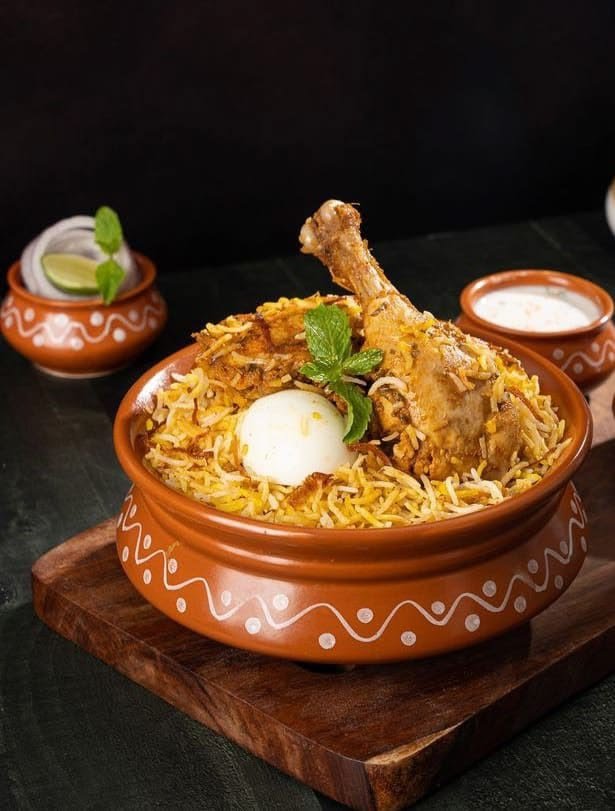
Dum biryani is the dish that appears most often at the centre of this kind of specific, unyielding craving. The preparation is meticulous enough — overnight marination, careful layering, sealed slow cooking across several hours — that any variation from the established method produces a perceptibly different result. Someone who has eaten a particular kitchen’s dum biryani enough times to know it in detail will notice immediately if something has been done differently. The dish is honest in exactly this way. It rewards precision and reveals any shortcut.
Haleem sits alongside it as an equally specific object of longing for those whose connection to it is personal and long-standing. The full-day simmer that turns mutton, broken wheat, and lentils into something unified and extraordinary is not something that can be approximated in less time. Nihari, shikampuri kebabs, patthar ka gosht, and marag each occupy specific places in the food memories of different people — and each of them is now available through Hungersate, ordered directly from the Hyderabadi kitchens that produce them to the standard that made them memorable in the first place.
What Makes an Intercity Order Actually Deliver on Its Promise
The difference between an intercity food order that resolves a specific craving and one that leaves a person slightly disappointed is almost entirely a question of how seriously the process is taken at every stage. Food prepared fresh for each individual order rather than drawn from a pre-made batch is the foundation. Packaging designed and selected specifically for multi-hour transit — thermally controlled, properly sealed, appropriate to the specific dish being sent — is what protects the preparation through the journey. And a careful, deliberate approach to which restaurants are included on the platform is what ensures the quality was worth protecting in the first place.
Hungersate has made each of these standards the basis of how it operates rather than an aspiration it works toward. The platform was built around the understanding that intercity food orders are not casual decisions — they are the result of specific, well-founded food memories and specific, well-founded expectations. Delivering against those expectations requires the same level of care and specificity that went into building them.
The Kitchen Waited. The Delivery System Finally Caught Up.
The Hyderabadi restaurants that Bengaluru residents have been carrying in their food memories have not changed. They are still making the same food, in the same way, with the same commitment to their own standards that built their reputations in the first place. What was missing was not quality at the source — it was a delivery infrastructure sophisticated enough to honour that quality across the distance between the two cities. Intercity food delivery has supplied that infrastructure. The craving that once required a train ticket now requires only an order. The kitchen is still in Hyderabad. The food just arrived in Bengaluru now.
Promote your articles nowCheck for details
Choose a promotion package
Choose a package below, scan the QR code and pay the displayed amount for 20 days.
After payment, email your article title and payment screenshot to info@yourneeds.asia. Once confirmation is received, one of our administrators will activate the promotion.

Choose where your promoted article receives extra visibility
Promotion changes presentation and placement for the selected period. It does not guarantee traffic, enquiries, search ranking or sales.
Priority visibility in the VIP Lounge, promoted shelves and highlighted article areas.
Top-style highlighting in article directories, homepage feeds and promoted article blocks.
Premium styling across supported article feeds, recommendations and directory placements.
Featured presentation in supported homepage, category, directory and related-article areas.
Build a stronger online presence for your business
Get Your Website for ₹15,000
Are you listed and don't have a website for your business? We can plan, design and launch a responsive website that makes your business easier to understand and contact.
Get My WebsiteSEO Starts from ₹10,000/Month
Improve how your business is presented across Google, local listings and AI-powered search results with ongoing SEO, content and authority-building work.
Improve My VisibilitySuggested Articles
View all articles
Best Tasting Sweet Potato Varieties: Which One Is the Sweetest?
Sweet potatoes are available in many varieties, each with its own balance of sweetness, texture, moisture, and flavor. Some varieties are naturally soft and…
How to Choose the Best Sweet Potato Variety for Your Needs
Sweet potatoes come in many varieties, and each one has different characteristics that make it more suitable for certain recipes, cooking methods, or food…
The Anniversary Dinner That Neither of Them Will Ever Forget
Anniversary dinners carry an expectation that grows heavier with each passing year. The first anniversary is forgiving — anything thoughtful feels significant simply because…
The First Order of Intercity Food to Bengaluru and the Silence That Followed It
There is a particular silence that good food produces — different from the silence of an empty room, different from the silence between people…
Latest Blog Posts
View all articles
ISO 27001 Procedures: A Complete Guide to Information Security Management
Information security has emerged as a significant aspect of current corporate processes. Companies process customer data, financial information, intellectual property, personnel data, and various…

New Flats in Pune City Guide | Real Estate Talk
Explore the New Flats in Pune City Guide 2026 from Real Estate Talk. Discover current residential developments, apartment configurations, pricing trends, amenities, connectivity, and…

LMPC Registration in India: Certificate Requirements for Importers, Packers and Manufacturers Under Rule 27
Every business that imports, packs or manufactures pre-packaged goods for sale in India must comply with the Legal Metrology law. The central requirement is…

How to Choose a Reliable Frozen Sweet Potato Fries Supplier?
Choosing the right frozen sweet potato fries supplier is an important decision for distributors, retailers, and foodservice businesses. A reliable supplier should provide consistent…
Ultimate Guide to Buying Frozen Sweet Potato Fries for Foodservice
Introduction Sourcing high-quality frozen sweet potato fries is an important part of successful foodservice operations. Restaurants, foodservice buyers, distributors, and brand managers need to…
From Madhapur Search to AI Discovery Best SEO Company Madhapur Done it right 2026
From Madhapur Search to AI Discovery: How YourNeeds.asia Builds a 360° SEO Visibility Engine for Local Businesses A customer looking for a business in…