
Published: |Last updated:
Listen to this article
Show Quick ReadConcise summary from this article
If there's one thing that separates a memorable intercity food delivery experience from a frustrating one, it's packaging. Not the logo on the box or the colour of the tape, but the actual, functional, food-safe packaging that determines whether what was prepared with care arrives with care. Packaging for intercity food delivery is a discipline in itself. It draws from food science, material science, logistics engineering, and practical experience. Getting…
Ask AI About This Article
Answers are limited to information in this article.
If there’s one thing that separates a memorable intercity food delivery experience from a frustrating one, it’s packaging. Not the logo on the box or the colour of the tape, but the actual, functional, food-safe packaging that determines whether what was prepared with care arrives with care.
Packaging for intercity food delivery is a discipline in itself. It draws from food science, material science, logistics engineering, and practical experience. Getting it right means understanding both the food you’re sending and the journey it’s about to take. Getting it wrong means spoilage, leakage, contamination, or a degraded eating experience — any of which can undo every other good decision made in the process.
This guide covers the most effective, proven safe packaging methods for intercity food delivery — the kind of knowledge that professional platforms like Hungersate have built into their operations and that anyone involved in long-distance food transport should understand.
The Foundation: Food-Grade Materials Only
The most basic but most important rule in intercity food delivery packaging is that every material that comes into contact with food — directly or indirectly — must be food-grade. This means materials that are certified safe for food contact, free from harmful chemicals, and resistant to the temperature ranges and moisture levels the food will be exposed to.
Non-food-grade materials can leach chemicals into food, absorb odours from the surrounding environment, or degrade under temperature changes in ways that compromise food safety. This includes the containers, the sealing tape, the inner liners, the absorbent pads, and the insulating materials.
Hungersate’s intercity food delivery packaging supply chain uses certified food-grade materials at every layer, from the inner food containers to the outer delivery boxes. This commitment to material safety is non-negotiable, regardless of the cost differential.
Layer 1 — The Primary Container
The primary container is the one that directly holds the food. For intercity food delivery, the primary container needs to meet several requirements simultaneously: it must be leak-proof, airtight or ventilated as appropriate for the food type, structurally rigid enough to withstand transit handling, and made from food-grade material.
For liquid and semi-liquid foods (gravies, soups, curries, stews): Rigid, airtight plastic containers with locking lids, or aluminium foil containers with crimped-and-sealed lids. These should be filled to approximately 80% capacity to allow for any expansion without forcing the seal open.
For dry and solid foods (rice, bread, baked goods, dry snacks): Containers with a small ventilation capability to prevent moisture buildup, but sealed enough to prevent external contamination. Kraft paper boxes with food-safe liners work well for dry foods.
For mixed dishes (a thali, a combination meal): Compartmentalised containers that keep different components separated while keeping them all within one sealed unit.
For frozen or refrigerated items: Vacuum-sealed pouches or airtight containers that can withstand the low temperatures of cold chain transit without cracking or warping.
Layer 2 — The Insulating Wrapper
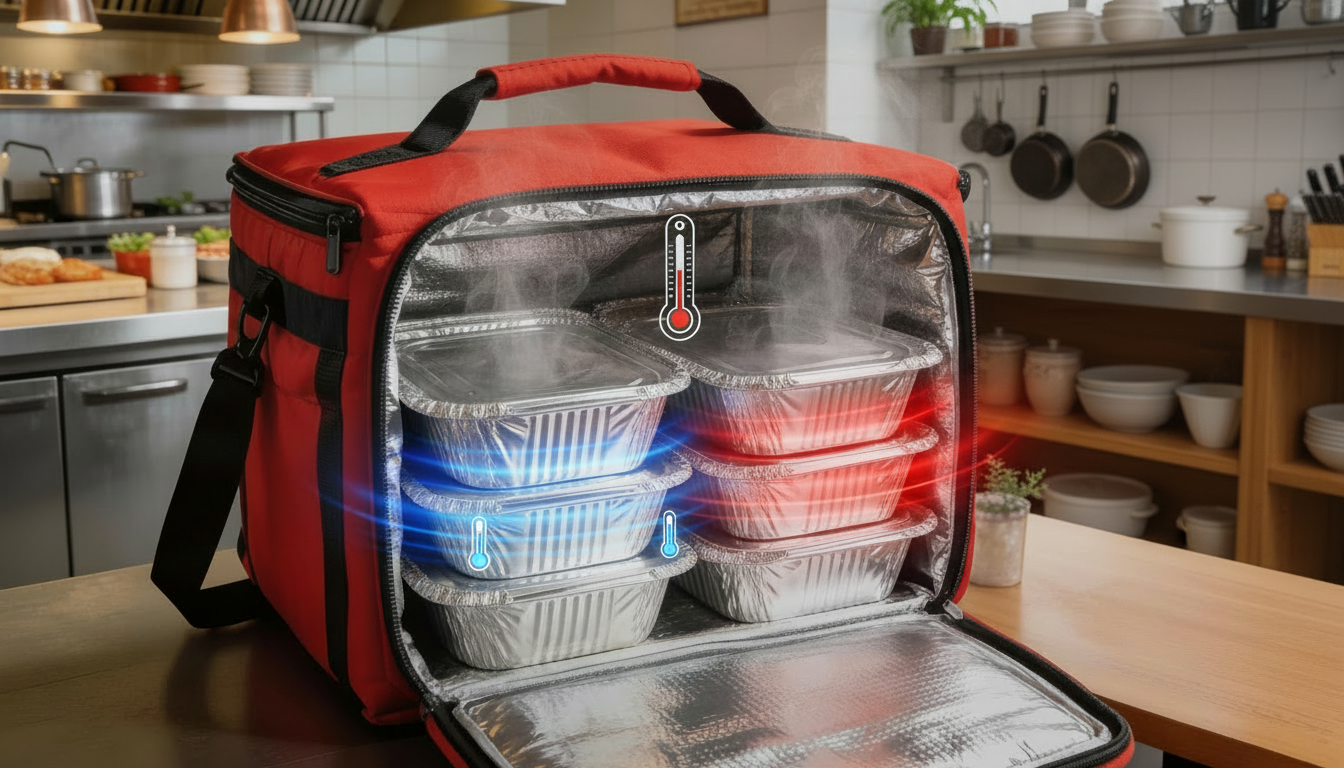
The second packaging layer is all about thermal management — maintaining whatever temperature the food needs to be at when it arrives. For hot food, this means retaining heat. For cold food, it means keeping the temperature down. For ambient foods, it means protecting against external temperature fluctuations.
Insulated foil pouches: These are highly effective for both hot and cold food. The foil reflects radiant heat, and the insulating inner layer creates a thermal buffer. For most intercity food delivery scenarios involving hot food, insulated foil pouches around the primary container provide excellent protection for transit windows up to five hours.
Gel ice packs or phase-change material packs: For cold items, gel packs or PCM packs placed around the primary container inside the insulating layer maintain low temperatures for extended periods. PCM packs are particularly effective because they maintain a specific temperature as they change phase rather than gradually warming.
Heat packs: For hot food in long transit windows, food-safe heat packs can be included to maintain temperature longer than passive insulation allows.
Hungersate selects the insulating wrapper type based on the specific food category, transit distance, and expected delivery window for each intercity food delivery order. This calibrated approach ensures that temperature is managed appropriately for the actual journey, not a generic estimate.
Layer 3 — The Outer Protective Box
The outer box in intercity food delivery packaging serves two functions: structural protection and additional insulation. It needs to be strong enough to withstand the stacking, vibration, and handling that come with long-distance logistics, and rigid enough to protect the inner packaging and food from compression.
Expanded polystyrene (EPS/thermocol) boxes: These are among the best outer containers for temperature-sensitive intercity food delivery. They provide excellent thermal insulation, are lightweight, and offer strong structural protection. Their one limitation is environmental — EPS is not biodegradable.
Multi-layer corrugated cardboard boxes: A strong, practical, and more environmentally friendly option. For ambient and dry food deliveries, double or triple-wall corrugated boxes provide adequate structural protection and some insulation.
Combination boxes: Some intercity food delivery packaging uses a corrugated outer shell with an EPS or insulated foil inner liner — combining the environmental and structural benefits of cardboard with the thermal properties of foam or foil.
Regardless of material, the outer box should be sealed with strong, waterproof tape on all seams. A box that opens in transit because of a weak seal is a packaging failure, regardless of how good everything inside it was.
Sealing and Labelling — The Often Overlooked Final Steps
Even the best packaging layers can be undone by poor sealing or absent labelling. For intercity food delivery, sealing and labelling are the finishing touches that complete the safety chain.
Sealing: Every container seal should be tested before packing. Lids should be locked, not just placed. Foil pouches should be fully crimped. Outer boxes should be taped on all six sides — top, bottom, and all four corners. For high-value or temperature-sensitive orders, tamper-evident sealing adds an additional layer of security and accountability.
Labelling: Food safety labels on intercity food delivery packages should include the contents of the package, the preparation date and time, the recommended consumption window, storage instructions (refrigerate immediately, consume within X hours), reheating instructions if applicable, and allergen information.
Clear labelling is not just a courtesy — it’s a food safety requirement. A recipient who doesn’t know that a dish needs refrigeration immediately upon receipt can unknowingly allow it to enter the temperature danger zone.
Hungersate includes comprehensive, food-safety-compliant labelling on every intercity food delivery package, ensuring that recipients have all the information they need to handle and consume the food safely.
Special Considerations for Different Food Categories
Different food types demand packaging customization:
Sweets and mithai: Individual piece-level wrapping inside the primary container prevents sticking and moisture transfer between pieces. Outer packaging should be rigid to prevent compression damage.
Fried and crispy items: These need ventilated packaging to release steam, preventing the moisture that turns crispy food soggy. Separate packaging from any wet components is mandatory.
Fresh bread and baked goods: Breathable packaging (kraft paper bags or ventilated containers) prevents condensation while maintaining softness.
Premium and gift food: Additional presentation packaging — a branded outer box with crinkle paper, for example — can enhance the delivery experience without compromising the functional food-safety packaging underneath.
Why Professional Intercity Food Delivery Packaging Is Worth It
There is always a cost difference between basic packaging and professionally engineered intercity food delivery packaging. And for individual senders trying to manage costs, it can be tempting to cut corners.
But here’s the thing: the cost of a failed delivery — in food waste, in disappointment, in reputation damage for businesses, in the loss of the moment that was being created — is almost always greater than the cost of proper packaging.
Hungersate’s packaging investment is visible in the quality and consistency of what arrives at the destination end. Their intercity food delivery packaging standards are not the cheapest option on the market — they’re the right option for food that matters.
And food, when it’s traveling across a city or a state to reach someone, always matters.
Promote your articles nowCheck for details
Choose a promotion package
Choose a package below, scan the QR code and pay the displayed amount for 20 days.
After payment, email your article title and payment screenshot to info@yourneeds.asia. Once confirmation is received, one of our administrators will activate the promotion.

Choose where your promoted article receives extra visibility
Promotion changes presentation and placement for the selected period. It does not guarantee traffic, enquiries, search ranking or sales.
Priority visibility in the VIP Lounge, promoted shelves and highlighted article areas.
Top-style highlighting in article directories, homepage feeds and promoted article blocks.
Premium styling across supported article feeds, recommendations and directory placements.
Featured presentation in supported homepage, category, directory and related-article areas.
Build a stronger online presence for your business
Get Your Website for ₹15,000
Are you listed and don't have a website for your business? We can plan, design and launch a responsive website that makes your business easier to understand and contact.
Get My WebsiteSEO Starts from ₹10,000/Month
Improve how your business is presented across Google, local listings and AI-powered search results with ongoing SEO, content and authority-building work.
Improve My VisibilitySuggested Articles
View all articles
Best Tasting Sweet Potato Varieties: Which One Is the Sweetest?
Sweet potatoes are available in many varieties, each with its own balance of sweetness, texture, moisture, and flavor. Some varieties are naturally soft and…
How to Choose the Best Sweet Potato Variety for Your Needs
Sweet potatoes come in many varieties, and each one has different characteristics that make it more suitable for certain recipes, cooking methods, or food…
The Anniversary Dinner That Neither of Them Will Ever Forget
Anniversary dinners carry an expectation that grows heavier with each passing year. The first anniversary is forgiving — anything thoughtful feels significant simply because…
The First Order of Intercity Food to Bengaluru and the Silence That Followed It
There is a particular silence that good food produces — different from the silence of an empty room, different from the silence between people…
Latest Blog Posts
View all articles
Emerging Business Opportunities That Are Shaping the Future Market
Due to continuous growth and development in the global economy, entrepreneurs are finding many ways to innovate, utilize advanced technology, and leverage strategic acquisitions…

ISO 20000 Manual: A Complete Guide to Modern IT Service Management
Current businesses rely on efficient IT services for the successful functioning of day-to-day operations, customer requirements, communications, and growth of their business. In the…

Amit Malhotra: Simplifying Forex Trading for a New Generation of Investors
A new generation of investors is entering financial markets faster than ever before, driven by digital access, social media exposure, and a growing curiosity…

Everyday Play for Children: 7 Powerful Ways to Build Life Skills
Children can benefit from simple play activities, such as working with blocks, drawing, and solving puzzles. Through play, children can explore their world and…

Seasonal Promotions for E-commerce: A Complete Guide to Planning, Marketing, and Growth
Seasonal promotions are one of the most effective ways for e-commerce businesses to increase sales, attract new customers, and create stronger engagement throughout the…

Inventory Management for Small Hospitals and Clinics in India: Where to Start and What to Automate
This is a condition most every small hospital and clinic in India have experienced: when a patient requires a medicine and the shelf is…