

Published: |Last updated:
Listen to this article
Show Quick ReadConcise summary from this article
If you run a product-based business in Lucknow and pay rent for your warehouse, there is a good chance you are paying GST on that rent every month. What fewer business owners know is that this GST does not have to be a permanent cost — it can be recovered through the Input Tax Credit mechanism, provided your business and the transaction meet the eligibility criteria. This blog explains GST…
Ask AI About This Article
Answers are limited to information in this article.
If you run a product-based business in Lucknow and pay rent for your warehouse, there is a good chance you are paying GST on that rent every month. What fewer business owners know is that this GST does not have to be a permanent cost — it can be recovered through the Input Tax Credit mechanism, provided your business and the transaction meet the eligibility criteria.
This blog explains GST on warehouse rent in simple language and gives you the step-by-step process for claiming ITC correctly.
Note: This is general guidance. Consult your tax advisor for advice specific to your situation.
GST on Warehouse Rent — The Basics
Renting of commercial property is a service under the GST law. When a GST-registered landlord rents out a warehouse, they are providing a taxable service and must charge GST at 18 percent on the rent. This is split as 9 percent CGST (Central GST) and 9 percent SGST (State GST) for same-state transactions within Uttar Pradesh, or 18 percent IGST for inter-state transactions.
The GST is charged on the total rent amount. It is the landlord’s obligation to collect this GST from the tenant and remit it to the government. The tenant — if GST registered — can claim the GST paid as Input Tax Credit, effectively getting the money back as a credit against their own GST liability.
Input Tax Credit — How It Works in Practice
ITC works like this: your business collects GST on its sales (output tax). Your business pays GST on its purchases and expenses (input tax). The ITC mechanism allows you to subtract the input tax from the output tax. You pay the government only the difference.
Warehouse rent GST is an input tax. Every rupee you pay in GST on rent reduces the net GST you owe to the government on your sales. For most businesses, this means the 18 percent GST on warehouse rent is effectively a neutral cost — it comes in through your rent payment and goes out through your GST liability reduction.
Full Step-by-Step ITC Claiming Process
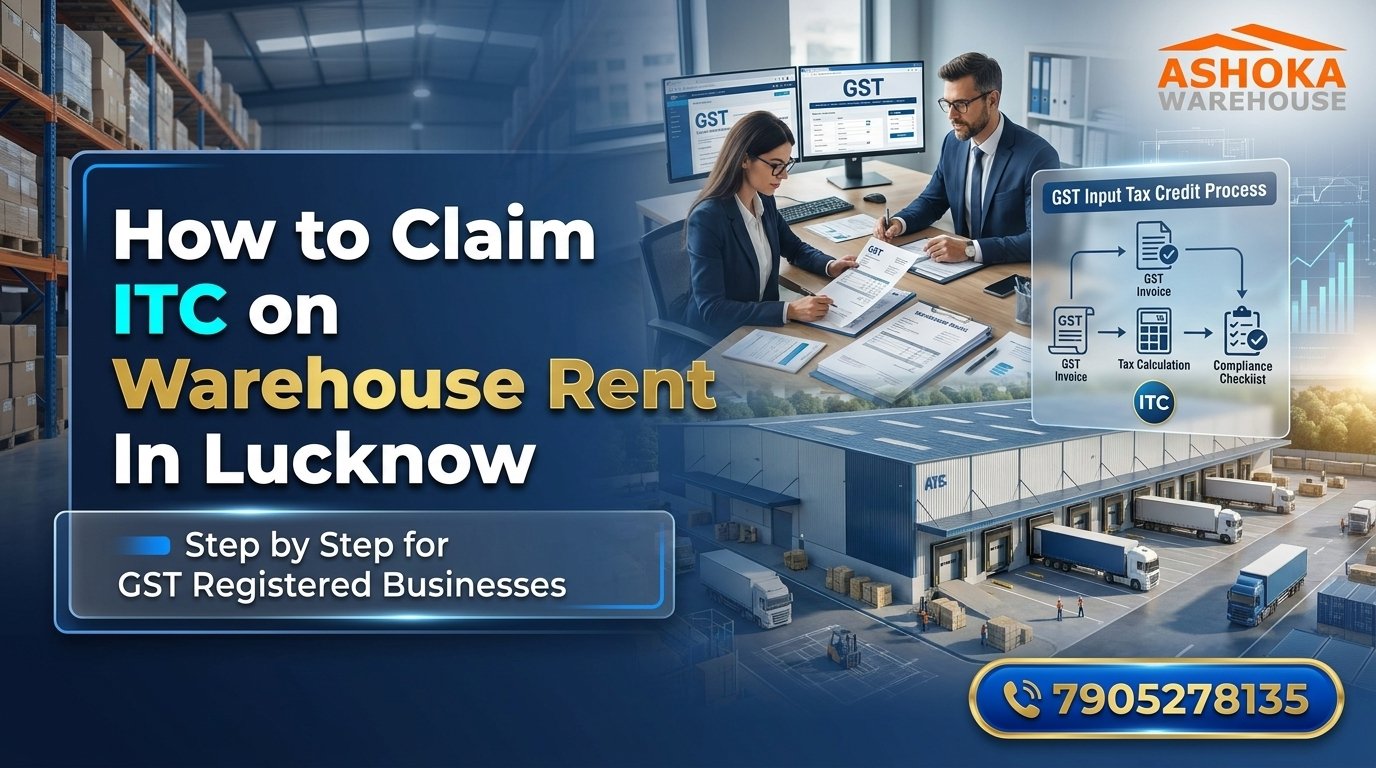
Step 1 — Get a Proper GST Invoice Every Month
This is the most important step and the one most commonly neglected. Ask your landlord to send a proper GST tax invoice at the beginning of each month or at the start of the billing cycle. The invoice must show: both parties’ GSTINs, the invoice number and date, the rent amount, the GST rate (18%), the GST amount split as CGST and SGST, and the total payable. Keep original invoices — physical or digital — as per your document management preference.
Step 2 — Verify the Landlord’s GSTIN on the Portal
Do a one-time check on gst.gov.in by searching the landlord’s GSTIN. Confirm the registration is active and the name matches. This simple check ensures you are not claiming ITC based on an invalid or cancelled GSTIN.
Step 3 — Pay the Invoice on Time
GST ITC claimed can be reversed if the corresponding invoice remains unpaid for more than 180 days. Pay your monthly rent invoices on time — ideally on the agreed rent date each month. Keep bank transfer confirmations as payment proof.
Step 4 — Check GSTR-2B Each Month
After the 14th of each month, log into your GST portal account and access GSTR-2B for the previous month. Look for your landlord’s invoice in the ITC available section. Verify the invoice number, date, taxable value, and GST amount match the physical invoice. If the entry is missing, contact your landlord to check their GSTR-1 filing.
Step 5 — Claim in GSTR-3B
In your GSTR-3B for the month, go to Table 4 and enter the eligible ITC amount as reflected in GSTR-2B. File GSTR-3B before the due date. Your ITC is set off against your output tax liability — reducing the net GST payable to the government.
Step 6 — Maintain a GST ITC Register
Maintain a simple register — spreadsheet is fine — tracking your monthly warehouse rent invoices, the GST amount on each, the GSTR-2B entry confirmation, and the GSTR-3B claim date. This register is invaluable during a GST audit and takes five minutes per month to update.
Lucknow Warehouse That Supports Clean ITC Claiming
Ashoka Warehousing on Sitapur Road NH-24 offers a 5,828 sq. ft. warehouse at Rs. 18 per sq. ft. — from a professional developer whose GST compliance is organized and reliable.
The monthly rent of Rs. 1,04,904 with Rs. 18,882.72 in GST at 18 percent gives eligible businesses a recoverable ITC of approximately Rs. 2.27 lakh per year. Combine this with the operational efficiency of the NH-24 location — direct highway access to Sitapur, Lakhimpur Kheri, Hardoi, Bareilly, and beyond — and this warehouse delivers measurable financial benefits on multiple fronts.
Ashoka Warehousing | 5,828 sq. ft. | Rs. 18/sq. ft. | NH-24 Sitapur Road Lucknow | GST-Compliant Developer | ITC-Eligible Invoicing | New Build | Move In Ready
For businesses that rely on smooth ITC claiming to manage their GST cash flow, a landlord who files their returns on time every month is not just convenient — it is financially important. Ashoka Warehousing’s professional management makes this one less thing to worry about in your monthly compliance routine.
ITC Claiming Errors and How to Avoid Them
- Claiming ITC before the invoice appears in GSTR-2B — wait for GSTR-2B before claiming
- Claiming ITC for invoices not paid — ensure payment before claiming, especially for any arrears
- Not reconciling physical invoices with GSTR-2B — discrepancies must be resolved before filing GSTR-3B
- Claiming full ITC when warehouse is partly used for exempt supplies — apportion using Rule 42 formula
- Not keeping original invoices — GST law requires invoice retention for six years
Why Ashoka Warehousing Is the Best Choice for Your Business
Ashoka Warehousing on Sitapur Road NH-24 makes the ITC process as clean as it can be for Lucknow businesses. The 5,828 sq. ft. newly constructed warehouse at Rs. 18 per sq. ft. is offered by a developer who understands the compliance requirements their tenants depend on. Correct GST invoicing, timely GSTR-1 filing, and organised lease documentation — these are the landlord-side requirements for smooth ITC claiming, and Ashoka Warehousing delivers them. The NH-24 highway location adds logistics value every day. And the combination of competitive rent and recoverable GST makes the true net cost of this warehouse genuinely attractive for eligible GST-registered businesses.
Famous Warehouse Locations in Lucknow
- Amausi Industrial Area — established airport-adjacent zone
- Chinhat Industrial Estate — Lucknow’s oldest and largest industrial zone
- Transport Nagar — primary goods hub
- BKT Road — newer industrial corridor
- Sitapur Road NH-24 — professional developers, GST compliance, best highway access
FAQ
Q. What is CGST and SGST and how do they apply to warehouse rent in Lucknow?
CGST (Central Goods and Services Tax) and SGST (State Goods and Services Tax) are the two components of GST for intra-state transactions — where both the supplier and recipient are in the same state. For warehouse rent in Lucknow, where both the landlord and tenant are in Uttar Pradesh, the 18 percent GST is split as 9 percent CGST collected by the central government and 9 percent SGST collected by the UP state government. The tenant claims ITC for both components — 9 percent CGST ITC and 9 percent SGST ITC — in their GSTR-3B.
Q. What if my landlord issues the invoice but does not deposit the collected GST with the government?
Under Section 16(2)(c) of the CGST Act as amended, ITC is available to the recipient only if the tax charged has actually been deposited by the supplier. If your landlord collected GST from you but did not deposit it, your ITC claim is at risk. You can check your landlord’s GSTR-3B filing status on the GST portal to confirm they are depositing tax regularly. This is another reason why renting from a professionally managed, GST-compliant property is important for ITC security.
Q. How is ITC on warehouse rent treated if I switch from a regular taxpayer to the composition scheme?
If your business switches to the composition scheme, you must reverse any ITC that was claimed on capital goods and inputs and services in stock as of the date of switching. You cannot claim any ITC under the composition scheme. This applies to warehouse rent ITC as well — any ITC on rent for periods after your switch to composition cannot be claimed. Plan this transition carefully with your CA to minimise the ITC reversal impact.
Promote your articles nowCheck for details
Choose a promotion package
Choose a package below, scan the QR code and pay the displayed amount for 20 days.
After payment, email your article title and payment screenshot to info@yourneeds.asia. Once confirmation is received, one of our administrators will activate the promotion.

Choose where your promoted article receives extra visibility
Promotion changes presentation and placement for the selected period. It does not guarantee traffic, enquiries, search ranking or sales.
Priority visibility in the VIP Lounge, promoted shelves and highlighted article areas.
Top-style highlighting in article directories, homepage feeds and promoted article blocks.
Premium styling across supported article feeds, recommendations and directory placements.
Featured presentation in supported homepage, category, directory and related-article areas.
Build a stronger online presence for your business
Get Your Website for ₹15,000
Are you listed and don't have a website for your business? We can plan, design and launch a responsive website that makes your business easier to understand and contact.
Get My WebsiteSEO Starts from ₹10,000/Month
Improve how your business is presented across Google, local listings and AI-powered search results with ongoing SEO, content and authority-building work.
Improve My VisibilitySuggested Articles
View all articles
Exploring More Flexible Ways to Trade Digital Assets
Digital asset platforms have changed a lot over the past few years. Spot trading is still widely used, but traders now have access to…

Salesforce Implementation Partner in UK | CRM FRONTIER |
Salesforce has become an important CRM platform for businesses looking to improve sales, customer service, marketing, and business operations. However, simply purchasing Salesforce licences…

Rudra Prime Mini – 25 HP Self‑Propelled Multi‑Attachments Machine for Construction & Utilities
The Rudra Prime Mini is a 25 HP diesel‑powered, self‑propelled multi‑attachments machine designed for urban infrastructure, rural utilities, and landscaping operations across India. Built…

How to Build a Target Account List for Chiropractic Practices in 2026
Reaching chiropractic practices effectively in 2026 requires more than collecting a large number of business contacts. Healthcare marketers need to identify practices that match…
Latest Blog Posts
View all articles
Flats for Rent in Hyderabad: Apartments, Tolet, Villas & Independent Houses 2026
Flats for Rent in Hyderabad: Apartments, To-Let Homes, Villas & Independent Houses – Complete 2026 Rental Guide Finding the right Flats for rent in…

Sara777 – Satta Matka Results and Chart Latest Records
Welcome to Sara777, an online platform created to provide easy access to Satta Matka results, charts, market records, and related information in one place.…

How to deposit on allpanel777?
Here is some steps to deposit on allpanel777 are:- Step 1: Start With Your Account To deposit, users should have an active AllPanel777 account.…

How Rhythm & Royalty Fitness Makes Dance Classes in Zirakpur Fun for Every Age Group
Dance has a unique way of bringing people together, no matter their age, fitness level, or experience. With everyone seeking a workout that doesn't…

Free JPG to PES Tools and Their Limitations
Turning a picture into an embroidery file sounds simple until you see what happens inside the machine. A JPG shows an image, while a…

Getting to Know Ciprofloxacin 500 mg: Uses, Safety and Important Information
[caption id="attachment_8302" align="alignnone" width="300"] Ciprofloxacin 500 mg: Understanding the basics in a simple way.[/caption] Ciprofloxacin 500 mg: Some Basic Points to Consider When one…