
Published: |Last updated:
Listen to this article
Show Quick ReadConcise summary from this article
Companies spend enormous budgets producing ads, emails, landing pages, and social content — yet a huge portion of that investment quietly leaks away for one simple reason: none of it feels like it's coming from the same brand. This isn't a creative problem. It's a coordination problem, and it has a name: the absence of Integrated Marketing. A Familiar Scenario A customer discovers a company through a sleek, confident Instagram…
Ask AI About This Article
Answers are limited to information in this article.
Companies spend enormous budgets producing ads, emails, landing pages, and social content — yet a huge portion of that investment quietly leaks away for one simple reason: none of it feels like it’s coming from the same brand. This isn’t a creative problem. It’s a coordination problem, and it has a name: the absence of Integrated Marketing.
A Familiar Scenario
A customer discovers a company through a sleek, confident Instagram ad. They click through, expecting more of the same, and land on a website that feels stiff and generic. A week later, they get a promotional email written in a completely different voice than the ad that first caught their attention. Then they call customer support with a question, and the tone there feels like a third, entirely different company.
Nothing here is technically wrong — each piece might even be well-made on its own. But together, they don’t add up to a coherent brand. That gap is where trust quietly erodes, and where potential customers slip away without anyone on the team ever quite understanding why. Leadership sees the ad performance numbers looking fine, the email open rates looking fine, the website traffic looking fine — yet conversions still lag. Inconsistency rarely shows up as a single bad metric. It shows up as a slow, distributed leak across the entire funnel.
What Integration Actually Means
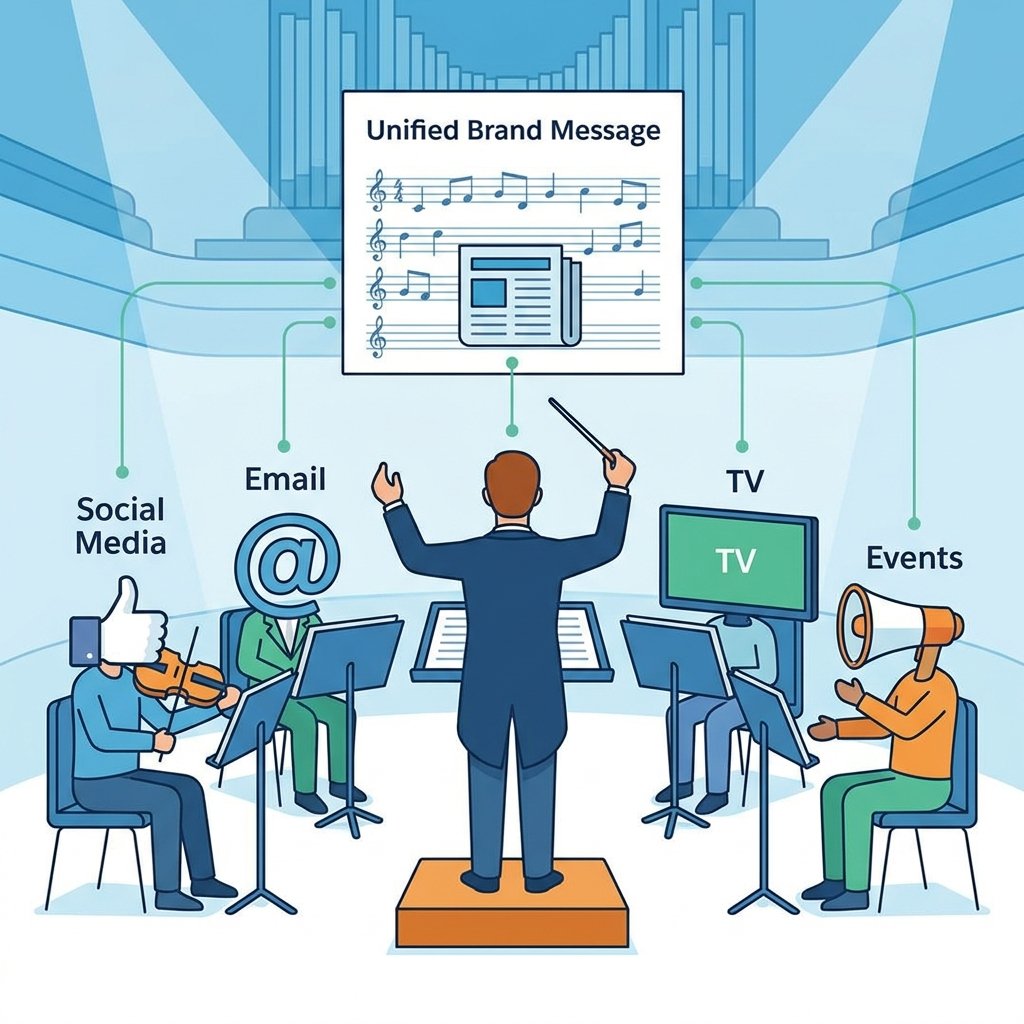
Integrated Marketing isn’t a buzzword for “using lots of channels.” Plenty of brands are technically present on every platform imaginable and still feel fragmented. Integration is the practice of designing every channel — ads, social, email, website, PR, even offline signage — around one shared message, tone, and visual identity, so a customer’s experience feels continuous no matter where they encounter the brand next.
The channels can look different on the surface; a billboard and an Instagram Story are never going to be identical formats, and they shouldn’t try to be. But the underlying voice, promise, and personality should be instantly recognizable across both. A customer should be able to see an unbranded screenshot of your content and still guess, with reasonable confidence, which company it came from.
Why This Is Harder Than It Sounds
If integration were simple, every brand would already be doing it. The difficulty usually comes down to organizational structure rather than creative ability. Social media, email marketing, paid ads, PR, and customer service are frequently run by different people, sometimes different departments entirely, often with different KPIs and different approval processes. A social media manager optimizing for engagement naturally gravitates toward a different tone than an email marketer optimizing for click-through rate on a promotional offer. Neither is doing anything wrong in isolation — but without a shared framework, their outputs drift apart over time.
Add in agencies, freelancers, and outsourced vendors who each bring their own creative instincts, and it becomes easy to see how a brand’s voice can splinter into five or six subtly different versions of itself within a single year, even with good intentions across the board.
The Practical Benefits
- Higher recall. A consistent message reinforced across multiple formats sticks in memory longer than one-off, disconnected campaigns. Repetition works, but only when what’s being repeated is actually the same idea.
- Smoother customer journeys. Buyers move from ad to website to email without ever feeling like they’ve landed somewhere unfamiliar, which reduces the hesitation that often kills conversions right at the final step.
- More efficient budgets. Creative direction, research, and messaging frameworks get reused intelligently instead of rebuilt from zero for every channel and every campaign.
- Better decision-making. Centralized data across channels makes it far easier to see what’s actually influencing conversions, rather than guessing from six separate dashboards that don’t talk to each other.
- Stronger internal alignment. When every department works from the same messaging framework, onboarding new hires, briefing agencies, and launching new campaigns all become faster and less error-prone.
Building It Step by Step
Getting to true integration usually starts with a clearly defined audience and a single core message everything else builds from. Skipping this step is the most common mistake — teams jump straight to channel tactics without first agreeing on what, exactly, they’re trying to say and to whom.
From there, it’s about selecting the right channel mix for that audience. Not every brand needs to be on every platform; integration is about coherence, not omnipresence. Once channels are chosen, budget and timing need to be coordinated across teams so that campaigns don’t launch in a staggered, disconnected way. Finally, performance should be reviewed holistically rather than channel-by-channel, so the team can see the full customer journey rather than isolated snapshots of each touchpoint.
None of this happens automatically. It requires deliberate planning and, often, breaking down walls between departments that have historically worked independently, sometimes even competitively, for budget and internal credit.
Signs Your Marketing Isn’t Actually Integrated
A few warning signs tend to show up consistently in brands that look integrated on paper but aren’t in practice: campaigns that launch on different dates across channels with no coordination; a brand voice guide that exists but is rarely referenced by any team outside of design; social media and customer support giving noticeably different answers to the same customer question; and marketing reports that are organized entirely by channel, with no view of the customer’s actual path across those channels. If several of these sound familiar, it’s usually less a sign of bad marketing and more a sign of missing coordination.
A Detailed Resource on the Topic
For anyone who wants a full walkthrough of this process — including real brand examples and a step-by-step approach to execution — Traditional Marketo has published a comprehensive guide worth reading:
👉 What Is Integrated Marketing? The Complete Guide
It covers the full arc from audience definition through execution and measurement, with real-world examples that make the concept easier to apply rather than purely theoretical.
Also Worth Checking
For a complementary perspective on structuring cross-channel campaigns, HubSpot’s guide to integrated marketing offers useful additional context and a slightly different framing of the same core ideas.
A Simple Starting Point
Teams that feel overwhelmed by the idea of overhauling their entire marketing operation don’t need to start there. A useful first step is picking a single upcoming campaign and mapping every channel it will touch, then writing down the one core message that campaign needs to communicate. Every piece of content, regardless of channel, gets checked against that single message before it goes live. Repeated consistently, this small habit does more to build integration over time than any large, one-time rebranding effort ever could.
In Short
Brand trust isn’t built in a single ad — it’s built in the sum of every interaction a customer has with a company, and whether those interactions feel like they belong together. Integrated Marketing is the discipline that makes that happen on purpose, rather than leaving it to chance across disconnected teams and channels. The Traditional Marketo guide is a strong place to start putting it into practice.
Promote your articles nowCheck for details
Choose a promotion package
Choose a package below, scan the QR code and pay the displayed amount for 20 days.
After payment, email your article title and payment screenshot to info@yourneeds.asia. Once confirmation is received, one of our administrators will activate the promotion.
Choose where your promoted article receives extra visibility
Promotion changes presentation and placement for the selected period. It does not guarantee traffic, enquiries, search ranking or sales.
Priority visibility in the VIP Lounge, promoted shelves and highlighted article areas.
Top-style highlighting in article directories, homepage feeds and promoted article blocks.
Premium styling across supported article feeds, recommendations and directory placements.
Featured presentation in supported homepage, category, directory and related-article areas.
Build a stronger online presence for your business
Get Your Website for ₹15,000
Are you listed and don't have a website for your business? We can plan, design and launch a responsive website that makes your business easier to understand and contact.
Get My WebsiteSEO Starts from ₹10,000/Month
Improve how your business is presented across Google, local listings and AI-powered search results with ongoing SEO, content and authority-building work.
Improve My VisibilitySuggested Articles
View all articles
What Is the Difference Between SEO and Digital Marketing?
SEO is an important part of digital marketing, but digital marketing covers a much broader range of online promotional activities. SEO focuses primarily on…

Multi-Branch Jewellery Stores How to Rank Each Location Separately
Managing a jewellery business with multiple branches creates significant opportunities for growth, but it also introduces new challenges when it comes to local search…

How Sponsorship Campaigns Drive Audience Engagement and Growth
Sponsorship Campaigns have become an effective way for businesses to connect with audiences, strengthen brand visibility, and support long-term growth. Instead of relying only…

How Intelligent Chatbots Drive Better Customer Engagement
Intelligent Chatbots are transforming the way businesses communicate with customers across websites, social media, messaging platforms, and digital services. Unlike traditional chatbots that follow…
Latest Blog Posts
View all articles
Why Should You Consider a Farmhouse in Naugaon for Weekend Getaways?
Busy schedules and crowded city neighbourhoods often encourage families to look for places where they can relax and spend quality time together. A countryside…

Buying Land in Goa for a Holiday Home or Permanent Residence
Buying land in Goa can support different lifestyle plans. Some people want to move to the state and build a permanent home. Others want…

How to Plan a Wedding at The Grand Marquee Karachi
Planning a wedding at a large venue involves more than choosing a beautiful stage and arranging dinner. The guest experience depends on how the…

Best ServiceNow ITSM Training in Hyderabad
From IT Support to Structured Service Modern organizations rely on efficient IT services to support daily operations. When employees face technical issues, need to…

Best Workday Finance Training in Hyderabad | Learn About Enterprise Finance
Understand Finance and Technology Financial management is being increasingly linked to enterprise software. Enterprises leverage technology to manage financial transactions and related business processes,…

How Can You Choose the Right Farmhouse in Naugaon?
Are you looking for a countryside property where you can enjoy open spaces, spend weekends with family, or explore long-term land ownership? Naugaon, located…