
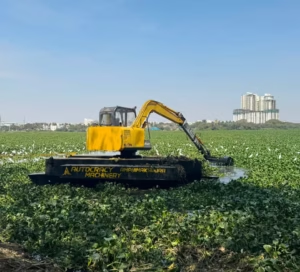
Wet-land excavtor
An amphibious excavator replaces tracks with pontoon-style floats that distribute weight across a much larger surface area. Lower ground pressure means the machine sits on top of soft material instead of cutting into it. Sealed hydraulic systems and marine-grade corrosion protection let it work in shallow water for extended periods rather than short, cautious bursts.
The practical effect on a desilting project is straightforward: the machine enters the canal or pond, works the full width and length of the waterbody, and comes out. No access road, no dewatering phase, no staged excavation from the banks.
The Rudra Amphimax 100EP from Autocracy Machinery follows this approach as an attachment for 6–10 tonne carrier excavators. A 3.8 m digging depth, 0.26 m³ bucket and 40–50 kW engine keep it in the range contractors already operate, so the carrier is familiar even if the undercarriage is not.
Where this equipment earns its cost
Aquatic weed removal is the clearest case. Prolific weed growth in lakes, temple tanks and irrigation ponds blocks flow, traps silt and reduces oxygen. Manual removal is slow and unsafe; a standard excavator cannot reach most of it. A pontoon-mounted machine can travel across the weed mat, cut and collect in passes, and clear a waterbody in days instead of months.
Canal and drain desilting is the highest-volume use. Silt removal restores flow capacity, and doing it without dewatering means the canal keeps functioning during the work. For irrigation departments and municipal bodies, that alone often justifies the machine.
Pond and reservoir dredging to restore storage volume, flood debris clearance, bio-mining of legacy waste ponds, and wetland restoration projects all involve soft, submerged ground where accessibility is the main constraint rather than digging force.