

The first time someone called an AI tool a “copilot,” I rolled my eyes. Another aviation metaphor from an industry that already gave us “growth hacking” and “north star metrics.” Two years later, I have to admit: it’s the most accurate label the marketing software world has produced in a decade.
I run paid campaigns for a living, and I’ve now spent enough hours working beside a performance marketing copilot to explain what the term actually means, where the metaphor holds, where it breaks, and how to tell a real copilot from a chatbot wearing the badge.
The Metaphor, Taken Seriously
Think about what an actual copilot does. They don’t fly a separate plane. They sit in the same
cockpit, see the same instruments, and share the same destination. They handle checklists,
watch for what the pilot misses, and speak up before a small drift becomes a problem. But the pilot in command makes the calls.
A performance marketing copilot works the same way. It sits inside your workflow, connected to the same ad accounts, dashboards, and data you look at, and it works with you in conversation.
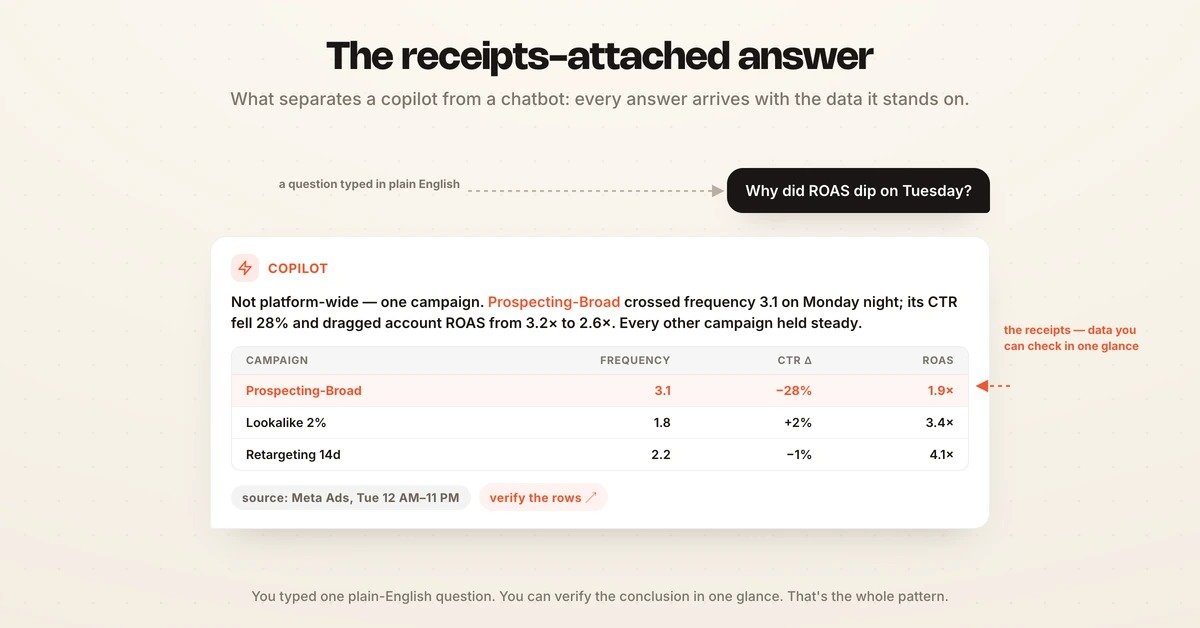
You ask why ROAS dipped on Tuesday; it pulls the numbers and tells you it was one campaign’s frequency problem, not a platform-wide issue. You’re planning next month’s budget; it drafts three allocation scenarios based on last quarter’s actuals. You’re staring at a losing ad; it tells you which element, hook, format, or audience, most likely dragged it down.
The command stays with you. That’s the defining trait, and it’s what separates a copilot from a fully autonomous agent that acts on its own schedule.
What a Real Copilot Actually Does All Day
After months of daily use, my copilot’s workload settles into four buckets.
It answers in seconds what used to take an hour. “Which creatives drove the most
conversions for the summer sale?” used to mean exporting, pivoting, and squinting. Now it’s a sentence, and the answer comes back with the data behind it.
It spots what I’d miss. Buried patterns, like a placement quietly eating budget or an audience segment fatiguing faster than the rest, surface in conversation instead of dying in row 400 of a spreadsheet.
It drafts, I decide. Campaign structures, test plans, copy variations, weekly report summaries.The first draft arrives done; my job becomes editing and judgment.
It remembers. Good copilots carry context across sessions: my targets, past decisions, what we tried in March and why it failed. That memory is what turns a Q&A tool into a colleague.

Where the Metaphor Breaks
Honesty matters in a guide, so here’s the other side. A copilot doesn’t fly the plane while you
sleep. If nobody opens the conversation, nothing happens. The analysis waits for your question. That makes copilots fundamentally different from autonomous performance agents, which monitor accounts and act within guardrails around the clock. The industry is converging on stacks that use both: the agent as the always-on operator, the copilot as the thinking partner. The moment this clicked for me was with Hawky’s copilot: I typed “why did ROAS dip on Tuesday?” and it came back naming one campaign’s frequency problem, with the actual account data it drew the conclusion from attached underneath. An answer I could verify in one glance, from a question I typed in plain English. That receipts-attached pattern, sitting alongside an agent that handles the always-on work, is what the category is converging toward: one tool extends your presence, the other extends your reasoning.
A copilot also inherits your blind spots. Ask it the wrong question and you’ll get a beautifully
argued answer to the wrong problem. It’s a force multiplier on your judgment, not a replacement for it.
How to Evaluate One
If you’re shopping, four questions cut through the noise.
Does it see your real data, live? A copilot disconnected from your ad accounts is just a chatbot with opinions. Does it show its work? Every answer should be traceable to numbers you can verify. Does it remember your context? Session amnesia is the tell of a thin wrapper. And does it fit your actual workflow: can it move from question to draft to action without you switching between six tabs?
Price matters less than trust here. The first week you catch a copilot confidently wrong is the
week you stop using it, so verify its answers early and often until it earns the benefit of the doubt.
Closing Thoughts: The Second Seat Was Empty
For most of my career, the second seat in my cockpit was empty. Every question, every export, every 11 p.m. “why is CPA up?” was mine alone. It isn’t anymore. The work didn’t disappear; the plane still needs flying, and the judgment calls still land on me. But there’s now something in the next seat that reads the instruments faster than I do and never gets tired of my questions. Once you’ve flown with a copilot, flying solo just feels
like an unnecessary risk.