
India’s Digital Personal Data Protection (DPDP) Act, 2023 has changed the way organisations need to approach personal data. Businesses that collect, use, store, share, or otherwise process digital personal data need appropriate processes and controls to manage their data protection obligations.
For organisations dealing with personal data across websites, mobile apps, CRM systems, databases, employee systems, branches, and third-party applications, managing privacy processes manually can quickly become difficult.
This is where DPDP compliance platforms can help. These platforms bring capabilities such as consent management, Data Principal request handling, data discovery, privacy workflows, governance, and audit records into a more structured environment.
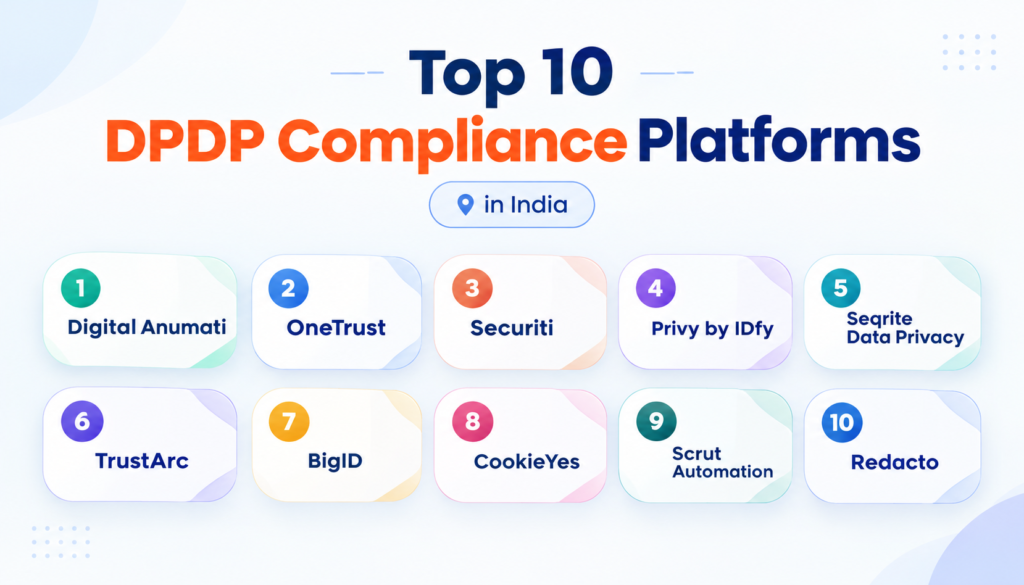
Here are 10 DPDP compliance and privacy platforms that organisations operating in India can consider.
1. Digital Anumati
Digital Anumati is an India-focused DPDP Compliance Platform designed to help organisations manage consent, privacy operations, and key requirements under India’s Digital Personal Data Protection framework.
The platform supports the complete consent lifecycle, including consent collection, purpose-based consent, preference management, withdrawal, and maintaining consent records. It also provides capabilities for Data Principal rights management, data discovery and mapping, grievance workflows, cookie and tracker management, and audit trails.
One of Digital Anumati’s notable capabilities is support for 22+ Indian languages, helping organisations provide consent and privacy experiences in languages that are easier for users across India to understand.
As a DPDP Compliance Platform, Digital Anumati also provides APIs, SDKs, plugins, and integration capabilities for connecting privacy and consent workflows with existing websites, applications, databases, CRM systems, and other enterprise infrastructure.
With a focus on sectors such as BFSI, healthcare, education, manufacturing, and other data-intensive industries, Digital Anumati is worth evaluating for organisations looking for an India-focused platform to manage consent, Data Principal requests, data governance, and broader DPDP compliance workflows.
2. OneTrust
OneTrust is a global privacy, security, and governance platform used by organisations to manage privacy programmes across multiple regulatory environments.
Its capabilities cover areas such as consent and preference management, privacy operations, data governance, assessments, risk management, and compliance workflows.
For multinational organisations operating in India as well as other jurisdictions, OneTrust can provide a broader framework for managing privacy requirements across different regulatory regimes.
3. Securiti
Securiti combines data privacy, security, governance, and data intelligence capabilities within a single platform.
Its technology helps organisations discover and understand personal and sensitive information distributed across databases, cloud environments, SaaS applications, and other enterprise systems.
This combination of data intelligence and privacy automation can be useful for organisations that need visibility into where personal data resides before implementing governance and privacy controls around it.
4. Privy by IDfy
Privy by IDfy is a privacy management solution aimed at helping organisations manage data protection and privacy operations.
Its capabilities include consent management and other privacy workflows relevant to organisations handling personal information.
Its focus on the Indian market makes it one of the platforms businesses can evaluate while developing their DPDP compliance programmes.
5. Seqrite Data Privacy
Seqrite Data Privacy is part of Seqrite’s broader cybersecurity and enterprise security portfolio.
The solution brings privacy and data protection capabilities alongside security-focused technologies, making it relevant for organisations looking to connect privacy management with their existing cybersecurity and information-security programmes.
For enterprises where privacy, security, and data protection teams work closely together, this type of integrated approach may be useful.
6. TrustArc
TrustArc is an established privacy management platform designed to help organisations manage privacy programmes, assessments, regulatory requirements, risk reviews, and related compliance activities.
It is particularly relevant for organisations operating across multiple jurisdictions where privacy teams need to monitor and manage requirements arising from several privacy regulations.
Companies with mature or multinational privacy programmes may consider TrustArc as part of their broader privacy management strategy.
7. BigID
BigID focuses heavily on data discovery, classification, privacy, security, and data intelligence.
The platform helps organisations understand where personal and sensitive data exists across databases, applications, cloud environments, and other repositories.
This visibility can provide an important foundation for privacy programmes because organisations need to understand what personal data they hold, where it resides, and how it is being used before they can effectively govern it.
8. CookieYes
CookieYes primarily focuses on website cookie consent and online tracking management.
Its capabilities include cookie consent banners, preference management, cookie scanning, and consent records. This makes it particularly relevant for organisations whose immediate privacy requirements involve managing cookies and tracking technologies across websites.
Businesses looking for broader enterprise privacy operations may need additional capabilities beyond cookie management, depending on their requirements.
9. Scrut Automation
Scrut Automation is primarily focused on governance, risk, compliance, and security compliance automation.
It helps organisations manage controls, evidence, risks, assessments, and compliance workflows through a central platform.
While its scope extends beyond data privacy, organisations developing a broader GRC programme may find value in connecting privacy requirements with their overall compliance and security operations.
10. Redacto
Redacto provides privacy and data protection capabilities aimed at helping organisations structure and manage privacy-related processes.
It can be considered by businesses looking to move away from fragmented or manual privacy operations and establish more organised workflows around personal-data management and compliance.
As with any privacy platform, organisations should assess its capabilities against their specific DPDP obligations, data environment, integrations, and operational requirements.
Why Businesses Need a DPDP Compliance Platform
Privacy compliance becomes increasingly difficult to manage manually as an organisation grows.
Personal data may enter the business through websites, mobile applications, customer portals, call centres, physical branches, CRM platforms, HR systems, payment systems, databases, and third-party applications.
A DPDP compliance platform can provide a central layer for managing and monitoring these activities.
Depending on the platform, organisations may be able to manage:
- Consent collection and consent records
- Consent withdrawal and preference management
- Data Principal requests
- Personal-data discovery and classification
- Data mapping
- Privacy and compliance documentation
- Cookie and tracker management
- Grievance workflows
- Compliance records and evidence
- Audit trails
- Privacy reporting and monitoring
The objective is not simply to automate compliance. It is to make privacy operations more structured, traceable, and manageable across the organisation.
Key Features to Look for in DPDP Compliance Software
There is no single DPDP platform that will be suitable for every organisation. The right solution depends on factors such as company size, industry, volume of personal data, existing technology, processing activities, and the maturity of the organisation’s privacy programme.
Here are some important capabilities to evaluate.
Consent Management
Where processing relies on consent, organisations need a structured way to collect, record, manage, and enable withdrawal of that consent.
A consent management system should also make it possible to maintain reliable records of consent choices and changes over time.
Data Principal Rights Management
Organisations need processes for receiving and handling applicable requests from Data Principals.
A privacy platform can help teams receive, assign, track, manage, and document these requests rather than relying entirely on emails, spreadsheets, or disconnected ticketing processes.
Data Discovery and Mapping
Knowing where personal data exists is fundamental to effective privacy management.
Data discovery and mapping capabilities can help organisations identify personal information across databases, applications, cloud infrastructure, files, and other systems and understand how that data moves through the organisation.
Audit Trails
Privacy activities should be traceable.
Audit trails can provide records showing when important actions took place, what changes were made, and how particular privacy workflows were handled.
These records can also make it easier for privacy, legal, security, and audit teams to review compliance activities.
Integration Capabilities
Privacy platforms rarely operate in isolation.
Look for APIs, SDKs, plugins, webhooks, and other integration options that can connect the platform with websites, mobile applications, CRM systems, ERP platforms, databases, HR systems, and other enterprise applications.
The easier the integration, the easier it becomes to embed privacy controls into existing business processes.
Multilingual Support
India is a linguistically diverse market.
For organisations serving users across different states and regions, multilingual consent notices and privacy experiences can help individuals understand the information presented to them and make informed choices.
Organisations operating at scale should therefore consider language capabilities when evaluating a platform.
Scalability
A privacy solution should be able to grow with the organisation.
Consider whether the platform can support increasing numbers of users, applications, consent records, Data Principal requests, data sources, integrations, departments, and business processes without creating additional operational complexity.
How to Choose the Right DPDP Compliance Platform
Before comparing vendors, organisations should first understand their own privacy environment.
Start by identifying what personal data you collect, why you collect it, where it is stored, which systems process it, who has access to it, and where it is shared.
Then evaluate platforms based on the capabilities you actually need.
For example, one organisation may primarily need consent and preference management, while another may require a broader combination of data discovery, Data Principal rights management, governance, assessments, and privacy automation.
The best platform is therefore not necessarily the one with the longest feature list. It is the one that fits your organisation’s privacy architecture, operational processes, integration requirements, and compliance objectives.
Conclusion
As Indian organisations collect personal data across websites, applications, customer systems, employee platforms, and other digital environments, privacy management is becoming an increasingly important operational function.
DPDP compliance platforms can help organisations bring consent management, Data Principal requests, data discovery, privacy workflows, governance, and compliance records into a more structured system.
Technology alone, however, does not create compliance.
Organisations also need appropriate policies, contracts, security safeguards, internal processes, governance, training, and accountability.
When evaluating a platform, start with your organisation’s actual data flows and privacy requirements. Then compare how effectively each solution can integrate with your existing environment and support your privacy programme over the long term.
FAQs:
Q1. What is a DPDP compliance platform?
A DPDP compliance platform is software that helps organisations manage privacy and data-protection activities such as consent management, Data Principal requests, data discovery, data mapping, privacy workflows, and compliance records.
Q2. Why do businesses need a DPDP compliance platform?
A platform can help organisations manage privacy processes more consistently and reduce their dependence on manual spreadsheets, emails, and disconnected workflows.
Q3. What features should a DPDP compliance platform have?
Important capabilities may include consent management, Data Principal rights management, data discovery and mapping, audit trails, integrations, privacy workflows, reporting, and governance.
The required features will depend on the organisation’s processing activities and privacy programme.
Q4. Is Digital Anumati a DPDP compliance platform?
Yes. Digital Anumati is an India-focused DPDP consent management and privacy compliance platform designed to support organisations with consent, Data Principal rights, data discovery, privacy workflows, and related DPDP requirements.
Q5. Can a DPDP platform manage consent withdrawal?
Yes. Platforms with consent management capabilities can provide mechanisms for individuals to withdraw consent and can help organisations record and manage those changes across connected systems.
Q6. Can DPDP platforms handle Data Principal requests?
Many privacy platforms provide workflows for receiving, assigning, tracking, and managing applicable Data Principal requests.
Q7. Do DPDP compliance platforms support multiple languages?
Some do. Multilingual support varies between platforms. This can be particularly important in India, where organisations may need to communicate privacy information to users across different linguistic regions.
Q8. Can a DPDP platform integrate with existing business systems?
Yes. Many privacy platforms provide APIs, SDKs, plugins, webhooks, or other integration methods for connecting with websites, applications, databases, CRM platforms, ERP systems, and other enterprise technologies.
Q9. Does using a DPDP compliance platform guarantee DPDP compliance?
No. A software platform can support and automate parts of a privacy programme, but compliance also depends on an organisation’s policies, processing practices, contracts, security measures, governance, employee awareness, and implementation.
Q10. How should businesses choose a DPDP compliance platform?
Start with your organisation’s actual privacy requirements. Compare platforms based on consent management, Data Principal rights, data discovery, integrations, scalability, multilingual support, deployment options, audit capabilities, and how well the technology fits your existing systems and processes.