
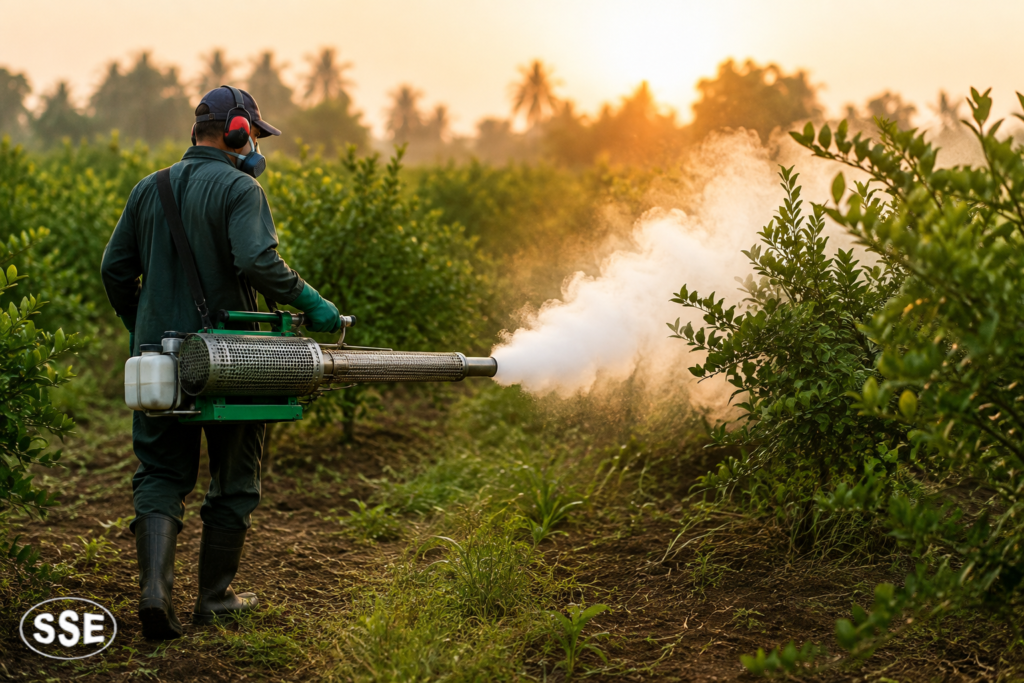
Farming isn’t just about growing crops. Farmers also have to protect what they grow — from insects, pests, and diseases that can hurt both the quality and quantity of a harvest.
Traditional sprayers have been the go-to method for years, used to apply pesticides and other crop protection products. They work well in a lot of cases. But when the area is large, or pests are hiding deep inside dense plants, spraying alone doesn’t always cut it.
That’s where a thermal fogging machine for agriculture comes in.
What Is a Thermal Fogging Machine?
At its core, it’s a machine that heats liquid pesticide until it turns into a fine fog — a bit like smoke moving through the air. That fog drifts on its own, settling on leaves, stems, and places a hand sprayer would likely miss entirely.
The droplets are so small and light that they end up covering far more ground than a regular spray ever could.
How It Actually Works
Inside a thermal fogging machine, the formulation is first heated and then carried through the machine’s hot airflow and when it exits into the cooler surrounding air, now it condenses into very small droplets, creating the visible fog. Those droplets move through the field on their own, drifting into thick crop cover and low spots that are otherwise hard to treat.
A backpack sprayer just can’t do this. It sprays wherever you point it, and that’s about it. Fogging goes further than that, and deeper too.
How Can Thermal Fogging Help Farmers?
The main advantage is how the fog spreads. A normal spray coats the crop directly. A thermal fogging machine creates finer droplets that travel through foliage and reach spots regular sprays often miss.
- Better reach inside dense crops. Fine fog moves through packed leaves and branches more easily, reaching pests hiding deep inside. Results still depend on the right product, dosage, and technique.
- Covers large areas faster. Fogging spreads mist over an area quickly, often using less spray mixture per hectare than traditional spraying — though this varies by machine and crop.
- Reaches difficult spots. Pests hiding deep inside plants are easier to treat with fine fog than with a regular sprayer.
- Cuts down manual work. Fogging machines, especially vehicle-mounted ones, reduce the need to carry equipment and refill tanks repeatedly. Machine size should still match farm size.
- Easier to see coverage. Since the fog is visible, operators can track and adjust the application path. It doesn’t guarantee perfect dosing, but it helps confirm where treatment is reaching. Wind and weather still affect how the fog moves.
Thermal Fogging vs Traditional Spraying
| Factor | Thermal Fogging Machine | Traditional Sprayer |
| Coverage area | Large, spreads through the air | Limited to where you point it |
| Reach | Gets under leaves and into tight gaps | Mostly covers exposed surfaces |
| Chemical usage | Often less liquid for the same area | Usually needs more liquid |
| Time needed | Faster for large fields | Slower, especially by hand |
| Weather sensitivity | Affected by wind and temperature | Less affected by wind |
| Best suited for | Big farms, recurring pest issues | Small areas, spot treatment |
| Equipment cost | Higher upfront investment | Generally lower cost |
Neither one wins in every situation. It really comes down to your farm size, the pest problem you’re dealing with, and what formulation you’re using.
Where It’s Commonly Used
Depending on the machine, formulation and approved application method, the thermal fogging can be used with different agricultural farm settings such as vegetable farms, orchards, protected cultivation areas and other pest-management environments. The specific applications should always follow the product labeled instructions and local agricultural guidance.
Bigger farms tend to see the bigger payoff here. Same with places where the same pest just keeps coming back, year after year, no matter what you try.
When Is a Thermal Fogging Machine Useful?
A thermal fogging machine for agriculture may be worth considering when:
- The crop has dense foliage.
- The target pest is difficult to reach.
- A suitable fogging formulation is available.
- A large area needs treatment.
- Fine aerosol distribution is appropriate for the application.
- The weather conditions are suitable.
- The product label specifically allows the intended method of application.
The machine should be used according to the pesticide label and local agricultural guidance.
It is also a good idea to consult an agricultural expert when there is uncertainty about the correct treatment.
What Should Farmers Check Before Buying One?
Look past price and appearance. Focus on these:
- Tank capacity — match it to your farm size
- Portability — lightweight for smaller farms, vehicle-mounted for larger ones
- Fog output — check it fits your actual application needs
- Maintenance — easy to clean, with spare parts and support available
A machine is only useful if it keeps running, so also confirm the manufacturer offers proper instructions and after-sales service.
Is It Right for Every Farm?
Depends, honestly. A small farm without a big pest problem probably doesn’t need one — a regular sprayer does the job fine. But once you’re dealing with more acreage, pests that won’t quit, or crops that are just a pain to treat by hand, that’s usually when fogging starts to make real sense.
Final Thoughts
Farming throws enough curveballs as it is. This machine isn’t going to fix everything, but it gives farmers one more way to actually get ahead of pests, instead of scrambling after the damage is already done.
At Sai Shree Enterprises, we’ve spent years building fogging machines for real farm conditions, not just lab settings. If you’re weighing whether fogging makes sense for your farm, our team’s happy to talk it through with you.