
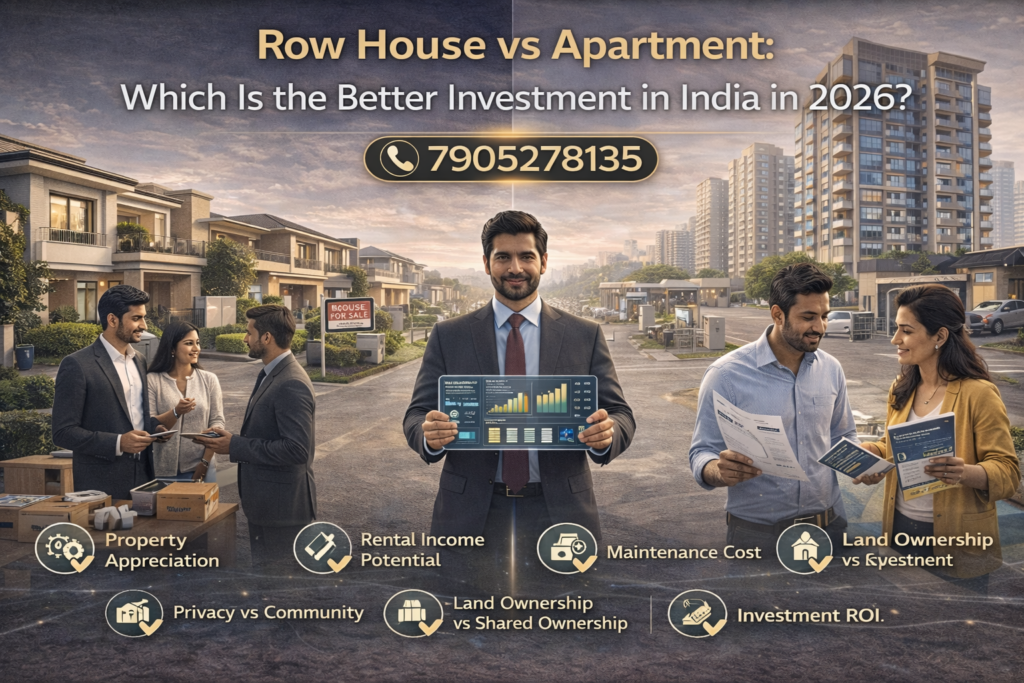
You Are Buying Your First Home. Everyone Has an Opinion. Here Is the Simple Truth.
When you start looking at property for the first time, everyone has strong opinions. Your parents say buy an independent house. Your colleagues say buy a flat with a gym and pool. Your broker shows you both. You end up confused.
Here is the simple version: a row house and an apartment are both good options — but they are very different experiences of owning a home. This guide breaks down the differences simply so you can figure out which one matches what you actually want.
The 5 Most Important Differences — Simply Explained
1. What You Actually Own
Row house: you own the land and the building. The ground is yours. The structure from basement to roof is yours. Nobody lives above you, nobody below you.
Apartment: you own the flat. You share the land with all other flat owners in the building. People live above you and below you.
2. Monthly Costs Beyond Your EMI
Row house: beyond your home loan EMI, you only maintain your own structure. No monthly society charge. Basic annual maintenance averages ₹15,000 to ₹25,000 per year.
Apartment: you pay monthly society maintenance charges on top of your EMI. This ranges from ₹2,000 to ₹6,000 per month depending on the complex. Over 10 years, this adds up to ₹2.4 to ₹7.2 lakhs in charges.
3. Freedom to Modify Your Home
Row house: you can paint it any colour, renovate any room, build a small porch, or add a floor later — subject to local permission. It is your structure.
Apartment: you can repaint inside and change flooring. You cannot change the structure, the balcony, the windows facing outside, or anything that affects the building’s look. Society rules apply to everything.
4. Lifestyle and Neighbours
Row house: your neighbours are to your left and right but not above or below. Less noise from neighbours. More privacy. If you have children or elderly parents, this difference is felt every single day.
Apartment: people above you, below you, and to both sides. Shared lifts, lobbies, staircases. The building is a community — which suits some people and frustrates others.
5. Price and What You Get
In Tier-2 cities like Lucknow, Jaipur, and Nagpur — a 2BHK row house and a 2BHK apartment in similar areas can be surprisingly close in price. The row house often costs less because it is in a developing area, while the apartment may cost more because of the amenities (pool, gym, clubhouse) included — amenities you pay for whether you use them or not through monthly maintenance charges.
A Simple Decision Test
| ✅ Answer These 5 Questions Honestly
1. Do you have elderly parents or young children at home? If yes — a row house is usually better. 2. Do you value privacy and quiet above amenities? If yes — row house. 3. Do you want a gym, pool, and building security without managing it yourself? If yes — apartment. 4. Are you in a metro city where row houses are very expensive? If yes — apartment may be the only affordable choice. 5. Are you buying to rent it out in the first few years? If yes — row houses give slightly better net yield. |
A Real Affordable Option Worth Knowing About
| 🏠 ASHOKA DEVELOPER — LUCKNOW
Affordable 2BHK Independent Row Houses — Ashok Vihar Colony, Faizullaganj 📐 Size: 750 sq ft — Smart layout with spacious living/dining, well-ventilated bedrooms & contemporary kitchen 💰 Price: Under ₹36 Lakh — Durable quality construction, genuine long-term value 📍 Location: Faizullaganj, Lucknow — peaceful, well-connected, growing neighbourhood 🏡 Type: Independent row house — no shared walls above/below, no society charges, no lift maintenance fees 👨👩👧 Best For: First-time buyers · Young families · Investors seeking rental income · Anyone wanting an independent home under ₹36 Lakh in Lucknow |
If you are a first-time buyer in Lucknow looking for your first home under ₹40 lakh, Ashoka Developer’s row houses in Faizullaganj are worth visiting before you make any decision. At under ₹36 lakh for a proper 750 sq ft 2BHK independent house, with quality construction, a smart layout, and a well-connected growing neighbourhood — this is the kind of first home that gives you real ownership (land + structure), zero society charges, and a home you can actually modify and personalise as your family grows. Many first-time buyers visit expecting a compromise at this price point and leave pleasantly surprised by what a quality developer delivers at the affordable end of the Lucknow market.
FAQs for First-Time Home Buyers
Q: Is it better to buy a smaller row house or a bigger apartment at the same price in India?
This is a great question that many first-time buyers face. At the same price, a row house may offer less carpet area than an apartment but it gives you more: land ownership, independence, no society charges, and the ability to extend later. An apartment at the same price may offer more square footage but within a shared building with monthly charges and no personal outdoor space. The right choice depends on your priorities: if living space is the main concern, the apartment wins. If independence, privacy, and long-term flexibility are priorities, the row house wins at the same price. For most Indian families buying for the long term, property consultants increasingly recommend the independent house option when both are available at a comparable price — because the land ownership advantage compounds significantly over 10 to 15 years.
Q: What documents should I check before buying a row house in India?
Before buying any row house, check these documents: Title deed (confirms the seller owns the land and property), Approved building plan from local authority (confirms the structure is legally built), Occupancy or Completion Certificate (confirms the building has been inspected and approved for occupancy), Encumbrance Certificate for the last 15 years (confirms no existing loans, mortgages, or legal cases on the property), No-objection certificate from local body for water/drainage connections, Property tax receipts (confirms taxes are paid up to date), RERA registration number if the project is under the Real Estate Regulation Act. If buying from a developer, also check their construction quality credentials and past completed projects. A property lawyer reviewing these documents charges ₹3,000 to ₹10,000 and is very well spent.
Q: What is RERA and should the row house I am buying be RERA registered?
RERA stands for Real Estate (Regulation and Development) Act. It is India’s property regulation law that protects home buyers from delays, fraud, and misleading advertisements by developers. Any residential project with more than 8 units or more than 500 sq metres of land must be registered with RERA. For a row house project in UP, check the UP RERA website (up-rera.in) and search for the developer’s project. A RERA-registered project gives you: a committed delivery date that the developer must meet, transparency on project specifications, an escrow account where your money is protected, and a grievance mechanism if the developer defaults. Always prefer a RERA-registered project for any new purchase — it is your legal protection as a buyer.