
Audit Trail Enforcer
When organizations move to SAP S/4HANA Cloud, logging and audit trails often become closely connected. Security teams need SAP logs available for monitoring, retention, or SIEM integration, while audit and compliance teams need assurance that required audit controls remain enabled and operational.
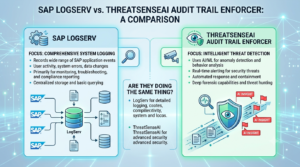
This can make SAP LogServ and ThreatSenseAI Audit Trail Enforcer appear to solve the same problem. They do not.
The key difference is simple: SAP LogServ focuses on collecting and delivering logs, while Audit Trail Enforcer focuses on maintaining a defined audit logging control.
What Does SAP LogServ Do?
SAP LogServ is primarily a log collection and delivery service. It helps make applicable logs from SAP Cloud environments available to customer destinations, such as file storage or SIEM platforms.
For organizations using SAP S/4HANA Cloud, Private Edition, this provides an important layer of the security architecture. Relevant SAP telemetry can be collected and delivered for security monitoring, operational analysis, investigation, and other customer requirements.
However, log collection does not automatically mean that every required audit mechanism is enabled.
If an audit logging mechanism is disabled, there may be no corresponding events for a log collection service to capture. Therefore, log availability and audit-control enforcement are separate requirements.
What Does Audit Trail Enforcer Do?
ThreatSenseAI Audit Trail Enforcer starts with a different question:
Is the required audit logging control actually enabled and being maintained?
Audit configurations can change over time because of administrative activity, system changes, or configuration updates. A one-time implementation check may therefore not be sufficient for organizations that depend on continuous audit controls.
Audit Trail Enforcer is designed around this control requirement. It helps continuously check the relevant audit logging state and enables required database-level DDL and DML logging for defined control objectives.
This makes it particularly relevant to organizations addressing audit and compliance requirements such as MCA Audit Trail Rule 11(g). The technology supports the control, while the organization’s finance, audit, compliance, and legal teams remain responsible for determining regulatory applicability and compliance interpretation.
The distinction is important because a successful SIEM integration does not prove that the required audit mechanism is enabled.
For example, an organization may successfully send SAP events to its SIEM through LogServ. But if a required database audit configuration has been disabled, the SIEM cannot receive events that were never generated. Audit Trail Enforcer addresses this control gap by focusing on the state of the audit mechanism itself.
Why Can Audit Trail Enforcer Generate Less Log Volume?
Audit Trail Enforcer is not intended to become another general-purpose telemetry or SIEM platform. Its focus is database-level DDL and DML auditing for defined control objectives.
Consequently, it can produce a narrower and potentially lower-volume audit stream than broad application or infrastructure logging. This does not mean lower control value. It reflects a different purpose.
Application logs, database logs, identity events, infrastructure telemetry, and network events can all contribute to a comprehensive SOC monitoring strategy. A focused database audit control serves a different compliance objective.
Can They Work Together?
Yes. In fact, they can complement each other.
A typical architecture could look like:
SAP S/4HANA Cloud → SAP LogServ → Customer Storage/SIEM → SOC Monitoring
Alongside:
SAP/HANA Audit Control → Audit Trail Enforcer → Continuous Control Validation and Enforcement
LogServ supports telemetry delivery, the SIEM supports correlation and investigation, and Audit Trail Enforcer supports the defined audit-control requirement.
Conclusion
SAP LogServ and ThreatSenseAI Audit Trail Enforcer are not replacements for each other.
LogServ helps move and deliver applicable SAP logs. Audit Trail Enforcer helps ensure that required audit logging is enabled and governed.
The better question is therefore not, “Which product replaces the other?” but rather, “What security, operational, or compliance requirement are we trying to satisfy?”
Once those responsibilities are separated, the architecture becomes clearer—and both technologies can potentially serve complementary roles within an SAP security and compliance strategy.
Read exciting blog SAP LogServ vs. ThreatSenseAI Audit Trail Enforcer: Are They Really Doing the Same Thing?