
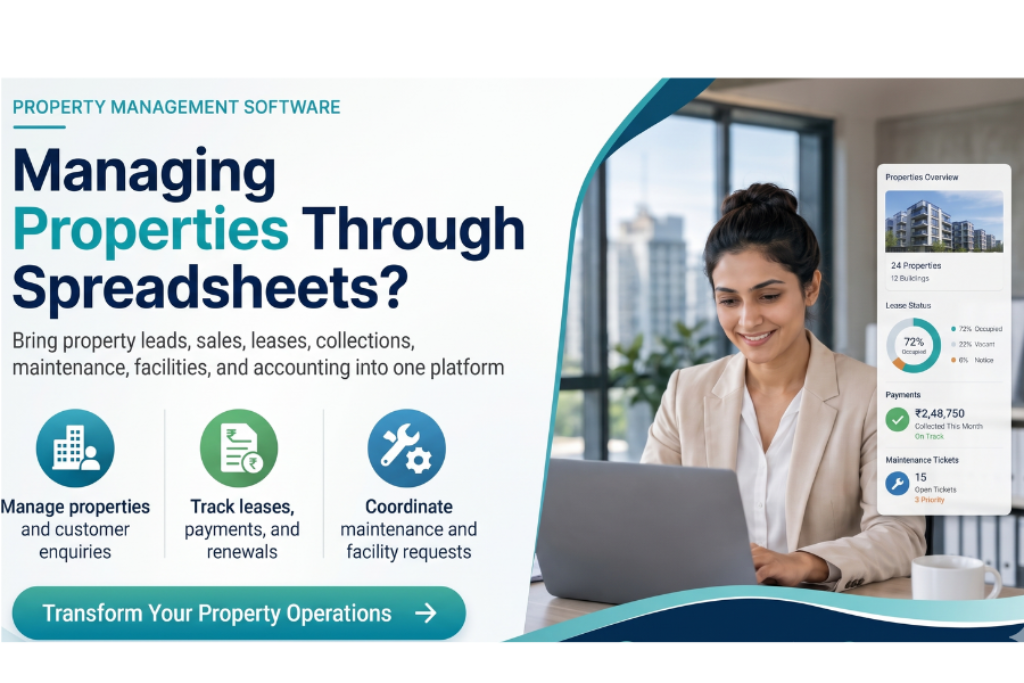
Managing rental properties in the UAE involves coordinating tenants, rental payments, lease agreements, maintenance activities, and financial records. For landlords with a few apartments, these responsibilities may be manageable through spreadsheets and calendars. For property management companies overseeing multiple buildings, however, disconnected records can create delays, missed deadlines, and unnecessary administrative work.
Property management software in UAE helps landlords and property managers organise these activities through a central digital system. Depending on the platform, it can support tenant management, rent tracking, lease renewals, maintenance requests, document storage, and property-level reporting.
However, choosing the right solution requires more than comparing feature lists. Individual landlords, residential property managers, and companies handling commercial portfolios have different operational needs.
This guide explains how property management software works, which features matter most, how UAE tenancy procedures affect software selection, and what to consider before implementing a system.
What Is Property Management Software?
Property management software is a digital platform designed to help property owners and management teams organise rental operations and property-related information.
Instead of maintaining separate spreadsheets for tenants, contracts, rent payments, maintenance expenses, and renewal dates, users can manage these records within a connected system.
Depending on the software, common capabilities include:
- Property and unit record management
- Tenant information and communication tracking
- Rental invoicing and payment monitoring
- Lease agreement and renewal management
- Maintenance requests and contractor coordination
- Expense tracking and financial reporting
- Document storage and automated reminders
The objective is to establish consistent processes, reduce repetitive administration, and make important information easier to access.
For UAE businesses, the selected platform should also fit the relevant tenancy procedures, documentation requirements, and existing financial workflows.
Why Landlords and Property Managers in UAE Need Property Management Software
Rental administration becomes more complicated as the number of properties, tenants, and transactions increases.
Consider a property manager responsible for 75 apartments. Each unit may have a different rental amount, payment schedule, tenancy agreement, maintenance history, and renewal date. Keeping every detail accurate through separate files requires time and consistent follow-up.
A centralised system can help address several common problems.
1. Disconnected Property Records
When property details are stored across spreadsheets, emails, and folders, retrieving information can become unnecessarily difficult.
Property management software provides a structured way to organise units, tenant details, agreements, and related documents. Authorised employees can retrieve the information they need without searching multiple locations.
2. Manual Rent Tracking
Landlords need to distinguish between expected rental payments, amounts received, and outstanding balances.
A rental management system can maintain payment histories and, where supported, generate invoices and reminders. This helps property managers identify transactions that require follow-up.
3. Missed Lease Renewals
Every tenancy agreement has specific terms and dates that require attention. Without reliable reminders, renewal discussions and document preparation may begin too late.
Lease tracking features can highlight upcoming expiry dates and help teams plan their work in advance.
4. Uncoordinated Maintenance
Repair requests may arrive through phone calls, emails, or messaging applications. Without a common tracking process, some requests may remain unresolved longer than necessary.
A maintenance workflow can record reported problems, assign responsibilities, monitor progress, and retain a history of completed work.
5. Limited Financial Visibility
Property owners need to understand rental income and property-related expenses. When financial records are maintained separately for every unit, comparing performance across a portfolio becomes more difficult.
Property-level reporting can help consolidate available information and support more informed decisions.
Essential Features to Look for in Property Management Software in UAE
Not every platform offers the same capabilities. Before choosing one, identify the features that solve your current operational problems.
Property and Unit Management
The software should allow users to organise properties, units, occupancy information, ownership details, and relevant documents.
For landlords with several properties, filters and consolidated dashboards can make it easier to review information across the portfolio.
Property management companies may also need separate records for different owners, buildings, and management agreements.
Tenant Management
Tenant management features should support contact information, tenancy records, agreement documents, communication histories, and relevant payment information.
These records help managers respond to enquiries, review tenant histories, and coordinate administrative tasks.
For businesses handling sensitive tenant information, role-based access controls are particularly important. Employees should have access only to the records required for their responsibilities.
Rental Billing and Payment Tracking
Rental management software should make it easy to record expected payments, monitor payment status, and review outstanding balances.
Depending on the platform, it may also support rental invoices, automated reminders, and integrations with payment providers or accounting systems.
Before subscribing, verify whether online payment collection is included or whether the system only records transactions completed through other channels.
Lease and Contract Management
Lease management features help organise agreement terms, rental amounts, commencement dates, expiry dates, and renewal reminders.
Property managers should be able to identify upcoming renewals without reviewing every contract individually.
For portfolios with different lease arrangements, confirm that the software can accommodate the required contract details and reporting workflows.
Maintenance and Vendor Management
Maintenance features should support issue logging, task assignment, priority setting, progress tracking, and completion records.
Vendor management may also be useful for companies coordinating multiple contractors across several buildings.
A maintenance history can help identify repeated repairs and track associated expenses over time.
Financial Reporting and Integrations
Property owners may need reports covering rental income, maintenance costs, outstanding payments, and other recorded expenses.
A suitable system should provide reports relevant to the business and support integration with existing accounting tools where necessary.
Avoid assuming that every property management platform includes full accounting functionality. Confirm the available modules and integration capabilities with the provider.
Property Management Software for Landlords vs. Property Managers
Although landlords and professional property managers use similar tools, their requirements can differ significantly.
For Individual Landlords
Individual landlords often need a simple way to manage a limited number of properties. Their priorities may include:
- Tracking rent and payment dates
- Maintaining tenant records
- Organising tenancy agreements
- Receiving lease renewal reminders
- Recording maintenance costs
For a landlord managing two or three apartments, a straightforward system may be sufficient. Paying for complex approval workflows or advanced portfolio analytics may offer little practical value.
For Property Management Companies
Property management companies typically coordinate activities across multiple properties, owners, employees, and contractors.
They may require:
- Multi-property and multi-unit dashboards
- Employee roles and access permissions
- Management agreement tracking
- Centralised tenant communication
- Maintenance assignment and monitoring
- Consolidated financial reports
- Integration with accounting and business systems
The key difference is operational complexity. A system suitable for one landlord may become restrictive when multiple employees need to manage hundreds of rental units.
UAE Tenancy Requirements: What Software Users Should Know
Property management software can help organise documents and rental administration, but it should not automatically be treated as a replacement for official tenancy registration.
In Dubai, tenancy contracts are registered through the Dubai Land Department’s approved channels, including the Ejari system and relevant digital services. The department provides official processes for registering and renewing tenancy contracts.
Landlords and property managers can review the Dubai Land Department’s tenancy registration and renewal service to understand the applicable procedures. <Cite refs={[“turn367320search0″,”turn367320search1”]}/>
Requirements also differ between emirates. The UAE Government’s official guidance explains that tenancy contracts are registered with the relevant authority in each emirate. Dubai uses the Dubai Land Department’s system, while Abu Dhabi and Sharjah have their respective tenancy-registration procedures. <Cite refs={[“turn367320search4”]}/>
Before choosing software, verify the following:
- Whether the system stores the tenancy documents your business requires
- Whether it supports reminders for important contract dates
- Whether a claimed government-system integration is available and authorised
- Whether additional steps are required through official channels
- Whether the software supports the emirates where your properties are located
A document-storage feature is not the same as an official registration integration. Confirm this distinction before relying on any platform for compliance-related workflows.
How to Choose the Best Property Management Software UAE Businesses Can Use
Searching for the best property management software UAE providers offer is only the beginning. The right choice depends on portfolio size, operational requirements, budget, and the software’s actual capabilities.
Step 1: Identify Your Requirements
List the properties and units you manage, the number of users, the types of rental agreements, and the tasks that currently consume the most time.
For example, a landlord struggling with lease renewals should prioritise contract tracking. A management company dealing with repeated maintenance delays should focus on work-order assignment and progress monitoring.
Step 2: Separate Essential Features from Optional Ones
Create two lists: features your business cannot operate without and features that would be useful later.
This prevents you from paying for functionality that does not solve an immediate problem.
Step 3: Compare the Total Cost
Review subscription charges, implementation, data migration, additional modules, user limits, integrations, and ongoing support.
A low starting price may become expensive if essential capabilities require separate subscriptions.
Step 4: Test Real Workflows
Request a demonstration and test common tasks using realistic scenarios.
Can your team locate a tenancy agreement quickly? Can it identify overdue payments? Can it assign a repair request and track completion? Can it produce the financial report you need?
These tests are more useful than relying solely on a vendor’s feature list.
Step 5: Check Security and Data Portability
Review access controls, backup policies, document security, and the process for exporting your records.
Your business should be able to maintain access to essential property information if you change software providers.
Step 6: Evaluate Support and Implementation
Ask how the provider handles onboarding, training, technical issues, and system updates.
A platform with suitable features can still underperform if employees are not trained or existing records are migrated incorrectly.
How PACT REVENU Fits into the Evaluation Process
When reviewing property management platforms, landlords and real estate businesses should consider how rental administration connects with their wider operational and financial processes.
PACT REVENU provides property management software information through its property management solution page.
For businesses evaluating the platform, relevant questions include whether the available features support their tenant and lease records, rental administration, maintenance workflows, and reporting requirements.
The evaluation should be based on the actual deployment and the needs of the business. Landlords should confirm current feature availability, pricing, implementation requirements, integrations, and support arrangements before making a decision.
This approach also applies when comparing PACT REVENU with other vendors. The objective is to find a system that fits the business’s workflow, not to select a product based on a brand name alone.
Common Mistakes to Avoid When Implementing Property Management Software
Choosing based only on price: An inexpensive system may lack important capabilities or require costly workarounds. Compare the total cost with the time and administrative effort the platform is expected to save.
Ignoring data migration: Incorrect tenant details, payment histories, or lease dates can create problems from the beginning. Review existing records before transferring them.
Assuming automation removes responsibility: Payment records still need verification, maintenance tasks need supervision, and tenancy procedures must be followed.
Overlooking employee training: Employees should understand how to enter payments, update records, assign maintenance tasks, and close completed requests.
Buying unnecessary features: Complex systems can add cost and make everyday tasks harder. Select features based on actual operational requirements.
Frequently Asked Questions
1. What is property management software in UAE?
It is software that helps landlords and property managers organise rental properties, tenant information, payments, lease agreements, maintenance requests, and financial records. Capabilities vary by provider.
2. Which property management software is best for landlords in UAE?
The best option depends on the number of properties, budget, required features, and local workflows. Individual landlords may need basic rental tracking and reminders, while larger businesses may require multi-property reporting and integrations.
3. Can property management software track rent payments?
Many platforms support rental payment records, outstanding balance monitoring, and reminders. Some also offer invoicing or payment integrations. Confirm whether the chosen platform supports actual payment collection or only transaction tracking.
4. Does property management software manage Ejari registration?
Not necessarily. Some platforms may offer relevant integrations, but landlords and property managers must verify their availability and scope. Dubai tenancy registration procedures are managed through approved Dubai Land Department channels.
5. Is property management software suitable for commercial properties?
Some systems support commercial leases, multiple units, expense tracking, and portfolio reporting. However, businesses should confirm that the platform accommodates their specific lease structures and reporting requirements.
6. How much does property management software cost in UAE?
Pricing varies by provider, number of properties, users, modules, implementation requirements, and support. Request a detailed quotation that includes recurring charges and any additional costs.
Conclusion
Property management software in UAE can help landlords and property managers organise rental payments, tenant records, lease renewals, maintenance activities, and financial reporting through more consistent workflows.
The right solution depends on the scale of the portfolio and the problems that need to be solved. Define your requirements, compare the total cost, verify local process requirements, and test the software before committing.
A practical system should make daily rental administration easier, improve access to reliable records, and support the business as its property portfolio grows.