
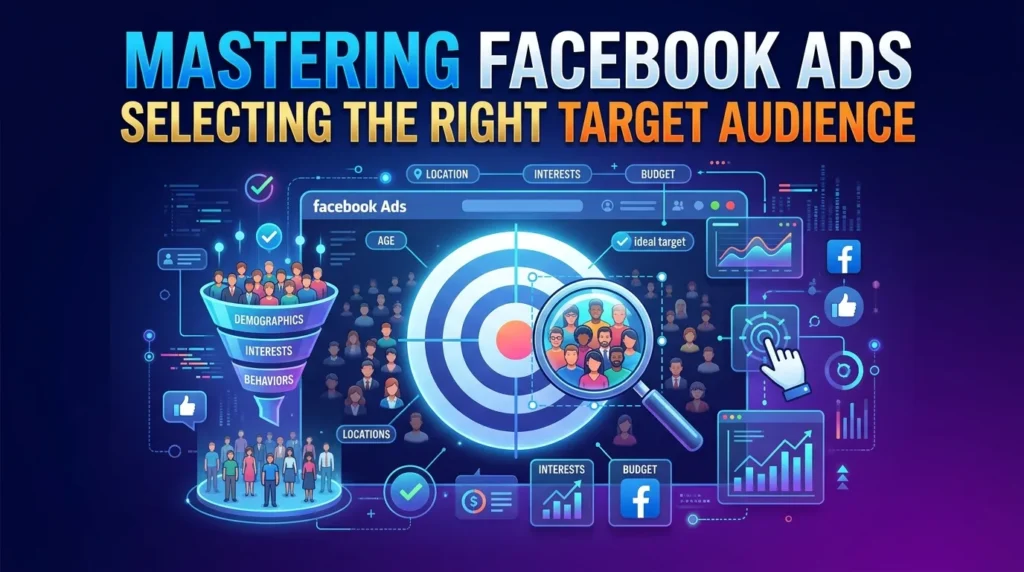
Building the right target audience is one of the most important parts of successful Facebook and Instagram advertising. Meta provides several audience options that help advertisers reach new prospects, reconnect with existing users, and find people similar to their best customers.
A strong audience strategy combines first-party data, broad targeting, Lookalike Audiences, interest-based targeting, and structured retargeting. For a complete overview of audience selection and targeting strategies, see this Facebook Ads Target Audience Guide.
The goal is not simply to reach more people, but to reach the right people at the right stage of the customer journey.
Understanding Meta Audience Types
Meta Ads Manager primarily uses three audience categories:
Core Audiences are created using location, demographics, interests, behaviors, and other native targeting options.
Custom Audiences are built from first-party data such as website visitors, customer lists, video viewers, lead-form interactions, and product engagement.
Lookalike Audiences use existing Custom Audiences as a source and allow Meta to identify new people who share similar characteristics and behaviors.
Define Your Ideal Customer Profile First
Before building an audience in Ads Manager, define your Ideal Customer Profile (ICP). Consider demographics, psychographics, behavior, and relevant topics or influences.
A clear ICP makes it easier to translate your customer knowledge into useful targeting parameters.
Broad Targeting and Meta’s AI
Broad targeting minimizes manual audience restrictions and gives Meta’s algorithm more freedom to identify potential customers. Advertisers can focus primarily on geographic location, age range, and gender when relevant.
With broad targeting, creative becomes an important audience signal. Use specific hooks, audience-focused messaging, and visuals that clearly communicate who the product is designed for.
High-Intent Lookalike Audiences
Lookalike Audiences work best when the source audience contains high-quality customers. Strong sources include high-LTV customers, repeat purchasers, completed purchases, and other high-intent actions.
For an LTV-based Lookalike, upload customer information with lifetime value data so Meta can use customer value as an important weighting signal.
Interest and Behavioral Stacking
Interest targeting remains useful for new accounts, niche products, and specific markets. Instead of creating many unrelated ad sets, group related interests into logical categories and use narrowing conditions to identify stronger buyer segments.
Retargeting with Custom Audiences
Retargeting focuses on people who have already interacted with your business. A time-based structure can separate recent high-intent users from older prospects.
Recent Add-to-Cart and Checkout users can receive stronger conversion-focused messaging, while older visitors may respond better to testimonials, educational content, comparisons, and trust-building offers.
Dynamic Catalog Targeting
For businesses with many products, Dynamic Product Ads and catalog campaigns can automate product-focused retargeting.
Common strategies include targeting users who viewed products without purchasing, promoting complementary products to existing customers, and using custom combinations of product engagement and purchase behavior.
Hyper-Local Targeting
Local businesses can use location pins and tight geographic targeting to reach customers within practical driving distance. Restaurants, clinics, gyms, and local retailers can also use scheduling to show advertisements during relevant business hours.
Managing Audience Overlap
When multiple ad sets target similar users, audience overlap can create unnecessary auction competition. Use Meta’s Audience Overlap tools and clear exclusions to separate prospecting, retargeting, and retention campaigns.
15 Facebook Ads Target Audience Blueprints
1. Completely Broad Advantage+ AI Audience
Stage: Top of Funnel
Best for: Scalable e-commerce and lead generation.
2. High-Value 1% Revenue LTV Lookalike
Stage: Top of Funnel
Best for: Premium and high-AOV businesses.
3. Stacked Niche Interest & Engaged Shopper Matrix
Stage: Top of Funnel
Best for: New accounts and niche products.
4. B2B Industry & Job Title Precision Layer
Stage: Top of Funnel
Best for: SaaS, agencies, and B2B services.
5. Competitor Audience Takeover
Stage: Top of Funnel
Best for: Challenger brands entering established markets.
6. Deep Video Engager Pool
Stage: Middle of Funnel
Best for: High-ticket products requiring trust and education.
7. Social Media Account Interaction Hub
Stage: Middle of Funnel
Best for: Content-driven and influencer-led businesses.
8. High-Intent Content & Blog Reader Cohort
Stage: Middle of Funnel
Best for: Complex products and inbound campaigns.
9. Event & Lead Form Engagement Recycler
Stage: Middle of Funnel
Best for: Webinars, real estate, dealerships, and local services.
10. Local Radius Geofenced Prospecting Pool
Stage: Top / Middle of Funnel
Best for: Restaurants, gyms, clinics, and local retail.
11. Abandoned Cart & Checkout Rescue
Stage: Bottom of Funnel
Best for: E-commerce and online sales.
12. Dynamic Catalog Retargeting
Stage: Bottom of Funnel
Best for: Multi-SKU retailers and apparel brands.
13. Time-Decay Website Visitor Retargeting
Stage: Bottom of Funnel
Best for: Re-engaging warm prospects.
14. Existing Buyer Cross-Sell & Upsell Engine
Stage: Post-Purchase
Best for: Consumables, SaaS upgrades, and seasonal products.
15. Win-Back At-Risk Customer Vault
Stage: Retention / Win-Back
Best for: Subscription renewals and dormant-customer reactivation.
Conclusion
A successful Facebook Ads audience strategy combines broad targeting, first-party data, Lookalike Audiences, interest targeting, retargeting, and strong exclusion logic.
The best results come from matching each audience to the appropriate funnel stage, creative message, and campaign objective. Test different audience structures, monitor performance, and continuously improve your targeting strategy.