
Disruptions within a business can occur out of the blue, regardless of whether they stem from a problem associated with cybersecurity, IT, logistics, natural calamities, or any other emergency situation. In order to cope with such issues effectively, an organization should develop a set of procedures to deal with disruptions, as well as plan its recovery and response actions.
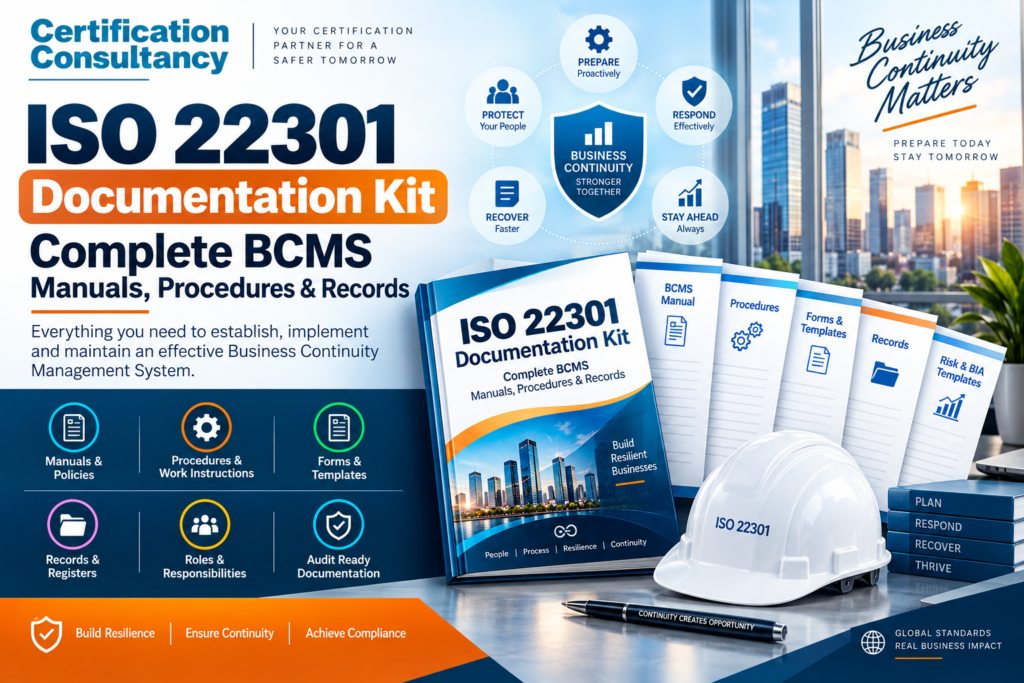
An ISO 22301 Documentation Kit can assist an organization in structuring the data needed to implement a BCsMS.
What Is ISO 22301?
ISO 22301 is an internationally accepted standard for Business Continuity Management Systems. It offers a comprehensive structure that will help businesses recognize the disruptions that may affect their business operations, determine critical business functions and plan continuity measures for the same.
This standard can be utilized by companies of different scales and different industries. This standard’s scope of application does not include only planning emergency situations, but developing a management system.
Why Is BCMS Documentation Important?
Documentation provides a clear structure for implementing business continuity practices. It helps employees understand their responsibilities and gives management a consistent method for monitoring continuity arrangements.
Effective documentation can help an organization:
- Define the scope and objectives of its BCMS.
- Establish business continuity responsibilities.
- Identify critical processes and activities.
- Assess disruption-related risks and impacts.
- Develop appropriate continuity strategies.
- Establish response and recovery procedures.
- Maintain evidence of testing and exercises.
- Monitor performance and corrective actions.
- Support internal and external audits.
Good documentation should be practical rather than unnecessarily complicated. Each document should have a clear purpose and should reflect the organization’s actual operations.
Key Documents in an ISO 22301 Documentation Kit
A comprehensive documentation package can include different levels of information required for implementing a BCMS. The exact documents may vary according to the organization’s size, activities, risks, and operational complexity.
- BCMS Manual
BCMS Manual offers an overview of the Business Continuity Management System. This document may cover the organizational context, scope of the system, roles and responsibilities, processes, and business continuity approach.
- Business Continuity Policy
The policy expresses the management commitment to business continuity. The policy states the organization’s direction, goals, and responsibilities for achieving business continuity.
- Business Impact Analysis
The Business Impact Analysis (BIA) assists in identifying critical processes and their impact in case of their failure.
- Risk Assessment
Risk assessment assists in determining possible risks and assessing the impact these risks may have on the organization’s operations. Such an assessment can help in formulating appropriate business continuity and risk mitigation measures.
- Business Continuity Procedures
The procedures include detailed guidelines on how to deal with disruptions. These include things such as emergency response, incident management, crisis communications, IT recovery, evacuation procedures, backup plans, and restoration processes.
- Business Continuity Plans
Business continuity plans detail the activities that should be undertaken during and after a disruption. They should also explain the necessary communication processes and should be easy to understand and access by those who will implement them.
- Test and Exercise Records
Continuity plan measures cannot be left in the theoretical sphere. Exercises, simulation tests, and reviews may help to find the weak links and improve them. Documentation of this process proves the efficiency of the BCM system.
- Control and Improvement Records
Companies may keep records concerning internal audits, management reviews, incidents, corrective actions, performance control, and improvement measures. Such records prove the continuous maintenance and development of the management system.
Benefits of Structured BCMS Documentation
Effective documentation will ensure easier and smoother implementation of the process. Proper documentation enables employees to have clear roles and provides management with an understanding of the operations of continuity programs.
Documentation may be effective in preparing for audits because it ensures that all necessary policies, procedures, plans, and supporting evidence are available. However, proper documentation is more critical in helping organizations shift from reactive crisis management to resilient and recovery management.
Keeping Documentation Effective and Up to Date
The documentation of business continuity will change as the organization changes. Changes may occur in technology, supplies, facilities, employees, processes, and business needs that will have an impact on business continuity plans.
Therefore, organizations should check their business continuity plans from time to time and make updates where necessary. Gaps should be detected using testing and exercising.
Conclusion
For an efficient BCMS, the presence of documents alone is not enough. The policies and procedures, impact assessment, risk assessment, continuity plan, testing documents, and continuous improvement activities need to function synergistically within a structured management framework. An appropriately designed ISO 22301 Documentation Kit could serve as a basis for implementing and developing the business continuity arrangement.
Certification Consultancy assists companies in providing professional documentation and consultancy solutions for the easy implementation of ISO 22301.