
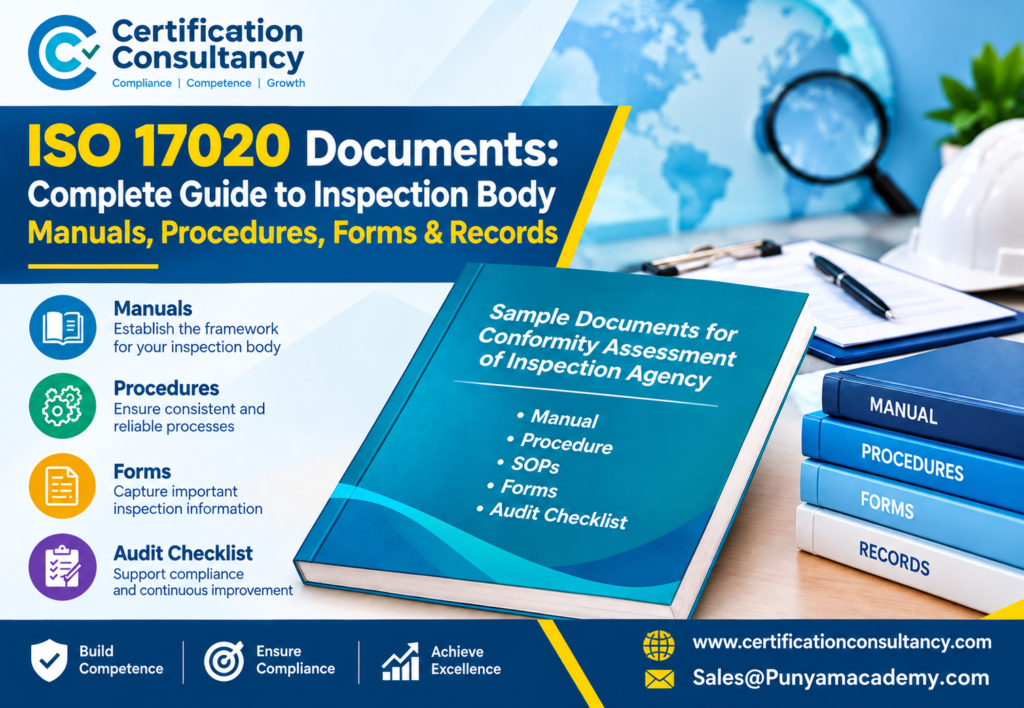
Inspection bodies are responsible for ensuring that the products, processes, services, and systems satisfy the required criteria. For an inspection body to conduct the inspection processes and be competent in doing so, there should be an effective management system accompanied by proper documentation. This is when ISO 17020 documents become relevant.
ISO/IEC 17020 gives the requirements for organizations conducting inspection activities. Good documentation assists an inspection body in defining the respective responsibilities and process control, maintaining impartiality, and ensuring consistency in conducting the inspection processes.
What Are ISO 17020 Documents?
Documents of ISO 17020 include manuals, procedures, forms, records, policies, and other documents required for the development and maintenance of an effective management system for the inspection body. They are needed to inform staff about the manner in which work should be done.
The right documentation system may also make it easy for you to conduct internal audits, take corrective action, carry out management review, and even undergo external assessment.
Importance of an ISO 17020 Manual
An ISO 17020 Manual is a tool that offers an overview of the management system of the inspection body. The manual gives an account of how the organization handles requirements and sets up the basis for its inspection practices.
The manual can cover the scope of the inspection carried out by the organization, organizational structure, responsibilities, management commitment, impartiality management, confidentiality management, resources management, and important process.
It is not a complex document containing numerous pieces of complicated information; instead, the manual is simple and practical in relation to the real-world practice of the inspection body.
Key ISO 17020 Procedures
Well-defined ISO 17020 Procedures help translate management system requirements into practical activities. Procedures should clearly explain what needs to be done, who is responsible, and what records should be maintained.
Depending on the inspection body’s scope and activities, documented procedures may cover areas such as:
- Management of impartiality and confidentiality
- Competence and qualification of inspection personnel
- Personnel training and monitoring
- Inspection planning and execution
- Review of inspection requests and contracts
- Handling inspection methods and instructions
- Control of inspection records
- Equipment management and calibration
- Reporting of inspection results
- Complaints and appeals
- Nonconforming work
- Corrective and preventive actions
- Internal audits
- Management review
- Document and record control
These procedures should reflect the organization’s actual workflow instead of simply reproducing standard requirements.
Forms and Records for Inspection Activities
Documents and records provide tangible proof that certain processes have been conducted. They could assist an inspection body to be consistent and comply with all procedures when conducting the inspection.
Some common documents that could be kept as records are personnel competence records, training records, equipment calibration records, inspection reports, contract review records, audit reports, corrective action records, complaint records, management review records, and checklists for inspections.
The specific records needed would be determined by several factors relating to the inspection body.
Benefits of Well-Organized Documentation
A well-organized document system will allow for various practical advantages. For example, it will enable workers to use standardized procedures and simplify the definition of responsibilities. Furthermore, good documentation will make the monitoring process more efficient and will give evidence of inspection activities.
Good documentation and records will allow an organization to detect weaknesses in procedures, to undertake corrective actions, and to become better prepared for the assessment. Well-organized documentation will prevent misunderstandings due to access to current forms and procedures.
Preparing for ISO 17020 Assessment
Before conducting an assessment, the inspection body must ensure that the documentation related to the management system is evaluated for any gaps in process implementation. Documentation must be up-to-date, under control, and compatible with the actual process of the organization.
The staff must also be aware of the procedure applicable to them. Records must be kept systematically so that information can be retrieved whenever needed.
Internal audits and management reviews may aid in identifying deficiencies prior to an external assessment. Documented action must be taken and verified as well.
Conclusion
Proper documentation is essential in developing an inspection body that is effective and efficiently managed. From the ISO 17020 Manual to the various forms and records, every document must be well-defined and play a role in supporting the inspection processes of the organization. Certification consultancy helps organizations in developing a set of documented management systems.