
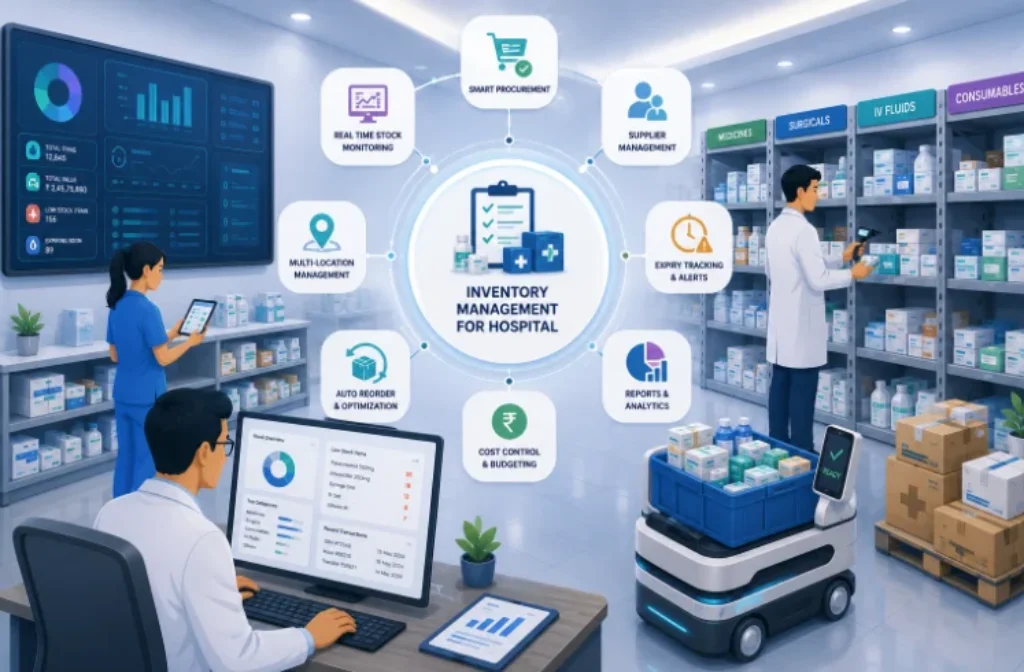
This is a condition most every small hospital and clinic in India have experienced: when a patient requires a medicine and the shelf is empty, or a box of expensive injections is found a week after they’ve passed their expiration date. Such accidents are not uncommon. The down side is the day to day expense of having to keep track of stock in notebooks, spreadsheets and memory. Good inventory management for hospital teams, even small ones, protects patient safety, cuts waste and keeps cash from sitting idle on shelves. The purpose of this guide is to illustrate where to begin and which tasks are the best to automate first.
Why Small Hospitals Struggle With Stock Control
Purchase departments and dedicated store managers are found in large hospital chains. Typically, a 20-bed hospital or a busy clinic will have one pharmacist, some nurses and an owner who is involved in approving purchases. In that environment, issues come up very quickly:
- Expired medicines that are never noticed until audit day
- Stockouts of essential drugs, consumables and surgical items
- Over-ordering based on assumption and locking up working capital.
- Mismatches between physical stock and paper entries
None of this is a sign of a lack of care by your team. Manual tracking can’t keep up with patient care.
Step 1: Know What You Actually Stock
Start with a full stock count. Record all medicines, consumables, implants, reagents and general supplies, their batch number, expiry date, purchase price and quantity. Organise items into groups: eg Emergency drugs, OPD medicines, Ward consumables, OT supplies, Lab reagents. This clean item master becomes the foundation of any inventory management for hospital setup, whether you use software or not.
Step 2: Set Reorder Levels and Minimum Stock
Next, determine the ‘Minimum Stock Level’ for each item in stock. Use it according to usage rate of the item and supplier delivery time. There should be a greater safety margin with emergency drugs than regular drugs. A purchase order should be placed when stock reaches reorder level and not left to chance.
Step 3: Follow FIFO and Expiry Discipline
The First In First Out (FIFO) rule means the oldest stock is used first. Get it together with a monthly review and just a rule: If something is closing in on its expiration date, place it in the front of the shelf or take it back to the supplier while the money can be returned. It’s easy to do it by hand for a couple of hundred items. It folds up when you have hundreds!
What to Automate First
When budget and time is restricted, automate in the following order, since each step results in a tangible saving.
- Expiry alerts and near expiry alerts. Automatic warnings save losses that can’t be caught by a register.
- Real-time stock tracking. All issues to a ward, OT or OPD patient immediately deplete the stock, and therefore the numbers are always up-to-date.
- Order alert and purchase tracking. System alerts for low stock and logs ordered, received and paid.
- Pharmacy-to-billing linkage. Medicines dispensed should show on the patient bill automatically, this will avoid missed dispenses.
- Reports and analytics. Moving fast, dead stock and monthly consumption help to negotiate with suppliers and make budgets.
A pitfall that should be avoided is purchasing an independent stock tool that is not tied to billing, OPD or IPD, thereby adding to another silo.
Why iCan CareFlow Is a Strong Choice for Indian Hospitals and Clinics
Small facilities require software which is easy to implement and is comprehensive enough to develop with them. iCan CareFlow, developed by ICAN Infotech Solutions, is a cloud-based hospital management system that integrates inventory into the greater hospital workflow rather than just another system.
Why it’s a good match for India:
- Smart expiry alerts and near expiry warnings to minimise medicine waste.
- Automatic FIFO management to use the oldest batch first.
- Real-time stock tracking and automatic alerts for low levels.
- Intelligent purchasing controls and predictive inventory management to help avoid both stockouts and over-ordering
- Integrated billing, so items disbursed go into invoices and reduce revenue loss,
- Connected OPD, IPD, lab, radiology and operation theatre modules, giving one source of truth across departments
- ABHA-ABDM integration for India’s digital health records
- Cloud-based design that scales from a single clinic to a multi-facility hospital network, with no heavy server investment
The platform states that it is HIPAA and GDPR compliant, has limited access and secure backups. It also claims to have seen massive reductions in waste, but like all vendor claims, request a real-life demo and cross-check against your own stock.
Where and How to Start This Month
- Do a stock check and clean inventory.
- Establish minimum values for top 50 fastest moving items.
- Identify two or three systems to be studied and schedule real systems demos.
- Request information on data transfer, employee training, help and costs.
- Begin with the Pharmacy and Inventory, then slowly add modules in as time goes on.
Final Thoughts
It’s not a massive amount of money or a large IT team that’s required to correct stock issues. You must have a clear process, a strong expiry discipline and the proper tool. Effective inventory management for hospital control for teams of any size begins with accurate data and extends to fewer losses, safer care and healthier margins. If you wish to have one solution for managing your Stock, Billing, and Clinical Workflow, book a demo of iCan CareFlow and discover how it matches your hospital.
Frequently Asked Qestions
Q1. What is inventory management for hospital settings?
It is the process of tracking, storing, ordering and using medicines, consumables, surgical items and lab reagents so the right stock is available when patients need it. Good inventory management for hospital teams reduces wastage, prevents stockouts and keeps purchase costs under control.
Q2. Why is inventory management important for small hospitals and clinics in India?
Small facilities run with fewer staff and tighter budgets, so one expired batch or one missing emergency drug has a bigger impact. Proper stock control protects patient safety, frees up cash tied to excess stock and gives owners accurate records for audits.
Q3. Where should a small hospital start with inventory management?
Start with a full physical stock count. Record the batch number, expiry date, purchase price and quantity for every item, then group items into categories such as emergency drugs, OPD medicines, ward consumables and OT supplies. Next, set minimum stock and reorder levels for your fastest-moving items.
Q4. What should a hospital automate first in inventory management?
Begin with expiry and near-expiry alerts, real-time stock tracking and low-stock reorder alerts. After that, link the pharmacy to billing so dispensed items appear on patient bills automatically, and add reports that show fast-moving items and dead stock.
Q5. What is FIFO, and why does it matter in a hospital pharmacy?
FIFO stands for first-in, first-out, which means the oldest stock is used first. It matters because medicines have expiry dates, and using older batches first reduces the chance of expired stock being left on the shelf.
Q6. Can hospital inventory software help reduce medicine wastage?
Yes. Software with expiry alerts, FIFO management and predictive inventory helps staff spot slow-moving and near-expiry items early, so they can be used, moved or returned to the supplier in time. The results depend on how consistently the team enters data, so training matters as much as the tool.
Q7. How does iCan CareFlow help with inventory management for hospital teams in India?
iCan CareFlow is a cloud-based hospital management system that treats inventory as part of the whole hospital workflow. Its pharmacy and inventory tools include real-time stock tracking, smart expiry alerts, automatic FIFO management and purchasing controls, linked to billing, OPD, IPD, lab and ABDM-ready records. It works for single clinics as well as multi-facility hospital networks.