
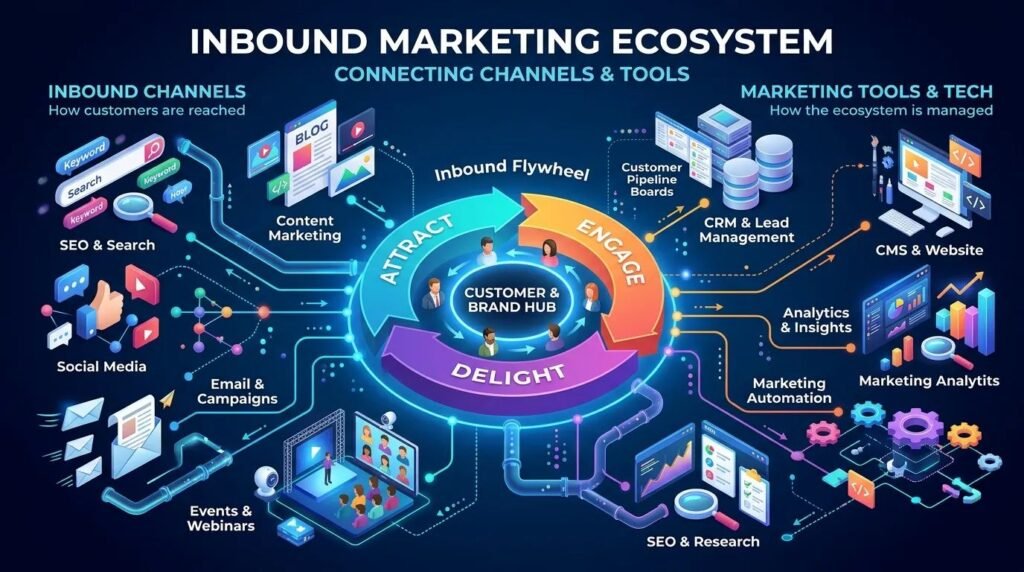
Successful inbound marketing requires more than publishing content or attracting visitors through search engines. Businesses need a coordinated approach that connects their marketing activities, communication channels, technologies, and customer relationships. This connected approach is known as an Inbound Marketing Ecosystem.
An inbound marketing ecosystem brings together content, SEO, social media, email marketing, automation, customer data, and business workflows. Each element supports a shared objective: attracting relevant audiences, providing useful information, developing relationships, and helping potential customers make informed decisions.
When these elements work together, businesses can create a more consistent customer experience and improve marketing efficiency. Instead of managing every activity separately, teams can build a connected system that supports visibility, engagement, lead generation, and long-term growth.
Understanding how an inbound marketing ecosystem operates helps businesses identify gaps, improve coordination, and make better use of their marketing resources.
Understanding the Inbound Marketing Ecosystem
An inbound marketing ecosystem is a combination of strategies, channels, tools, and processes that help businesses attract and engage potential customers through relevant experiences. It focuses on providing information that addresses audience questions, solves problems, and supports purchasing decisions.
Unlike traditional promotional approaches that often depend on direct advertising, inbound marketing attracts people by making valuable information available when they are actively researching a topic or looking for solutions.
Search engine optimization, educational content, social media, email communication, and marketing automation all contribute to this system. However, their effectiveness depends on how well they connect with one another. Search traffic, for example, becomes more valuable when visitors discover useful resources and have relevant opportunities to continue engaging with the business.
A connected ecosystem also helps marketers understand how prospects interact with different channels. These insights can guide content improvements, audience segmentation, and communication decisions.
The objective is not to use as many platforms as possible. It is to create a coordinated marketing environment where each activity contributes to a consistent and useful customer journey.
The Importance of Inbound Marketing Channels
Inbound marketing channels provide the pathways businesses use to reach audiences and distribute useful information. They help potential customers discover a brand, explore its expertise, and interact with relevant resources.
Organic search is an important channel because it connects businesses with people actively looking for information. A website with useful articles, relevant service pages, and well-organized content can attract visitors who already have an interest in its subject areas.
Social media provides opportunities to distribute resources, participate in industry discussions, and build professional relationships. Email marketing supports continued communication by delivering updates and relevant information to people who have chosen to subscribe.
These channels become more effective when they support one another. A visitor might discover a blog post through a search engine, explore related articles, and eventually subscribe to a newsletter. Each interaction creates another opportunity to build trust and provide value.
Businesses should choose channels according to their audience, objectives, and available resources. Maintaining a focused presence on relevant platforms is often more effective than trying to participate everywhere without a clear strategy.
Essential Components of an Inbound Marketing Ecosystem
A successful inbound marketing ecosystem depends on several connected components, including content, audience research, lead capture, customer information, and performance measurement.
Content provides the foundation for attracting potential customers. Blog posts, videos, reports, educational resources, and newsletters can answer questions and explain solutions at different stages of the buying journey. Effective content focuses on audience needs rather than relying entirely on promotional messages.
Audience understanding helps marketers identify which subjects deserve attention. By examining customer questions, search behavior, feedback, and engagement patterns, businesses can create resources that reflect genuine interests. Developing stronger Inbound Marketing Prospect Insights can help marketers understand these patterns and improve the relevance of their communication.
Lead capture connects content engagement with ongoing relationship development. Visitors may subscribe to updates, request information, or download resources in exchange for sharing appropriate contact details. Clear forms and meaningful value propositions make these interactions more useful.
Performance measurement helps businesses understand whether their activities are contributing to marketing objectives. Traffic, engagement, qualified leads, conversion rates, and acquisition costs provide useful information for evaluating results.
Together, these components create a coordinated system that supports informed marketing decisions.
Inbound Marketing Tools and Platforms
Inbound marketing tools help businesses manage campaigns, publish content, organize customer information, analyze performance, and maintain communication with prospects. The appropriate combination depends on business size, marketing complexity, and audience requirements.
Content management systems make it easier to publish and organize website resources. SEO tools support keyword research, technical analysis, and search performance monitoring. Analytics platforms provide information about website traffic, visitor behavior, and marketing results.
Customer relationship management systems help organize contact records and monitor interactions with potential customers. Email marketing platforms support subscriber management, audience segmentation, and campaign reporting. Marketing automation systems connect repetitive activities and help teams coordinate communication.
These tools provide greater value when they can exchange relevant information. For example, connecting website analytics with CRM data can help businesses understand which content contributes to qualified opportunities instead of simply generating traffic.
Selecting technology should involve more than comparing features. Usability, integration capabilities, data quality, security, and long-term costs are equally important. A smaller group of well-connected applications may provide better results than several disconnected tools.
Improving Efficiency Through Marketing Automation
Marketing automation allows businesses to manage repetitive marketing activities while maintaining consistent communication with prospects. It can support email sequences, contact segmentation, lead qualification, campaign coordination, and internal notifications.
For example, someone who subscribes to a newsletter may receive relevant educational information through an automated sequence. If that person later explores a specific service page, the system may update their engagement record or notify the appropriate team.
Automation can also help marketers respond to customer behavior more efficiently. Instead of manually reviewing every interaction, teams can establish workflows that organize information and initiate suitable follow-up activities.
However, automation should not replace human judgment. Poorly designed workflows can send irrelevant messages, create excessive follow-ups, or make incorrect assumptions about customer interests. Regular reviews help ensure that automated communication remains appropriate.
Effective automation combines operational efficiency with personalization. By using reliable information and relevant engagement signals, businesses can reduce manual work while delivering a more consistent customer experience.
Connecting Marketing Systems Through Integration
Integration allows different parts of an inbound marketing ecosystem to share information and work together. Without it, businesses may experience duplicated records, inconsistent reporting, disconnected campaigns, and limited visibility into customer interactions.
Consider a company using separate applications for its website, email marketing, lead management, and sales activities. If these systems do not communicate, marketing teams may struggle to understand which resources attracted a prospect or what communication that person has already received.
Connected systems provide a more complete view of customer interactions. Website activity, subscription information, campaign engagement, and sales updates can contribute to a shared understanding of the relationship, provided information is collected and handled appropriately.
Integration also improves coordination between marketing and sales departments. Both teams can work with more consistent records, agree on lead qualification standards, and identify where prospects need additional information.
Businesses may use native integrations, application programming interfaces, or data synchronization platforms to connect their systems. The best approach depends on the tools involved and the organization’s technical requirements.
Successful integration also requires consistent data definitions, clear ownership, and appropriate access controls. Connecting applications without maintaining data quality can spread inaccurate information throughout the marketing operation.
Building an Effective Inbound Marketing Workflow
An inbound marketing workflow defines how activities move from audience attraction to engagement and potential conversion. It gives structure to the ecosystem and helps teams understand how individual marketing tasks contribute to the customer journey.
The process often begins with audience research and content development. Marketers identify relevant questions, search opportunities, and customer needs before creating resources that address them. SEO and content distribution then help those resources reach the intended audience.
When visitors engage with content, businesses can provide relevant next steps. These may include exploring related articles, subscribing to updates, downloading resources, or requesting additional information.
Lead management follows these interactions by helping teams understand which prospects may need further communication. Some people require introductory information, while others may be comparing specific solutions. A well-organized workflow allows businesses to respond according to these different needs.
This process becomes more effective when connected with Inbound Marketing Content Mapping. Content mapping helps businesses align resources with the questions and requirements people have at different stages of their buying journey.
Workflows should also remain flexible. Customer behavior, campaign performance, and changing business priorities may reveal unnecessary steps or opportunities for improvement. Regular evaluation helps businesses maintain an effective process.
Inbound Marketing Tactics for Audience Engagement
Inbound marketing tactics turn broader strategies into practical activities that attract attention and encourage meaningful engagement. Their success depends on content quality, audience relevance, and consistent communication.
Search-focused content helps businesses answer questions that potential customers are already asking. By understanding search intent and creating useful resources, companies can reach people who are actively researching relevant subjects.
Content repurposing extends the value of existing resources. A detailed blog post can become an email newsletter, a series of social media updates, or a short educational video. Different formats allow businesses to reach audiences with varying content preferences.
Personalized communication can also improve engagement. Segmenting subscribers according to their interests or previous interactions helps marketers provide more relevant information. Personalization should always rely on appropriate data and avoid making intrusive assumptions.
Professional networking provides another opportunity to build visibility and credibility. Sharing useful insights, participating in relevant discussions, and maintaining consistent communication can help businesses develop relationships with their target audiences.
The most effective tactics are those that support the wider ecosystem. Rather than adopting every new marketing trend, companies should focus on activities that match audience needs and contribute to measurable objectives.
Developing Valuable Inbound Marketing Resources
Inbound marketing resources help potential customers understand a business, explore its expertise, and evaluate possible solutions. Different formats can support different information needs throughout the buying journey.
Educational articles are useful for answering common questions and attracting search traffic. Reports and downloadable resources provide more detailed information, while case studies explain how particular approaches address real business challenges. Email newsletters maintain ongoing communication with subscribers.
A coordinated content library makes these resources easier to manage. Marketers can identify missing topics, update outdated information, and connect related pages through relevant internal links. This improves content discovery and helps visitors explore subjects in greater depth.
Resources should reflect the audience’s current needs. Someone researching a general problem may benefit from an introductory article, while a prospect comparing solutions may need detailed information about features, costs, or implementation.
Content performance should also be evaluated according to its purpose. An introductory article may be valuable for attracting visitors, while a specialized resource may contribute more directly to qualified leads. Recognizing these differences helps businesses make better content investment decisions.
The Role of Inbound Marketing Technologies
Inbound marketing technologies provide the infrastructure needed to coordinate content, communication, customer data, and performance measurement. They help businesses manage complex marketing activities more efficiently.
Analytics technologies help marketers understand traffic patterns and engagement trends. CRM systems organize customer information, while automation platforms coordinate repetitive communication. Artificial intelligence can support research, content analysis, data organization, and the identification of patterns in marketing performance.
However, technology alone does not guarantee successful marketing. Results still depend on strategic planning, reliable information, and content that addresses genuine audience needs.
Businesses must also consider data privacy, security, and responsible information handling when adopting new technologies. Collecting unnecessary customer information or using it without an appropriate legal basis can damage trust and create compliance risks.
A sustainable technology strategy focuses on solving real business problems. Companies should evaluate whether a tool improves decision-making, reduces unnecessary work, or creates a better experience for customers.
When technology supports a clear marketing purpose, it becomes an important part of a connected and effective ecosystem.
Measuring and Improving Ecosystem Performance
Performance measurement helps businesses understand whether their inbound marketing ecosystem is producing meaningful results. Without reliable information, teams may focus on visible activity without knowing whether it contributes to qualified opportunities or business growth.
Website traffic provides an indication of audience reach, but it should not be treated as the only measure of success. Engagement, returning visitors, content interactions, and subscriber growth can provide additional context about how people respond to marketing activities.
Lead generation metrics offer another perspective. Businesses can evaluate qualified lead numbers, conversion rates, lead-to-customer progression, and customer acquisition costs to understand how marketing contributes to commercial outcomes.
Attribution is also important because customers often interact with several channels before making a decision. Organic search may introduce a prospect to a company, email may maintain the relationship, and a later consultation may contribute to conversion. Reviewing these interactions together provides a more complete understanding of marketing performance.
Regular performance reviews help teams identify underperforming content, refine workflows, adjust channel priorities, and improve resource allocation. These ongoing changes make the ecosystem more coordinated and effective over time.
Conclusion
An inbound marketing ecosystem connects content, channels, tools, automation, workflows, and technologies to create a coordinated approach to attracting and engaging potential customers. Its effectiveness depends on how well these elements support one another.
By understanding audience needs, publishing useful resources, connecting marketing systems, and maintaining consistent communication, businesses can create more valuable customer experiences. Clear workflows and reliable performance measurement also help teams identify opportunities and improve their results.
Building an effective ecosystem does not require using every available platform or adopting every new technology. It requires selecting suitable components, connecting them thoughtfully, and improving their performance over time.
With a focus on relevance, coordination, and measurable outcomes, businesses can develop an inbound marketing ecosystem that strengthens customer relationships, supports qualified lead generation, and contributes to sustainable growth.
Frequently Asked Questions
1. What is an inbound marketing ecosystem?
An inbound marketing ecosystem is a connected combination of marketing channels, content, tools, technologies, and processes that attracts potential customers, provides useful information, and supports relationships throughout the buyer journey.
2. What are the main components of an inbound marketing ecosystem?
Its main components include content marketing, SEO, social media, email marketing, lead capture, CRM systems, marketing automation, analytics, and workflows that connect these activities.
3. Why is integration important in inbound marketing?
Integration allows different marketing systems to share relevant information. It reduces duplicated records, improves reporting, and helps marketing and sales teams understand customer interactions more effectively.
4. How does marketing automation support an inbound marketing ecosystem?
Marketing automation helps manage repetitive activities such as email follow-ups, contact segmentation, lead notifications, and campaign workflows. It improves efficiency and supports more consistent communication.
5. How can businesses measure inbound marketing ecosystem performance?
Businesses can evaluate organic traffic, engagement, subscriber growth, qualified leads, conversion rates, customer acquisition costs, and the contribution of different channels to business outcomes.