
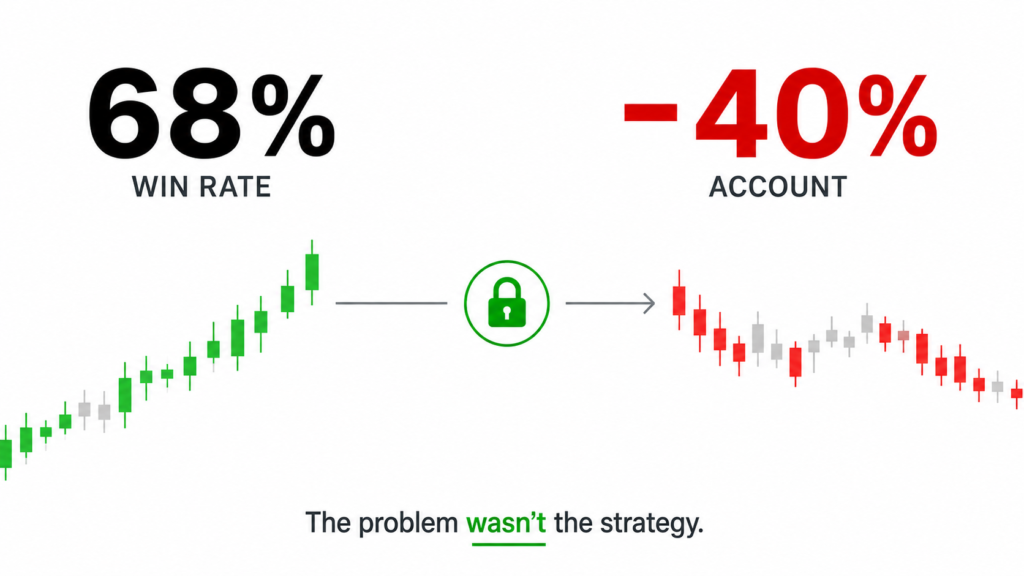
Most traders don’t blow their accounts because they can’t find winning trades.
They blow them because they don’t know when to stop trading.
You can have a profitable strategy, a solid win rate, and months of experience—and still lose a large chunk of your account in a single bad session.
It usually starts innocently.
One trade goes wrong.
You take another.
Then you think, I just need one winner to make it back.
So you increase your position size.
You loosen your rules.
You take a setup you normally wouldn’t touch.
And suddenly, you’re no longer trading your system.
You’re trading your emotions.
The Hidden Reason Good Traders Still Lose Money
The forex market doesn’t require you to be right all the time.
It requires you to manage the times you’re wrong.
That’s where many traders fall apart.
A strategy can have a 60% or even 70% win rate and still produce losing streaks. That’s simply part of trading.
The problem isn’t the losing streak.
The problem is how the trader reacts to it.
A disciplined trader takes the loss and moves on.
An emotional trader tries to get the money back immediately.
That’s when position sizes increase, extra trades appear, and risk management starts disappearing.
The result?
A normal losing streak becomes an account-threatening drawdown.
Your Biggest Risk Might Be Your Next Trade
Think about what happens after a loss.
You tell yourself you’re going to wait for the next perfect setup.
Then the market starts moving.
You see a setup that is almost valid.
Normally, you’d ignore it.
But now you want to recover the loss.
So you enter.
That trade loses too.
Now the pressure gets worse.
This is how revenge trading starts.
Not with some dramatic decision to destroy your account.
It starts with a small exception.
“I’ll take just one more trade.”
That sentence has probably cost traders more money than most bad indicators ever have.
Stop Depending on Willpower
Here’s the uncomfortable truth:
You don’t become a consistently disciplined trader simply by promising yourself you’ll behave better next time.
You’ve probably already made that promise.
The problem is that your rules are easiest to break at exactly the moment you’re most emotional.
So instead of relying on willpower, build safeguards around your trading.
For example:
- Define your maximum risk before entering.
- Set a hard daily loss limit.
- Stop trading after reaching that limit.
- Consider a cooldown period after a significant loss.
- Don’t allow yourself to increase position size just because you’re trying to recover.
- Track every rule violation, not just every winning and losing trade.
The objective isn’t to make yourself more disciplined.
It’s to make impulsive decisions harder to execute.
Your Journal Should Expose Your Bad Habits
Most traders use journals to track entries, exits, profits and losses.
That’s useful.
But there’s another layer of information that can be even more valuable: your behavior.
What happened before your worst trades?
Were you coming off a loss?
Did you increase your size?
Were you trading outside your normal hours?
Did you enter because the setup was valid—or because you wanted action?
Did you move your stop after the trade went against you?
Patterns like these can reveal exactly where your trading process breaks down.
And once you know where the breakdown happens, you can build a rule around it.
Don’t Just Record the Mistake. Stop It.
This is where automated trading controls become powerful.
A journal can tell you:
“You exceeded your daily loss limit today.”
Useful—but too late.
An enforcement system can say:
“You’ve reached your limit. No more trades today.”
That’s a completely different approach.
Instead of reviewing the damage after the fact, you’re preventing the damage from getting worse.
The goal isn’t to predict every losing trade.
Nobody can.
The goal is to make sure one losing trade doesn’t turn into five because you got angry.
The Best Trading System Protects You From Yourself
Most traders spend their time looking for better entries.
Experienced traders eventually realize something else matters just as much:
What happens after the entry?
Your edge matters.
Your execution matters.
Your risk management matters.
And your ability to stop matters.
You don’t need a strategy that wins every trade.
You need a structure that keeps normal losses from becoming catastrophic ones.
That’s the difference between having a trading plan and actually being able to follow it.
If your strategy works but your discipline keeps getting in the way, TradeChecx is built to help bridge that gap. Its trading journal helps you identify behavioral patterns, while its Kill Switch can automatically halt trading when you breach your daily loss limit.
Because sometimes the biggest improvement you can make to your trading isn’t finding a better entry.
It’s making sure you can’t sabotage the good strategy you already have.