
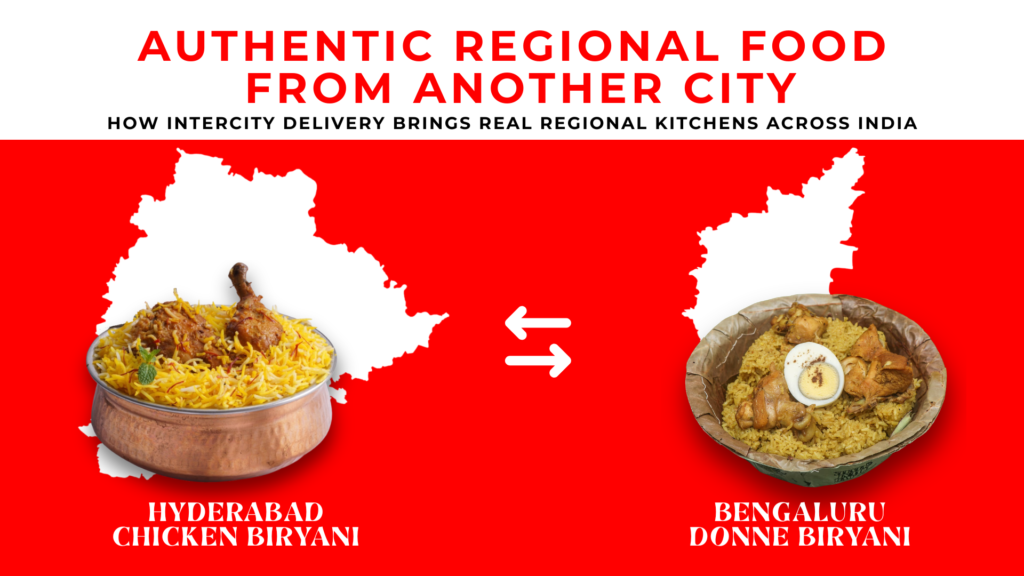
The food a city is known for took generations to develop. Intercity food delivery is finally giving everyone access to it.
There is a category of food in India that belongs to specific cities in a way that is difficult to overstate. Not food that is associated with a city, or popular there, or characteristic of its cuisine — but food so deeply grown from a particular place that experiencing it properly means, in effect, experiencing the city itself. Hyderabadi biryani is one. Lucknawi kebabs are another. The list is long and each entry carries with it the same essential truth — that this food and the city that made it are, in some fundamental sense, the same thing. Intercity food delivery is doing something that has not been possible before. It is allowing that food to travel without losing what makes it what it is.
The people who feel this most directly are the ones who grew up eating these dishes and then moved away. For them, intercity food delivery is not an addition to a food landscape that was already satisfying. It is the restoration of something that moving cities removed — the ability to eat the food that belongs to where they are from, prepared by the kitchen that has been preparing it for decades, arriving at wherever they now live without any of the compromise that distance used to require. The city speciality is no longer held in place by geography. It travels now.
“Every city has a dish that belongs to it. Intercity food delivery is how that dish finally travels.”
Why City Specialities Are So Hard to Replicate
The food that becomes inseparable from a city’s identity does not develop quickly or easily. It takes shape over generations, through the interaction of local ingredients, local cooking traditions, and the accumulated refinement of kitchens that have been making the same preparation long enough to understand it completely. The result is food that is deeply specific — not just in recipe but in character, in the particular way it smells and tastes and presents itself. That specificity is what makes it irreplaceable.
When a kitchen outside the tradition attempts to produce the dish, it works from the recipe but lacks the accumulated context. The small judgments that determine the quality of the final preparation — judgments that are learned through repetition over years — are not present. The dish can be technically competent and still miss the particular quality that makes the original what it is. This is not a failure. It is simply what happens when a preparation moves outside the conditions that shaped it.
Intercity food delivery addresses this by not asking any kitchen to move outside its conditions. The original kitchen makes the original food. The logistics carry it to the person ordering. Nothing about the food changes. Only the distance it travels.
The Heritage Kitchen Difference
The kitchens that make intercity food delivery genuinely valuable are the ones that have been the source rather than the reference. In every Indian city, there are restaurants that created the standard against which every other version of their dish is measured — not because they were ambitious or innovative, but because they have been consistently excellent for long enough that the city came to depend on them. These are the kitchens that intercity food delivery works with.
The knowledge held in these kitchens is not transferable through documentation. It is accumulated through practice — through the thousands of preparations that build an understanding of how the dish should behave at every stage, what adjustments are needed in different conditions, what the finished preparation should be in every detail. That knowledge is present in the food itself, in ways that people who know the original recognise immediately and people who have never tasted it sense without being able to explain.
This is what makes the specificity of intercity food delivery so important. Not food from a kitchen that knows the recipe. Food from the kitchen that is the reason the recipe exists.
“It is not just the dish that travels. It is the kitchen’s entire history of making it.”
The Cities and Their Dishes
To understand what intercity food delivery makes possible, it helps to think about a few specific examples of the food that belongs to specific Indian cities. Hyderabadi biryani is the most internationally recognised — a preparation so particular in its method, its spice balance, and its overall character that the city’s name is part of its name and always will be. To eat it properly is to eat something that exists nowhere else in precisely the same form.
Lucknow’s culinary identity is equally specific, expressed most clearly in the soft, slow-cooked kebabs that the city’s kitchens have been perfecting for generations. Kolkata holds its food with a certainty that comes from knowing its dishes are genuinely distinct. Chennai’s food traditions — the sourness of the rasam, the specific texture of food from kitchens that have been making it correctly for decades — are particular in ways that visitors and transplants quickly come to understand as irreducible.
Each of these cities, and many more across India, holds food of this kind. Specific, locally rooted, experienced as a genuine and named absence by everyone who grew up with it and then moved away. Intercity food delivery is not trying to solve this all at once. It is creating the route, one heritage kitchen at a time, that brings the original to the person who knows it.
What Accessibility Actually Means
When city specialities become accessible across India through intercity food delivery, they do not lose the quality that made them worth accessing. A heritage kitchen’s preparation, delivered to a city where it would otherwise never appear, does not become ordinary by arriving there. It remains exactly what it is — specific, authentic, produced by the hands and knowledge that have always produced it. What changes is only who can reach it.
Previously, that reach was defined entirely by geography. The person in the right city could eat the food. Everyone else had to either travel or accept a version. Intercity food delivery creates a third state — one in which the right city comes to the person, rather than requiring the person to go to the right city. The food is an order now, not a journey.
The effect of this on both sides is real. The person from that city, living elsewhere, finds their food again without needing a return trip. The person who has never been to that city encounters the genuine dish for the first time — not a local interpretation, but the original itself. Both experiences are made possible by the same model. And both are meaningful in different but equally valid ways.
“You no longer have to travel to taste the real thing. It can travel to you.”
Quality and Care Over Distance
Delivering food across cities requires the same quality of attention that producing it does. A heritage kitchen’s preparation that leaves Hyderabad in perfect condition can arrive in Bengaluru in diminished condition if the transit is not managed with care. This is the practical challenge that intercity food delivery is specifically built to address — and the model it has developed for doing so is the foundation of the entire value proposition.
The food is prepared on the day it travels. It is packed in temperature-controlled packaging that maintains the specific conditions required by the specific dish throughout the full journey. The logistics are managed and tracked. The delivery arrives within a window that was confirmed at the time of ordering. Every element of the process is designed around the particular demands of food that has no tolerance for being treated like an ordinary parcel.
The result is food that arrives as the heritage kitchen intended it to arrive. The qualities that define the dish — its texture, its aroma, its specific balance — are present at the destination as they were at the source. The distance was covered. Nothing essential was left behind.
India’s Food Culture Without Borders
India’s regional food traditions are extraordinary in their variety and their depth. They are the accumulated expression of centuries of local culture, climate, and creativity — and they belong, historically, to the specific places that produced them. The experience of eating them in their original form has always required proximity to those places.
Intercity food delivery changes this by building a reliable, considered bridge between the kitchens that hold these traditions and the people in other cities who want to experience them. It does not flatten the food or generalise it. It delivers it specifically, from specific kitchens, in the specific form that those kitchens have always produced. The food retains its origin and its character. The only thing that changes is the range of people who can reach it.
That range, expanding across India as the model grows, means that city specialities stop being the exclusive domain of the people who happen to live where they were created. They become shared — not in a way that dilutes them, but in a way that honours them by making them available in their original form to everyone who wants to experience them. The dish stays exactly what it always was. It reaches further now.