
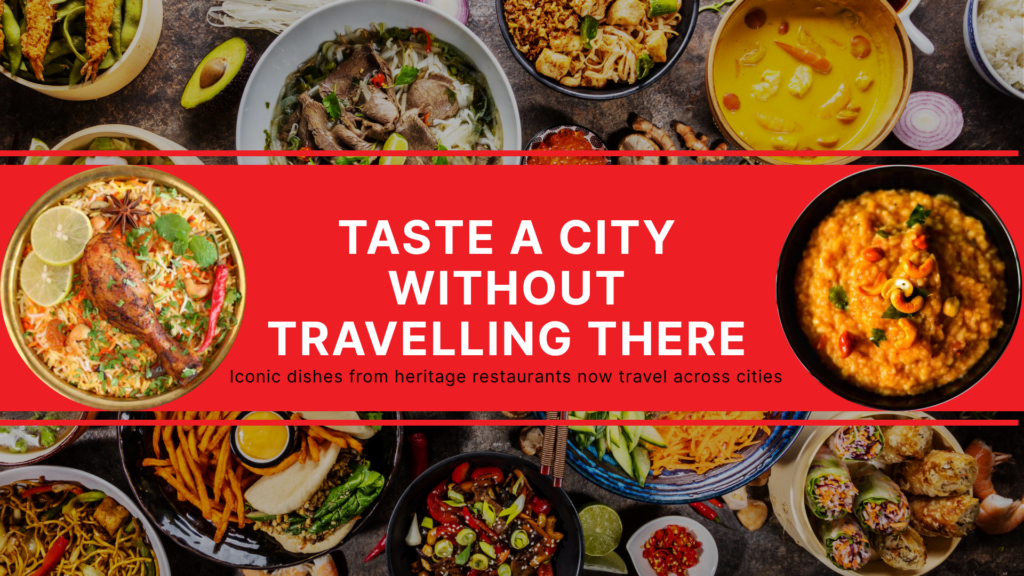
The food of every Indian city has always been worth seeking. Getting to it no longer requires a journey.
There is a specific kind of food memory that many people in India carry from a city visit. Someone brings you to a restaurant the city trusts, and the food is better than you expected — not exotic, but done in a way you have not encountered. The biryani from a kitchen with four decades behind it. The dosa the regulars arrive early for. The kebab that changes how you think about the dish. That discovery is real, and it used to come with one condition: leaving the city meant leaving the food.
Intercity food delivery is slowly removing that condition. The requirement to be present in the right city to eat its food — the geographic rule that has shaped food discovery in India for as long as anyone can remember — is beginning to break down. What follows from this, for how people explore Indian regional cuisine, is worth paying attention to.
“The right logistics do not just move food from one city to another. They carry the tradition within the food intact.”
What Makes Regional Food Specific
India’s regional food traditions are not just variations on a theme. Hyderabadi biryani and Kolkata biryani are different preparations with different identities. South Indian food as Chennai makes it is not what arrives under that name in a city that does not belong to the tradition. Lucknowi kebabs carry a character that cannot be reproduced outside the specific knowledge that built them. Every Indian region has produced food of this depth. And for most people, most of this food has been available only in the form their own city offers.
This is felt most sharply by people who have relocated. Someone from Hyderabad in Pune. Someone from Kolkata in Bengaluru. The food of home is available as an approximation at best. As a genuine absence at worst. Intercity delivery is what is beginning to change that.
“Every order from a heritage kitchen is an encounter with something made long before that order existed.”
The Logistics Behind Getting It Right
Long-distance food delivery is not local delivery with more time. The distance between a kitchen in one city and a customer in another changes every condition that affects food quality. Temperature, packaging, which dishes can make a multi-hour journey without losing what makes them worth eating — all of this has to be managed specifically.
Hungersate approaches this by evaluating dishes for travel-worthiness before listing them. Can the texture hold? Can the required temperature be maintained by air or road? Does the shelf life allow for safe, fresh delivery? Dishes that fail these conditions are not listed. The result is a smaller, more carefully constructed menu — with insulated packaging, temperature management, and a pre-order model that allows preparation and pickup to be timed precisely.
Heritage Kitchens and Why They Matter
The quality of intercity food delivery as food discovery depends entirely on the kitchens involved. Hungersate partners specifically with restaurants that have built long-term reputations in their own cities — the places locals have relied on for decades, whose food has become the standard for what that cuisine should be. Not the most fashionable. The most consistently right.
None of these kitchens was built with intercity delivery in mind. They were built for their communities. Intercity delivery extends their reach without asking them to change anything. The food is the same preparation their regular customers have always eaten. For the person in another city receiving it for the first time, this is exactly the point — it is the original, from a kitchen that has spent decades making it correctly.
Two Experiences of Discovery
There are two kinds of people who discover food through intercity delivery. The first is genuinely encountering a regional tradition for the first time — curious, no prior connection to the city. Their first order from a heritage kitchen can be the moment a cuisine stops being something they know about and becomes something they have actually tasted. That conversion is discovery in its full sense.
The second person knows the food already. They grew up with it and now live somewhere it is not available as the real version. For them, the food arriving is not new — it is a return. Something out of reach coming back. Both experiences are real. And both fail completely if the food is not the original. An approximation of a first encounter teaches the wrong thing. A generic substitute returns nothing.
What Intercity Delivery Opens Up
India’s regional food traditions represent centuries of accumulated knowledge — food shaped by geography, climate, history, and the specific culinary intelligence of the people who built each tradition. Much of this has always been practically inaccessible to people outside the regions that produced it. Heritage kitchens with genuine reputations have been known locally and invisible beyond it. People’s understanding of Indian cuisine has always been shaped by what their own city offered, not by the full range of what exists.
Intercity food delivery works within limits. It cannot carry everything or reach every kitchen. But for the heritage kitchens it does connect, and the people in other cities who receive their food, the experience is the real one. The food arrives as the original. The discovery is genuine. And the opening this creates — in how people across India can encounter their own food culture — is, one order at a time, genuinely significant.