
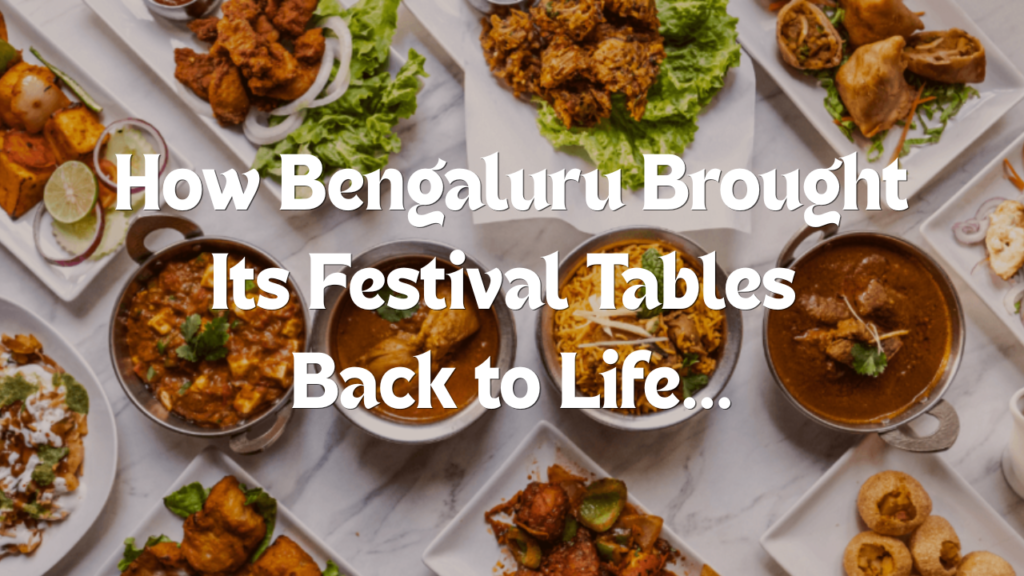
Bengaluru has always been a city of arrivals. People come from every part of India — from Hyderabad and Chennai, from Lucknow and Kolkata, from small towns whose names the city does not know but whose food traditions arrive quietly with the people who carry them. The city absorbs all of it, offers opportunity and infrastructure in return, and asks, in the way that large cities always do, that certain things be left behind. For a long time, one of the things most reliably left behind was the festival table — the specific spread that a particular cuisine produces for a particular occasion, made the way it has always been made, by the people who have always made it.
That has changed. And the change has happened gradually enough that many of the people living there have not fully registered how different their festival tables now look from the ones they were setting even three years ago.
What Festival Food Used to Look Like in a Migrant City
For families who relocated from Hyderabad to Bengaluru, festival occasions — Eid, Bakrid, family gatherings built around significant dates — carried a particular kind of food pressure. The meal was supposed to look and taste a certain way. The nihari was supposed to have been cooking since the previous night. The haleem was supposed to carry the depth of a full day’s preparation. The dum biryani was supposed to arrive at the table with the fragrance that only a sealed, slow-cooked preparation produces.
None of these things were easily replicated in a new city. Local restaurants offering Hyderabadi food could approximate some of it, but approximation and the real thing are separated by a distance that anyone who has eaten both understands immediately. Festival tables in Bengaluru, for many migrant families, ended up being either a compromise or a reason to travel home — and travelling home for every significant occasion is not a practical option for most people most of the time.
The Shift That Intercity Delivery Made Possible
The arrival of reliable intercity food delivery changed the fundamental equation. For the first time, the question of what to put on a festival table in Bengaluru had an answer that did not require a compromise — the food could come from the kitchens in Hyderabad that had been making it correctly for decades, packaged with the care that multi-hour transit requires, and arrive at a Bengaluru address in a condition that honored what it was.
Hungersate has been at the center of this shift for food lovers on the Hyderabad-Bengaluru route. The platform’s focus on established, specialist kitchens — the ones known by reputation rather than advertising, selected for the depth and consistency of their signature dishes — means that what arrives at a festival table through the platform is not a delivery-adjusted version of the cuisine. It is the cuisine, made the right way, by the right hands, arriving through a logistics chain built specifically around preserving what makes it worth ordering.
The freshness that a festival spreads demands — the nihari that has cooked through the night, the haleem that has spent a full day developing, the biryani that carries its fragrance intact from a sealed vessel — is not incidental to the intercity delivery experience. It is the thing the platform has been built to protect.
What Festival Tables in Bengaluru Look Like Now
The change is visible in the specifics. Families who previously set Eid tables with whatever could be sourced locally are now ordering nihari and haleem and dum biryani from Hyderabadi kitchens that their grandparents would recognise by name. The spread that arrives on Bakrid morning carries the weight of the occasion in a way that the compromised version never quite managed.
As the best intercity food delivery app on this route, Hungersate has made it possible for festival tables in Bengaluru to carry the culinary identity of the tradition they belong to — not as an exceptional luxury but as a regular and accessible part of how the occasion is observed. Families that have made the intercity festival order once tend to make it again, because the difference between the compromise and the real thing is impossible to unfeel once it has been felt.
Rashida, who has lived in Bengaluru for six years after relocating from Hyderabad, describes the change plainly. Before intercity delivery, Eid at her Bengaluru home felt like a partial occasion — the gathering was right, the family was right, but the table was not quite what it should have been. The first year she ordered through an intercity platform, she says, was the first year the Eid table in her new city felt like the Eid tables she grew up around. That is not a small thing, she notes. For a festival built around the idea of gathering and abundance, the table is not decoration. That is the point.
The Practical Reality Behind the Change
What has made this shift sustainable rather than occasional is the combination of quality and accessibility. A festival spread from the right Hyderabadi kitchens, delivered intercity through a platform that has built its operation around quality and care, arrives at a price that is genuinely budget-friendly when measured against what the occasion requires. The cost of ordering a full Eid or Bakrid spread through Hungersate — nihari, haleem, biryani, kebabs — compares favorably with the alternatives, and the alternatives do not deliver the same result.
This is the practical dimension of what intercity food delivery has done to festival tables in Bengaluru. It has not just made the real thing available. It has made the real thing affordable and repeatable — a regular part of how significant occasions are observed rather than a rare exception within them.
A City That Now Eats Its Festivals Differently
Bengaluru has always been a city that absorbs what arrives and makes it part of how the city lives. Intercity food delivery has given it something new to absorb — not just the people who carry food traditions with them, but the food traditions themselves, in their authentic form, arriving from the cities where they originated and landing on tables where they belong.
The festival table in Bengaluru looks different now. It looks, increasingly, exactly the way it is supposed to look. And for the families sitting around it, that difference — between the approximation and the real thing — is the whole point.
Bring the authentic festival spread to your Bengaluru table through Hungersate — intercity food delivery that makes every occasion feel exactly the way it should.