
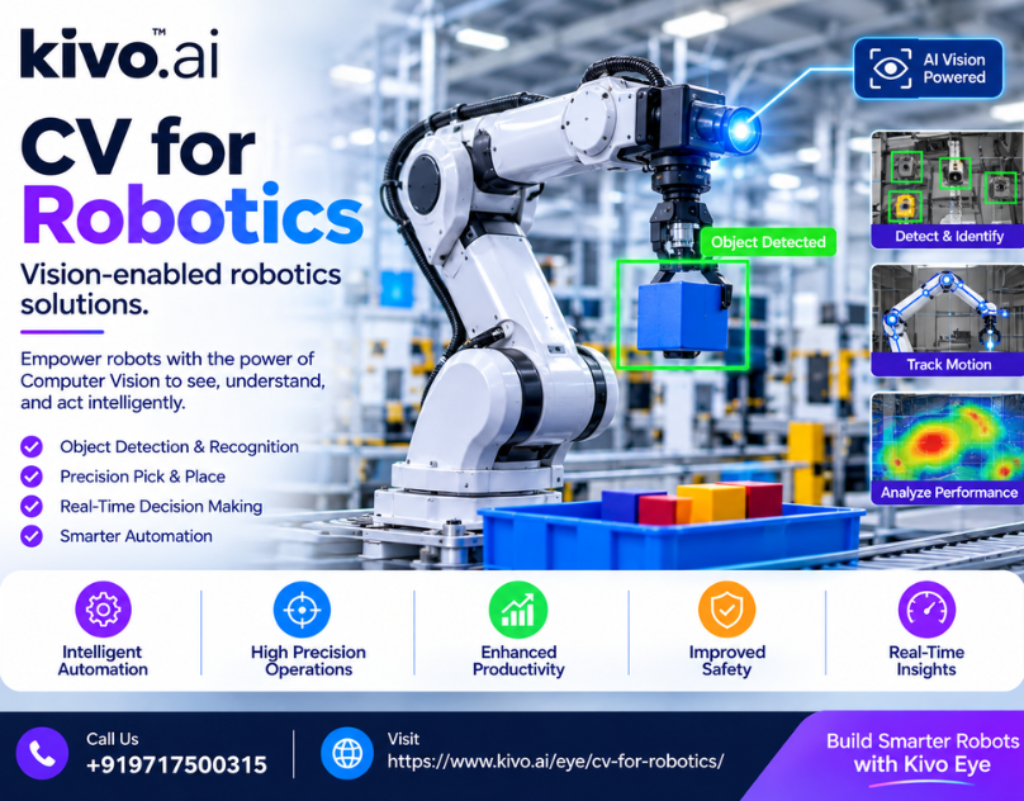
Computer Vision for Robotics: Build Smarter Robots with AI-Powered Vision Solutions by Kivo Eye
The robotics industry is transforming rapidly as businesses adopt Artificial Intelligence (AI), automation, and intelligent vision technologies to improve productivity and operational efficiency. Modern robots are no longer limited to repetitive, pre-programmed tasks. They are becoming smarter, more adaptable, and capable of understanding their surroundings.
One of the key technologies driving this transformation is Computer Vision for Robotics. By combining AI, machine learning, deep learning, and real-time image processing, computer vision enables robots to see, identify, track, and respond to objects and environments with greater precision.
Kivo Eye delivers advanced vision-enabled robotics solutions that help businesses build intelligent, autonomous, and safer robotic systems. From object detection and robotic navigation to quality inspection and human-robot safety monitoring, AI-powered vision is changing how robots interact with the physical world.
What Is Computer Vision in Robotics?
Computer vision in robotics is an AI-powered technology that allows robots to interpret and understand visual information captured through cameras and imaging sensors.
Instead of relying entirely on fixed instructions, robots equipped with computer vision can analyze their surroundings, recognize objects, detect obstacles, and make decisions based on real-time visual information.
Computer vision enables robotic systems to perform tasks such as:
- Object detection, recognition, and classification.
- Automated picking, sorting, and placement.
- Real-time obstacle detection and avoidance.
- Autonomous robot navigation.
- Visual quality inspection and defect detection.
- Human-robot interaction and safety monitoring.
With Kivo Eye, businesses can integrate intelligent computer vision capabilities into robotic platforms to develop smarter automation systems.
How AI-Powered Computer Vision Is Transforming Robotics
Traditional robotic systems often struggle when objects change positions, environments become unpredictable, or unexpected obstacles appear.
AI-powered computer vision addresses these challenges by giving robots better visual awareness and the ability to respond to changing conditions.
Here are some important applications of computer vision in robotics.
1. Robotic Object Detection, Recognition, and Picking
Robotic object detection is essential for automated manufacturing, packaging, material handling, and warehouse operations.
Computer vision systems identify objects, determine their positions, and help robotic arms perform accurate picking and placement operations.
Kivo Eye enables intelligent object detection and tracking to support:
- Automated pick-and-place operations.
- Robotic bin picking and palletizing.
- Object classification and counting.
- Assembly line automation.
- Precision material handling.
By using AI-based object detection and instance segmentation, robots can better identify irregularly shaped objects and improve manipulation accuracy.
2. Autonomous Robot Navigation and Obstacle Avoidance
Autonomous navigation is one of the most important capabilities of modern robotics.
Robots operating in warehouses, factories, and industrial environments must understand their surroundings and avoid unexpected obstacles.
AI-powered computer vision helps robotic systems identify people, equipment, objects, and movement patterns in their operating environments.
Key applications include:
- Autonomous Mobile Robots (AMRs).
- Automated Guided Vehicles (AGVs).
- Warehouse navigation systems.
- Industrial autonomous robots.
- Dynamic obstacle detection.
Kivo Eye supports intelligent visual perception that helps robotics developers build more adaptive and responsive robotic platforms.
3. Human-Robot Safety and Monitoring
As robots increasingly work alongside people, workplace safety becomes a major priority.
Computer vision enables real-time monitoring of human presence, restricted areas, and robot operating zones.
AI-powered vision systems can identify when workers enter designated safety zones and generate alerts or trigger configured safety responses through integrated control systems.
Kivo Eye helps support:
- Human presence detection near robotic arms.
- Virtual safety zone monitoring.
- Restricted-area intrusion detection.
- Collaborative robot (cobot) safety monitoring.
- Industrial workplace compliance monitoring.
These applications help businesses improve safety awareness and support safer human-robot collaboration.
4. Robotic Quality Inspection and Defect Detection
Product quality is critical in industries such as automotive, electronics, pharmaceuticals, and manufacturing.
Traditional manual inspection can be slow and inconsistent, particularly in high-speed production environments.
AI-powered computer vision allows robots to inspect products, identify defects, and verify assembly quality automatically.
With Kivo Eye, businesses can explore:
- Surface defect detection.
- Scratch, crack, and dent identification.
- Component presence verification.
- Assembly validation.
- Automated visual quality inspection.
Advanced instance segmentation enables pixel-level analysis, helping identify and measure visible defects more precisely.
5. Work-in-Progress Tracking and Robotic Process Optimization
Manufacturing facilities often operate multiple robotic workstations simultaneously. Without accurate monitoring, identifying bottlenecks and production delays can be challenging.
Computer vision helps monitor robotic workflows and track objects across different production stages.
Kivo Eye supports intelligent process monitoring through:
- Real-time object counting.
- Work-in-progress (WIP) tracking.
- Region-based activity monitoring.
- Workflow heatmaps.
- Robotic station performance analysis.
These insights help manufacturers identify operational bottlenecks, reduce idle time, and improve overall equipment effectiveness (OEE).
6. Intelligent Robotic Vision for Industrial Automation
Industrial automation requires robotic systems that can operate reliably in complex and changing environments.
Computer vision provides robots with the ability to recognize components, understand workspaces, and perform visual verification during automated operations.
Applications include:
- Automotive assembly automation.
- Electronics component inspection.
- Industrial material handling.
- Robotic packaging and sorting.
- Automated manufacturing processes.
Kivo Eye helps robotics companies develop customized AI vision systems that can integrate with their robotic hardware and control workflows.
Advanced Computer Vision Technologies for Robotics
Modern robotics requires more than basic image recognition. Advanced computer vision technologies improve object understanding, spatial awareness, and operational intelligence.
AI-Based Object Detection and Tracking
Object detection allows robotic systems to identify objects in camera feeds, while tracking helps maintain their identities and monitor movement over time.
This technology is useful for automated picking, sorting, material handling, and robotic navigation.
Instance Segmentation for Precision Robotics
Instance segmentation identifies individual objects at the pixel level rather than simply drawing bounding boxes around them.
This capability is especially useful for:
- Handling irregularly shaped objects.
- Precision robotic grasping.
- Surface defect identification.
- Object separation in crowded environments.
- Detailed visual inspection.
Heatmaps and Dwell-Time Analytics
Heatmaps provide visual insights into movement patterns, activity concentration, and areas where robotic operations experience delays.
These analytics help businesses understand robotic performance, identify workflow inefficiencies, and optimize industrial layouts.
Edge AI: Real-Time Computer Vision for Robotics
For robotics applications, processing speed and reliability are essential. Sending every camera frame to a remote cloud server can introduce delays that affect real-time robotic operations.
Edge AI addresses this challenge by processing visual information directly on supported local hardware.
Kivo Eye supports edge-optimized AI vision deployment using platforms such as:
- NVIDIA Jetson Nano, Xavier, and Orin: For high-performance robotic vision applications.
- Raspberry Pi: For lightweight robotic projects and prototyping.
- ESP32-CAM: For distributed, low-power visual monitoring applications.
Key Benefits of Edge AI in Robotics
- Low-latency visual processing.
- Faster response to changing environments.
- Reduced dependence on internet connectivity.
- Improved control over local data processing.
- Cost-efficient and scalable deployment.
Edge-based computer vision makes it easier to develop responsive robotic systems for industrial and commercial environments.
Benefits of Computer Vision for Robotics
Implementing AI-powered computer vision provides several advantages for modern robotics businesses.
- Improved Operational Accuracy: AI-powered object recognition and tracking help robots perform visual tasks with greater consistency.
- Increased Automation Efficiency: Automated picking, sorting, inspection, and monitoring reduce repetitive manual work.
- Enhanced Workplace Safety: Visual monitoring helps identify people, obstacles, and restricted-area activity.
- Better Adaptability: Vision-enabled robots can respond to changes in object positions and surrounding environments.
- Reduced Operational Downtime: Early detection of process issues and visual anomalies supports more efficient operations.
- Scalable Robotic Systems: Custom AI vision models can be developed and deployed across different robotic platforms and environments.
Why Choose Kivo Eye for Computer Vision in Robotics?
Building intelligent robots requires reliable visual perception, customized AI models, and seamless integration with robotic hardware.
Kivo Eye provides computer vision solutions designed to help robotics OEMs, system integrators, and automation companies develop production-ready AI vision systems.
Key advantages include:
- Customized AI Vision Models: Develop computer vision models based on specific robotic applications and environments.
- Real-Time Object Detection: Enable robots to identify and track objects through intelligent camera systems.
- Edge AI Deployment: Run vision models on supported edge hardware for low-latency processing.
- Advanced Instance Segmentation: Support precise object understanding and visual inspection.
- Robotics Workflow Analytics: Use heatmaps and movement analysis to identify operational inefficiencies.
- Scalable Integration: Support development from proof-of-concept to larger robotic deployments.
- End-to-End Technical Support: Get assistance with vision architecture, model development, integration, and optimization.
Kivo Eye focuses on building practical AI vision systems that help robots move beyond basic automation toward intelligent, perception-driven operations.
The Future of Robotics Is Vision-Enabled
The future of robotics will be shaped by intelligent perception, autonomous decision-making, and advanced AI technologies.
As industries adopt collaborative robots, autonomous mobile robots, and intelligent manufacturing systems, computer vision will play an increasingly important role in making robots more adaptable and capable.
From automated warehouses and smart factories to healthcare robotics and industrial automation, AI-powered vision systems are helping machines understand the world around them.
Businesses investing in computer vision for robotics can build more efficient automation workflows, improve operational accuracy, and prepare their robotic platforms for increasingly complex tasks.
Conclusion
Computer vision is transforming robotics by enabling machines to see, understand, and interact with their surroundings. Through object detection, autonomous navigation, robotic safety monitoring, defect detection, and intelligent workflow analytics, AI vision systems are making automation smarter and more efficient.
Kivo Eye helps businesses develop vision-enabled robotics solutions that combine advanced AI models, real-time image processing, and edge computing capabilities.
Whether you are building autonomous robots, upgrading industrial automation, or developing next-generation robotic products, Kivo Eye can help turn your robotics vision into intelligent, practical solutions.
Explore Kivo Eye’s Computer Vision Solutions for Robotics and discover how AI-powered vision can transform your robotic systems.