
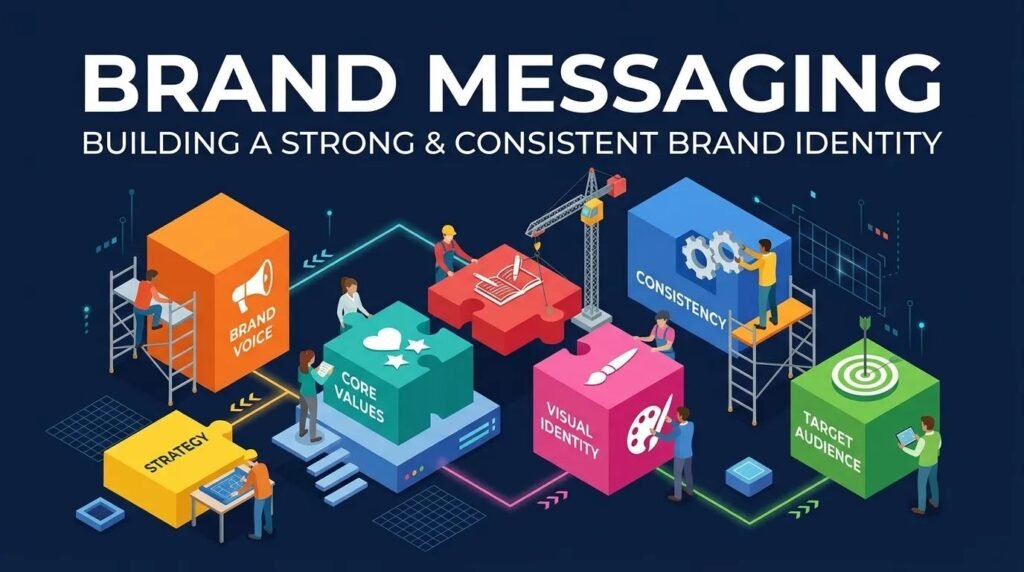
Brand messaging gives businesses a clear and consistent way to communicate their identity, values, personality, purpose, and unique value. When messaging is carefully developed, it can strengthen brand recognition, improve customer understanding, support positioning, and create stronger relationships across different communication channels.
A business can have an attractive logo, professional website, and strong products, but these elements alone do not determine how customers understand the brand. The words a company uses, the ideas it emphasizes, and the way it communicates its value all contribute to the overall perception of the business.
Customers may discover a company through search engines, social media, online advertisements, blog content, videos, email campaigns, or conversations with sales teams. If each interaction communicates a similar identity and purpose, customers can develop a clearer understanding of the brand. This consistency can make the business easier to recognize and remember.
What Is Brand Messaging?
Brand messaging refers to the collection of ideas, statements, values, benefits, and communication themes that explain what a business represents. It creates a connection between the company’s identity and the expectations of its target audience.
Effective messaging is not simply about describing products or services. It should communicate why those offerings matter and what kind of value customers can expect. A company may have several competitors offering similar products, but strong messaging can help explain why its particular approach, experience, expertise, or customer benefits are worth considering.
Brand messaging can also create alignment within an organization. Marketing teams, sales representatives, customer service employees, and business leaders can communicate more effectively when they understand the central ideas that define the brand. This creates a more unified experience for customers.
Developing a Strong Brand Messaging Strategy
A brand messaging strategy creates a foundation for communicating a business’s purpose, positioning, personality, and value proposition. Instead of allowing every marketing channel to communicate independently, the strategy establishes a central direction that different types of content can support.
Understanding the target audience should be an important part of this process. Customers have different problems, motivations, preferences, and expectations, so messaging should reflect the people a business is trying to reach. Audience research, customer conversations, reviews, surveys, and feedback can all provide useful insights into what matters most to potential customers.
Businesses should also identify what makes them meaningfully different. Differentiation may come from expertise, convenience, innovation, customer service, reliability, product quality, specialization, or another characteristic that customers genuinely value.
When audience needs and brand strengths are connected, the resulting message becomes more relevant and persuasive without needing to rely on exaggerated claims.
Creating a Consistent Brand Communication Strategy
A brand communication strategy determines how the central brand message should appear across different channels and customer touchpoints. The communication format may change from one platform to another, but the underlying identity should remain recognizable.
For example, website content can provide detailed explanations, while social media communication may be shorter and more conversational. An advertisement might highlight one specific benefit, while an email campaign can develop a longer relationship with subscribers.
Consistency does not require every platform to use identical language. Instead, the same core values, positioning, personality, and promises should be communicated in ways that fit each channel.
Businesses exploring broader approaches to branding and marketing can also look at Smart Marketing and Branding Ideas for additional context on connecting communication with broader business objectives.
Brand Voice and Tone
Brand voice and tone strongly influence how customers experience written and spoken communication. Brand voice represents the personality of the business, while tone changes according to the context in which that personality is expressed.
A financial services company, for example, may want a voice that feels knowledgeable, dependable, and confident. A lifestyle company may use a warmer, more relaxed personality. Neither approach is automatically better. The important factor is whether the communication feels appropriate for the audience and the brand’s positioning.
Tone can change depending on the situation. Promotional content may be energetic and persuasive, while customer support communication may need to be calm, helpful, and empathetic. The emotional expression can change without abandoning the brand’s underlying personality.
A recognizable voice can eventually become part of the brand itself. Customers may identify a company not only through its visual elements but also through the language, attitude, and communication style it consistently uses.
Why Consistent Brand Messaging Matters
Consistent brand messaging creates familiarity. When customers repeatedly encounter similar positioning, values, benefits, and personality, they have more opportunities to understand what the brand represents.
Inconsistent communication can create uncertainty. A business that presents itself as premium in one channel but focuses heavily on discount messaging in another may unintentionally create conflicting perceptions. Customers may struggle to determine what the company actually stands for.
Consistency can also support trust. When a company communicates stable promises and then delivers an experience that matches those promises, customers are more likely to view the brand as credible.
This consistency should extend beyond marketing. Sales conversations, customer service, email communication, website copy, advertising, and social media can all influence the same overall brand perception.
Brand Positioning and Customer Perception
A brand positioning strategy establishes how a business wants to be perceived relative to competing businesses. It gives the brand a distinct place in the customer’s mind and helps communicate why the company deserves consideration.
Strong positioning usually focuses on something meaningful rather than relying on broad statements that could describe almost any company. A brand may emphasize specialist expertise, simplicity, premium service, affordability, reliability, innovation, or another characteristic that has genuine relevance to its audience.
Messaging turns this positioning into language customers can understand. Instead of simply claiming that a company is different, effective communication explains the specific value behind that difference.
Clear positioning can also make content development easier. Once marketers understand the central identity of the brand, articles, campaigns, advertisements, social posts, and other materials can reinforce the same perception.
Brand Identity Messaging
Brand identity messaging connects a company’s verbal communication with its broader visual and strategic identity. Logos, colors, typography, photography, and design contribute to recognition, but language also plays an important role.
The words a company chooses can communicate its personality and values. A technology company focused on innovation may use language associated with progress and possibility, while a service business built around reliability may emphasize trust, consistency, and dependable support.
When verbal and visual identities work together, customers receive a more coherent experience. If a company’s design feels modern and innovative but its communication sounds outdated or disconnected, the overall identity can become less convincing.
A clear identity becomes increasingly useful as a company grows because new employees, campaigns, products, and communication channels can all build upon the same foundation.
Customer-Focused Brand Messaging
Customer-focused brand messaging shifts communication away from simply describing what a business does and toward explaining why its offering matters to customers.
A software company, for instance, could describe its platform through a long list of technical features. A customer-focused message might instead explain how those features help users save time, simplify workflows, improve productivity, or reduce operational difficulties.
Creating this type of communication requires an understanding of real customer needs. Reviews, support conversations, sales calls, surveys, and direct feedback can reveal the words customers naturally use to describe their problems and desired outcomes.
Using familiar customer language can make messages easier to understand. It can also reduce unnecessary technical terminology that may prevent potential customers from immediately recognizing the value of an offering.
Using Brand Storytelling
A brand storytelling strategy gives businesses a way to communicate their identity through meaningful narratives. Stories can explain why a company was created, what challenges it has overcome, what values guide its decisions, or how its products and services have helped customers.
Storytelling does not need to involve dramatic events. A simple customer experience can become a powerful story when it demonstrates an important brand value.
For example, rather than simply stating that a company prioritizes customer service, a business could describe a situation where its team went beyond expectations to solve a customer’s problem. The story provides evidence of the value instead of merely making a claim.
Stories can also make abstract ideas easier to remember. Customers may forget a general statement about company values but remember a relatable experience that demonstrates those values.
Communicating Effectively Across Digital Channels
Effective brand communication requires businesses to understand how different platforms are used. A message designed for an email newsletter may not work exactly the same way on social media or within a video.
The central idea should remain consistent, while the format and presentation can change. Social content may be conversational and concise, websites can provide detailed information, videos can communicate personality visually, and email can support more direct relationships.
The objective is to create a connected experience rather than forcing every channel to look or sound identical.
This becomes particularly relevant as businesses explore emerging digital environments. Companies interested in virtual brand experiences can explore Mastering Metaverse Branding to understand how branding can extend into new forms of digital interaction.
Simplifying the Core Brand Message
Many businesses make their communication unnecessarily complicated by trying to explain everything at once. They may include every feature, achievement, service, technical detail, and benefit in a single message, leaving customers unsure about the most important point.
Simplifying the brand message can make communication clearer. The goal is not to remove important information but to establish a central idea that customers can understand quickly.
A clear core message can then support more detailed communication. Website pages, sales materials, articles, and advertisements can expand on that central idea without losing sight of what the brand ultimately wants customers to remember.
This clarity can also benefit employees. When the central brand message is easy to understand, teams can communicate the company’s value more consistently.
For businesses interested in reducing unnecessary complexity, Brand Simplification offers another perspective on making brand communication more focused and understandable.
Brand Message Development
Brand message development should be viewed as an ongoing process. Businesses evolve, customer expectations change, new competitors enter markets, and products or services are updated. As these changes occur, existing communication may no longer accurately represent the company.
Regular reviews can reveal outdated claims, unclear benefits, inconsistent terminology, or positioning that no longer reflects the organization’s direction.
Customer feedback is especially valuable because customers can reveal what they actually understand from the brand’s communication. Sales teams can also identify common questions and objections, while customer service teams can highlight areas where customers appear confused.
However, businesses should avoid changing their messaging too frequently. Constant changes can weaken recognition and make the brand difficult to remember. Meaningful updates should be made when there is a genuine change in the company, audience, offering, or market position.
Building Trust Through Brand Messaging
Trust develops when brand communication is supported by real experiences. A business that consistently communicates promises it can deliver has a stronger opportunity to build credibility.
Overly exaggerated claims can create unrealistic expectations. If the customer experience does not match the message, disappointment can damage trust. Clear and honest communication is often more sustainable than aggressive promotional language.
Trust also develops through repeated experiences. When the information customers receive before purchasing aligns with what they experience after becoming customers, the brand becomes more believable.
For this reason, messaging should not be treated as something that belongs only to the marketing department. The promises communicated through branding should be reflected in products, services, support, and the complete customer experience.
Brand Messaging and Digital Customer Engagement
Strong messaging can also contribute to deeper online relationships. When customers clearly understand a company’s personality and value, they have a stronger foundation for interacting with it through social platforms, websites, email, communities, and other digital channels.
This connection becomes particularly important when businesses are working to create meaningful customer interactions rather than simply broadcasting promotional content. Consistent communication can help customers feel that different interactions belong to the same brand experience.
Businesses can explore Digital Brand Engagement to learn more about strengthening customer relationships through digital interactions and creating more connected brand experiences.
Supporting Long-Term Brand Growth
Strong brand messaging can provide a foundation for sustainable growth because it gives marketing activities a recognizable identity to build upon. Instead of creating disconnected campaigns, businesses can develop different initiatives around the same central positioning and values.
Clear messaging can also attract more relevant audiences. When customers immediately understand what a business offers and who it serves, they can more easily determine whether the company is appropriate for their needs.
Over time, repeated and consistent communication can strengthen the associations customers have with a brand. This can support recognition, loyalty, recommendations, and stronger relationships.
A clear messaging foundation can also help businesses expand into new products, services, or markets. While communication may need to adapt to new audiences, the core identity can remain recognizable.
Conclusion
Brand messaging provides businesses with a structured way to communicate who they are, what they offer, what they value, and why customers should pay attention. It connects brand identity with customer needs and creates a consistent foundation for communication across multiple channels.
A strong brand messaging strategy does not require businesses to repeat the same words everywhere. Instead, it ensures that the central identity, positioning, personality, and value remain recognizable while communication adapts naturally to different platforms.
When businesses combine clear positioning, customer-focused language, authentic storytelling, consistent brand voice, and honest communication, they can create a stronger connection with their audiences. Over time, this consistency can contribute to greater recognition, credibility, customer trust, and long-term brand growth.
Frequently Asked Questions
1. What is brand messaging?
Brand messaging is the collection of ideas, values, statements, benefits, and communication themes a business uses to explain its identity and value to customers. It helps create a consistent understanding of the brand across different channels.
2. Why is brand messaging important?
Brand messaging helps customers understand what a company offers, what makes it different, and why its products or services matter. Clear messaging can support recognition, trust, positioning, and stronger customer relationships.
3. What is a brand messaging strategy?
A brand messaging strategy establishes how a company communicates its purpose, personality, positioning, benefits, and value proposition. It provides direction for communication across websites, social media, advertising, email, sales, and customer service.
4. What is the difference between brand voice and tone?
Brand voice represents the consistent personality of a company, while tone describes how that personality changes according to the situation. A business can maintain the same voice while using different tones for advertising, customer service, or social media.
5. How does consistent brand messaging help businesses?
Consistent messaging creates familiarity and makes a company easier to recognize. It can also reduce confusion and help customers develop a clearer understanding of what the brand represents.
6. What is customer-focused brand messaging?
Customer-focused brand messaging emphasizes the needs, problems, goals, and desired outcomes of customers. Instead of only describing features, it explains how an offering can provide meaningful value.
7. How does storytelling support brand messaging?
Storytelling makes brand communication more relatable and memorable. Stories can demonstrate company values, explain the brand’s purpose, and show how customers have benefited from its products or services.
8. What is brand positioning?
Brand positioning defines how a company wants customers to perceive it compared with competitors. It identifies meaningful characteristics or benefits that can help the business occupy a distinct position in the market.
9. How can a business improve its brand messaging?
A business can improve its messaging by researching its audience, clarifying its value proposition, understanding competitors, reviewing customer feedback, developing a consistent voice, and simplifying complex ideas.
10. Should brand messaging remain the same forever?
No. Messaging can evolve as a company, market, audience, or product offering changes. However, updates should be intentional so the brand maintains continuity and recognition.
11. What role does brand messaging play in customer trust?
Clear and honest messaging can help establish realistic expectations. When the experience customers receive matches the promises communicated by the brand, credibility and trust can become stronger.
12. How does brand messaging affect brand recognition?
Repeated communication of consistent ideas, values, positioning, and personality helps customers associate those characteristics with the company. Over time, this can make the brand easier to recognize and remember.
13. Can brand messaging be different on social media and a website?
Yes. The format and tone can change according to the platform, but the central brand identity and positioning should remain recognizable. This allows communication to feel natural without becoming inconsistent.
14. Why is customer research important for brand messaging?
Customer research reveals the problems, motivations, language, and expectations of the target audience. These insights can help businesses create messages that are more relevant and easier for customers to understand.
15. How often should a company review its brand messaging?
There is no universal schedule, but businesses should review messaging when there are meaningful changes in their audience, products, services, positioning, competition, or market. Regular evaluation can help identify communication that has become outdated or unclear.
16. What is brand identity messaging?
Brand identity messaging connects the verbal side of a brand with its visual identity and broader positioning. It ensures that the language, personality, design, and values communicate a coherent overall identity.
17. Does simple brand messaging mean using fewer words everywhere?
Not necessarily. Simplification means making the central idea clear rather than removing all detail. Long-form content can still provide depth while supporting a simple and understandable core message.
18. How does brand messaging support marketing campaigns?
A clear message gives campaigns a common foundation. Different campaigns can focus on different products, audiences, or benefits while still reinforcing the same overall brand identity and positioning.
19. Can small businesses benefit from strong brand messaging?
Yes. Clear messaging can help small businesses communicate their value and differentiate themselves from competitors. It can also make their marketing and customer communication more consistent.
20. What makes brand messaging effective?
Effective brand messaging is clear, relevant, consistent, authentic, customer-focused, and aligned with the actual experience a business provides. It should communicate meaningful value without creating unrealistic expectations.