
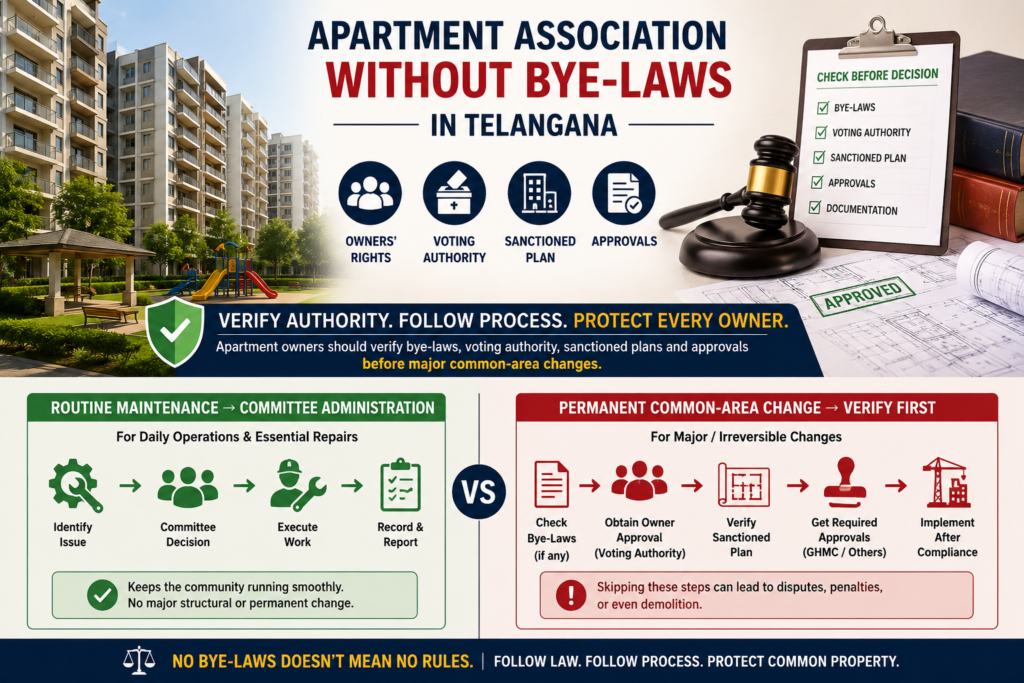
Apartment Association Without Bye-Laws in Telangana: 11 Critical Risks & Legal Remedies
An Apartment Association Without Bye-Laws in Telangana can create serious confusion for flat owners.
Who can vote?
How many owners must approve a decision?
Can 10 or 20 people attending a meeting decide for 100 or 200 flats?
Can an existing common facility be removed?
Can a garden, play area, parking area or other common space be permanently changed?
Can the committee spend large amounts without a recorded vote?
And what can an individual owner legally do if the association proceeds without clear authority?
These questions are increasingly important in apartment communities across Hyderabad and Telangana.
The simple principle is:
No bye-laws does not mean no rules.
Essential maintenance may have to continue, but an association should not treat the absence of bye-laws, quorum rules or voting procedures as unlimited authority to make irreversible decisions affecting common property.
The main legal starting point is the Telangana Apartments (Promotion of Construction and Ownership) Act, 1987. The Act is Telangana’s apartment-ownership legislation and deals with apartment ownership and common-area administration.
Readers looking for more apartment-related public guidance can also browse the YourNeeds.asia Articles Portal.
The strongest case example for this article is actually the February 2026 Raheja Vistas TGRERA order because it directly connects several themes our readers will care about: corpus transfer, registered maintenance society, common-area demarcation, sanctioned-plan compliance and refusing certain changes beyond the sanctioned plan. TGRERA ordered corpus reconciliation and transfer, required common/open areas to be demarcated according to the sanctioned plan, and declined certain clubhouse/open-space changes beyond that approved plan.
Quick Answer: What Happens if an Apartment Has No Bye-Laws?
If valid bye-laws exist, the association should follow the notice, quorum, voting, expenditure and decision-making procedures contained in those bye-laws and other governing documents.
If an Apartment Association Without Bye-Laws in Telangana genuinely has no defined voting procedure, major and irreversible decisions should not be justified merely by saying that a few residents attended a meeting and agreed.
Routine administration is one thing.
Permanent alteration of common property is another.
The more permanent and important the decision, the stronger the need for clear legal authority, documented approval and compliance with the sanctioned plan.
1. Can an Apartment Association Function Without Bye-Laws?
Yes, essential administration may still need to continue.
Security, lifts, water systems, common electricity, housekeeping, drainage and essential repairs cannot simply stop because governance documents are incomplete.
But that does not answer whether the committee can permanently alter common property.
If bye-laws exist → follow them.
If bye-laws do not exist → continue essential management, but establish a lawful governance and approval process before major discretionary changes.
The Telangana Apartments Act itself recognises apartment governance through formal legal structures rather than leaving all common-property decisions to informal understandings.
2. Can 10 or 20 Residents Decide for Every Apartment Owner?
Not automatically.
A meeting attendance sheet proves that people attended.
It does not by itself prove that a legally sufficient vote occurred.
Before accepting a major decision, owners should ask whether proper notice was issued, whether the issue appeared on the agenda, whether quorum was defined, whether voting rights were known, what majority was required and whether the result was formally recorded.
If valid rules exist → those rules should answer these questions.
If no rules exist → attendance alone should not be presented as unquestionable authority over all owners.
This is particularly important for an Apartment Association Without Bye-Laws in Telangana, because there may be no previously agreed mechanism for determining whether a small meeting represents the wider ownership.
3. What If There Is No Voting Procedure?
If voting rules exist → use them.
If they do not exist → establish a transparent procedure before approving major irreversible decisions.
Owners should know:
who can vote, what counts as quorum, what percentage is required, how notice is issued, how votes are recorded and how the final resolution is certified.
A committee should not decide after the dispute begins that whichever owners happened to attend constituted the required majority.
For major common-property decisions, documented owner participation becomes particularly important where formal bye-laws are missing.
4. Is a WhatsApp Poll Legally Compulsory?
No general rule makes WhatsApp the compulsory voting mechanism for every apartment association in Telangana.
WhatsApp is a communication platform, not a substitute for the applicable law or valid governing documents.
However, where an Apartment Association Without Bye-Laws in Telangana has no established voting mechanism, a documented electronic poll involving all eligible owners may be useful evidence that the wider ownership was actually consulted.
The distinction is important:
No WhatsApp poll does not automatically make a decision illegal.
But:
A small informal gathering does not automatically mean all owners approved the decision.
5. Can an Association Remove or Change an Existing Common Amenity?
First determine whether the proposal is maintenance or an alteration.
Repairing broken play equipment is maintenance.
Removing the entire facility and converting the area to another use is different.
Repairing damaged landscaping is maintenance.
Constructing a permanent structure in an existing open area may be an alteration.
If valid approval rules exist → follow them.
If no bye-laws or voting process exists → obtain documented authority before making an irreversible change.
If the sanctioned plan shows the area or amenity in a particular manner → the sanctioned plan becomes particularly important.
A residents’ resolution should not be assumed to override applicable planning or building requirements.
6. Can an Apartment Association Construct Something New in a Common Area?
Possibly, depending on what is being proposed.
Placing movable furniture is very different from constructing a permanent base, shed, enclosure, wall, drainage connection, plumbing arrangement or other civil work.
Within GHMC jurisdiction, regulated construction and sanctioned-plan issues may require examination under the municipal building framework. Owners can refer to the official Greater Hyderabad Municipal Corporation and its building-related services when municipal approval is relevant.
A vote cannot automatically legalise something prohibited by a sanctioned plan or municipal regulation.
The Telangana High Court has dealt with apartment disputes where proposed common-area/boundary construction became a question of sanctioned plans and municipal authority rather than merely an internal association preference.
7. Apartment Association Without Bye-Laws in Telangana: What About Common Funds?
Essential authorised maintenance expenditure must continue.
Large discretionary expenditure deserves greater scrutiny.
If financial powers are defined → follow them.
If no financial rules exist → obtain documented approval for substantial non-essential spending.
Every major expenditure should leave a clear record showing:
proposal → estimate → authority → approval → invoice → payment → accounts.
Where permanent assets are purchased, the association should also maintain an asset register showing ownership and custody.
This becomes especially important when office-bearers change.
8. Can a Separate Informal or Cultural Committee Control Common Property?
Not merely because the group exists or conducts community activities.
The important question is legal authority.
If an organisation claims the right to control or permanently alter apartment common property, owners can reasonably ask:
What is the entity?
How is it registered?
What do its governing documents permit?
Who authorised it to exercise powers over common property?
A social or cultural role does not automatically establish legal authority over immovable common areas.
If the lawful apartment owners’ body has authority → decisions should proceed through that governance structure.
If authority is unclear → establish it before permanent action.
9. What If the Present Committee Is Leaving Soon?
An outgoing committee does not stop functioning simply because elections are approaching.
Essential maintenance should continue.
Emergency repairs should continue.
Existing lawful contracts may need to be administered.
But major optional and irreversible decisions deserve additional caution when a committee will shortly leave office.
Ask one simple question:
Why must this permanent change be made now rather than after a properly documented owner decision or the next committee takes office?
If there is an emergency → document it.
If there is no urgency → postponing the irreversible part may reduce legal and governance disputes.
10. What If There Are No Signed Approvals From Owners?
This does not mean every apartment decision requires signatures from every owner.
That would make routine administration almost impossible.
But consider a different situation:
There are no bye-laws.
There is no quorum rule.
There is no established voting procedure.
There is no formal ballot.
There is no signed resolution from a defined majority.
And a small meeting proposes a permanent change affecting everyone.
In that situation, the absence of documented approval becomes an important weakness.
An Apartment Association Without Bye-Laws in Telangana should be able to explain the legal basis on which its decision is said to bind owners who did not attend or consent.
11. What If the Sanctioned Plan and the Association Decision Are Different?
This is one of the most important questions.
If the sanctioned plan permits the proposed work → association approval and any other statutory requirements must still be followed.
If the sanctioned plan does not permit it → do not assume an owners’ vote automatically cures the problem.
If nobody has checked the sanctioned plan → obtain it before undertaking major permanent work.
Recent Telangana RERA proceedings reinforce the importance of sanctioned layouts, common areas and authorised use.
Major Court and RERA Cases Apartment Owners Should Know
These cases do not mean every apartment dispute will have the same result. Each depends on its own law, documents and facts.
They are useful because they show how courts and regulators approach common areas, sanctioned plans, corpus funds and apartment-owner rights.
Supreme Court 2026: Common-Area Rights Cannot Simply Be Ignored
In a judgment dated 20 January 2026, the Supreme Court considered a Haryana apartment project where authorities had allowed part of the group-housing land to be used for commercial development.
The applicable Haryana apartment law provided that apartment owners had an undivided interest in common areas in the percentage recorded in the Declaration.
The Court found that the authorities had ignored vested apartment-owner rights when allowing the disputed change. It emphasised the permanent character of the declared undivided interests and the legal requirements for altering those interests.
What happened?
The dispute arose after land associated with the housing project was effectively removed from the original project framework for commercial use.
The Supreme Court criticised the way the authorities and developer had dealt with the apartment owners’ vested rights and held that the apartment-ownership framework could not simply be bypassed.
What is the lesson for Telangana owners?
This was a Haryana case under Haryana legislation, so it should not be presented as if it directly decides the Telangana Act.
But the broader lesson is useful:
Common property and apartment owners’ undivided interests are legal rights, not merely committee conveniences.
Read the official Supreme Court judgment.
Telangana High Court: Bellezza Apartment Common-Area/Boundary Dispute
The Telangana High Court dealt with litigation involving Bellezza Apartment Owners Welfare Association, another adjoining apartment community and GHMC.
The dispute concerned construction of a compound wall and whether the work was consistent with the sanctioned plan and applicable requirements. GHMC treated the disputed wall as unauthorised/deviating from the sanctioned plan, leading to litigation.
What happened?
The matter could not be resolved simply on the basis that one group of apartment owners wanted the wall.
The dispute required consideration of the sanctioned plan, municipal authority and interests of affected stakeholders.
That is the important practical lesson:
An association resolution does not automatically end the legal inquiry when the physical work also raises sanctioned-plan or municipal questions.
Read the Telangana High Court case.
Aliens Elite Corpus Fund Case: Telangana RERA Ordered ₹5.09 Crore Plus Interest
The Aliens Elite Welfare Association pursued a corpus-fund dispute before Telangana RERA.
According to the official order, flat owners had paid ₹100 per square foot toward a corpus fund, with the total claimed corpus calculated at ₹5,09,23,500. The association alleged that the corpus had not been transferred as promised.
The promoter argued, among other things, that residents had unpaid maintenance and that the project had been completed before RERA.
TGRERA made an important distinction between maintenance charges and corpus fund. It concluded that alleged maintenance arrears did not by themselves justify withholding the corpus.
What happened?
TGRERA directed the respondents to refund:
₹5,09,23,500
with:
10.65% interest from 2013 until actual payment
within 60 days, according to the order.
Why does this matter?
It shows that corpus-fund obligations should not casually be mixed with ordinary maintenance disputes.
If a builder owes corpus under the applicable sale documents and legal framework, residents may have a separately enforceable claim.
Read the official Telangana RERA order.
2026 Raheja Vistas Case: Corpus, Common Areas and Sanctioned Plans
A particularly useful 2026 Telangana RERA order involved Raheja Vistas Towers D, E and F.
Among the issues were transfer of corpus and maintenance deposits, common areas, project documentation, the compound wall, parking and sanctioned-layout compliance.
TGRERA noted that Sections 11 and 17 of RERA connect promoter obligations with formation of the association, common areas, handover and relevant project documents. It also examined contractual obligations requiring maintenance/corpus amounts to be transferred to the appropriate registered maintenance society.
What happened to the corpus?
TGRERA directed reconciliation of the accounts within 15 days and then directed transfer of the balance corpus, subject to the terms stated in the order, within a further 30 days.
What happened to common areas?
The Authority required physical demarcation of common areas, open spaces, driveways, service zones and amenity/commercial areas according to the sanctioned layout, and directed that the demarcation plan be handed over to the registered maintenance society.
It also warned against converting or permitting exclusive use of common/visitor parking contrary to sanctioned plans.
What is the lesson?
For an Apartment Association Without Bye-Laws in Telangana, this case is particularly useful for understanding a separate but related point:
The sanctioned plan remains important even when residents have strong preferences about how an area should be used.
Read the official 2026 Telangana RERA order.
Apartment Association Without Bye-Laws in Telangana: If Rules Exist vs If They Do Not
The simplest approach is to use the following test.
If valid bye-laws exist: follow them.
If no bye-laws exist: establish a proper governance process before major permanent decisions.
If quorum is defined: satisfy it.
If quorum is not defined: do not invent a convenient number after the meeting.
If voting rules exist: conduct the required vote.
If voting rules do not exist: obtain broader documented approval and legal guidance for major irreversible decisions.
If the work is routine maintenance: continue necessary administration.
If the work permanently changes a common amenity: verify authority, owner approval and sanctioned-plan compliance first.
If municipal permission is required: obtain it.
If the sanctioned plan does not permit the work: do not assume a residents’ vote automatically legalises it.
Can RERA Be Used Against an Apartment Association?
Not every association dispute belongs before TGRERA.
RERA is especially relevant where the dispute concerns the promoter, project obligations, sanctioned plans, promised amenities, handover, common-area documents, association formation, conveyance, maintenance deposits or corpus obligations.
The 2026 Raheja Vistas order expressly discussed Sections 11 and 17 of RERA in relation to association formation, common areas, documents and corpus/maintenance transfer.
A purely internal dispute between owners and their own association may require another route depending on the association’s legal registration and the relief sought.
Owners should therefore identify who allegedly violated what obligation before choosing the forum.
Visit the official Telangana RERA website.
When Can an Owner Approach GHMC?
GHMC may become relevant where the physical work raises municipal issues such as unauthorised construction, deviation from the sanctioned plan or work requiring municipal approval.
GHMC is not normally the body that decides whether an association’s internal meeting achieved its required quorum.
Those are different issues.
The Bellezza litigation illustrates why sanctioned-plan disputes involving common property can move beyond internal association voting and require municipal/legal scrutiny.
Visit the official GHMC website.
Can an Individual Owner Approach a Civil Court?
Potentially, yes.
Where an owner contends that common property is about to be unlawfully or irreversibly altered, a lawyer may examine whether civil remedies such as an injunction or declaration are appropriate.
If the work has not started → object in writing and ask for the supporting authority.
If work is imminent → obtain legal advice quickly.
If work has started → preserve dated photographs, communications, meeting records and available plans.
Whether a court grants temporary or permanent relief depends on the facts, documents, ownership rights, urgency and applicable law.
Can an Owner File a Police Complaint Against Association Members?
A disagreement about an association decision does not automatically become a criminal case.
A criminal complaint should be considered only where facts and evidence independently support an alleged offence.
Examples could include situations involving alleged forgery, dishonest misappropriation, threats or intentional property damage, depending on the evidence and applicable criminal law.
Do not label an unpopular association decision as “fraud” or “cheating” merely because owners disagree with it.
First determine what actually happened.
What Should an Owner Ask the Association For?
Before taking legal action, send a written request seeking the association registration details, Declaration, applicable bye-laws if any, sanctioned plan, meeting notice, agenda, attendance record, quorum calculation, voting/result record, resolution, estimate, source of funds and any municipal approval relevant to the proposed work.
Then ask one direct question:
“Please identify the legal or governing provision authorising this decision and the approval process through which it became binding on apartment owners.”
If the documents answer that question clearly, the dispute may become much easier to evaluate.
If the association cannot answer it, the governance problem becomes clearer.
What If the Association Produces Valid Documents?
If the documents show that proper authority existed, required voting was completed, the decision falls within association powers and no statutory or sanctioned-plan restriction is violated, an individual owner’s disagreement alone may not invalidate the decision.
The correct response is then to use the remedies available under the applicable governance structure rather than assuming the decision is automatically illegal.
What If the Association Has Bye-Laws but Did Not Follow Them?
This is different from having no bye-laws.
If valid bye-laws exist → follow them.
If the committee ignored them → object in writing and request that the decision be reconsidered using the proper notice, quorum and voting procedure.
Depending on the association’s registration and the nature of the dispute, remedies may lie before the relevant registration authority or civil court.
What If There Are Truly No Bye-Laws and No Voting Rules?
This is the core problem addressed by this article.
For an Apartment Association Without Bye-Laws in Telangana, absence of formal rules should create more caution, not more power.
Essential maintenance can continue.
Emergency work can continue.
But before an optional permanent common-area change, owners should establish:
legal authority,
the applicable governance mechanism,
a transparent voting process,
documented approval,
financial authority,
and sanctioned-plan compliance.
If these cannot be established and irreversible work is about to begin, an affected owner should obtain legal advice before the physical situation becomes difficult to reverse.
Frequently Asked Questions About an Apartment Association Without Bye-Laws in Telangana
Can an Apartment Association Without Bye-Laws in Telangana make major decisions?
Routine administration may continue, but major permanent common-area decisions should not simply rely on informal attendance. The association should establish its authority, owner-approval process and compliance with applicable law and sanctioned plans.
Does no bye-laws mean every owner must sign every decision?
No. Routine maintenance cannot practically require unanimous signatures. The concern becomes stronger for major irreversible changes when there is no quorum rule, voting mechanism or documented approval.
Can 20 residents decide for 100 flats?
Not automatically. The important question is whether those residents constituted a valid decision-making body under the applicable governance rules.
Is a WhatsApp poll mandatory?
No. But documented owner consultation can be useful where no formal voting system exists.
Can the association remove an existing common amenity?
Possibly, depending on the legal status of the amenity, sanctioned plan, governing documents and required approval. Repair and permanent removal should not automatically be treated as the same thing.
Can an association construct something permanently in an open area?
Check the sanctioned plan, association authority and applicable municipal requirements first.
Can the majority override the sanctioned plan?
Do not assume so. The Raheja Vistas TGRERA order demonstrates the importance placed on sanctioned-layout compliance for common areas and facilities.
What if the builder has not transferred the corpus fund?
Review sale agreements and project documents. Telangana RERA has ordered corpus transfers/refunds in appropriate disputes, including Aliens Elite and the 2026 Raheja Vistas matter.
Can one flat owner challenge the association?
Potentially yes, depending on the owner’s rights and the relief sought. Start with a written objection and document request, then identify the appropriate legal forum.
Should owners immediately approach police?
Usually not for a simple governance disagreement. Criminal remedies require facts supporting an actual offence.
Legal Action: What to Do in Each Situation
If valid bye-laws exist and were followed: review the documents; personal disagreement alone may not invalidate the decision.
If bye-laws exist but were ignored: object formally and ask for the process to be repeated correctly.
If there are no bye-laws and no voting rules: ask that major irreversible work be kept on hold until authority and documented approval are established.
If there was no owner vote: ask the association to identify what legal authority made the decision binding.
If sanctioned-plan rules appear to be violated: obtain the sanctioned plan and consider the competent municipal authority, including GHMC where applicable.
If the builder/promoter has failed to transfer corpus, documents, common-area rights or other project obligations: examine remedies before Telangana RERA.
If common property faces imminent irreversible alteration: consult a property lawyer about civil injunctive relief.
If association funds are questioned: request accounts, invoices, approvals, audit information and asset records first.
If there is evidence of an independent criminal offence: obtain legal advice on the appropriate complaint rather than assuming every governance dispute is criminal.
Final Answer: Apartment Association Without Bye-Laws in Telangana
An Apartment Association Without Bye-Laws in Telangana is not automatically powerless.
But it is also not automatically all-powerful.
The practical rule is straightforward:
If bye-laws exist → follow them.
If bye-laws do not exist → establish governance before major irreversible decisions.
If voting rules exist → use them.
If voting rules do not exist → obtain wider documented approval rather than relying only on informal attendance.
If it is essential maintenance → continue it.
If it is an emergency → act and record why.
If it is a permanent common-area alteration → verify authority first.
If the sanctioned plan permits it → still follow the required governance and statutory process.
If the sanctioned plan does not permit it → do not assume owner voting alone makes it lawful.
If the builder is responsible → examine RERA remedies.
If the association is responsible → examine its governing law and civil remedies.
If municipal rules are involved → approach the competent authority.
The most important point for every owner and committee member is:
An Apartment Association Without Bye-Laws in Telangana should never treat the absence of rules as permission to make unlimited permanent decisions affecting all owners.
Clear rules protect owners.
They also protect committee members by ensuring that decisions can later be shown to have been properly authorised.
For more awareness guides concerning apartments, societies and residents’ rights, visit YourNeeds.asia Articles.