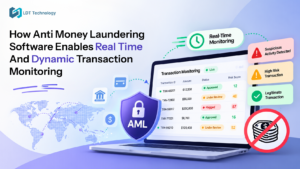


As digital payments, online banking, fintech, and cross-border transactions continue to grow, financial crime is becoming more sophisticated. Traditional compliance methods that depend heavily on manual reviews and fixed rules may struggle to keep up with high transaction volumes and rapidly changing risk patterns.
Modern anti money laundering software combined with real-time monitoring can help businesses identify suspicious activity faster, assess risks more effectively, and support compliance teams with automated insights.
Why Real-Time Transaction Monitoring Matters
Financial crime can develop through a series of transactions rather than a single suspicious event. A customer may suddenly change transaction frequency, transfer money between multiple accounts, or begin dealing with unfamiliar counterparties.
Real-time monitoring helps organizations identify such changes as they happen rather than waiting for periodic reviews.
Key areas that can be monitored include:
- Transaction value and frequency
- Customer transaction history
- Geographic activity
- New beneficiaries and counterparties
- Unusual account behavior
- Risk indicators and customer profiles
- Relationships between accounts
The goal is not to flag every unusual transaction but to identify activity that requires further investigation.
What Makes Monitoring Dynamic?
Traditional monitoring often depends on predefined thresholds. Dynamic monitoring adds more context by evaluating changing customer behavior and multiple risk factors together.
For example, a transaction may appear normal on its own but become more significant when considered alongside:
- A sudden increase in transaction frequency
- Transactions involving new locations
- Unusual changes in transaction value
- Multiple connected accounts
- Behavior that differs from the customer’s historical profile
This approach allows compliance teams to move from simple transaction checking toward broader behavioral analysis.
Important Features to Consider
When evaluating aml transaction monitoring tools, businesses should consider more than basic alert generation.
| Real-time monitoring | Helps identify unusual activity quickly |
| Risk scoring | Helps prioritize higher-risk activity |
| Behavioral analysis | Detects changes from normal patterns |
| Alert management | Organizes potential risk indicators |
| Case management | Supports investigation workflows |
| Reporting | Helps maintain compliance records |
| Audit trails | Provides visibility into decisions |
| Integration | Connects monitoring with existing systems |
The right solution will depend on transaction volume, customer profiles, business model, geographic presence, and risk exposure.
How Transaction Monitoring Supports Fraud Detection
Modern transaction monitoring software can support both compliance and fraud-risk management.
Consider a customer who normally makes a small number of low-value transactions but suddenly receives numerous payments from unrelated accounts before transferring the funds to several new beneficiaries.
Reviewing one transaction may not reveal much. Examining the entire sequence can provide a clearer picture of potentially unusual behavior.
This is why transaction monitoring for fraud detection should consider transaction history, frequency, value, customer behavior, counterparties, and other relevant risk indicators.
Connecting KYC With Transaction Monitoring
Customer verification should not stop after onboarding.
kyc compliance software can help organizations collect and verify customer information, while ongoing monitoring can evaluate whether actual activity remains consistent with the customer’s expected profile.
A connected workflow can look like this:
Customer Onboarding → Identity Verification → Risk Assessment → Transaction Monitoring → Alert → Investigation
This creates a continuous risk-management process instead of treating compliance as a one-time activity.
The Role of Document Verification
Financial crime can also begin with fraudulent documentation during customer onboarding.
document fraud detection software can help organizations identify potential inconsistencies in submitted documents and strengthen the customer verification process.
When combined with identity checks, customer risk assessment, screening, and transaction analysis, document verification can provide compliance teams with additional context when evaluating risk.
Real-Time Monitoring vs. Periodic Reviews
| Detection | After activity occurs | During or shortly after activity |
| Analysis | Periodic | Continuous/event-driven |
| Response | Potentially delayed | Faster |
| Behavioral visibility | Limited | More comprehensive |
| Automation | Lower | Higher potential |
| Risk prioritization | Often manual | Can use automated scoring |
Real-time monitoring does not have to replace periodic reviews. Both approaches can work together to provide continuous oversight and broader compliance visibility.
How to Reduce False Positives
Large numbers of unnecessary alerts can increase the workload of compliance teams. Organizations can improve alert quality by:
- Using customer segmentation
- Applying risk-based thresholds
- Reviewing historical behavior
- Prioritizing higher-risk alerts
- Regularly reviewing monitoring rules
- Combining automated detection with human investigation
The objective should be better alerts, not simply more alerts.
Illustrative Case Study
This example is illustrative and demonstrates a potential monitoring workflow.
A digital payments company processes thousands of transactions every day. Its compliance team initially relies on manual exception reports, resulting in a high volume of low-priority alerts.
The company introduces dynamic monitoring that evaluates transaction frequency, value, customer history, counterparties, geographic activity, and account relationships.
A customer who previously maintained predictable activity suddenly begins receiving multiple payments from unrelated accounts and transferring funds to several new beneficiaries.
Instead of reviewing each transaction separately, the compliance team receives a consolidated alert showing the broader behavioral pattern.
This allows analysts to investigate the activity more efficiently and determine whether it has a legitimate explanation or requires further action.
Choosing the Right Financial Crime Technology
The best financial fraud detection software will vary from one organization to another. Businesses should evaluate solutions based on:
- Transaction volume
- Customer risk profile
- Integration requirements
- Geographic operations
- Compliance processes
- Investigation capabilities
- Scalability
- Reporting requirements
Technology should fit the organization’s actual risk-management framework rather than being selected solely on the number of features available.
How AI Can Improve Financial Crime Monitoring
AI and advanced analytics can help organizations analyze large datasets and identify patterns that may be difficult to detect manually.
Potential applications include:
- Anomaly detection
- Behavioral analysis
- Risk scoring
- Alert prioritization
- Account relationship analysis
- Identification of unusual transaction patterns
However, technology should work alongside appropriate human oversight. Automated alerts still require context and investigation before organizations make compliance decisions.
Conclusion
Financial crime continues to evolve as digital financial services expand. Businesses therefore need monitoring strategies that can respond to changing customer behavior and transaction patterns.
A modern anti money laundering software solution can bring together customer risk information, transaction analysis, alerts, investigation workflows, and reporting. Real-time and dynamic monitoring can further help compliance teams identify unusual activity earlier and focus their resources on higher-priority cases.
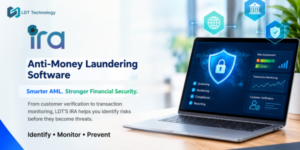
Being an IT consulting company LDT Technology provides IRA, its anti-money-laundering solution designed to support AML-CFT and fraud-prevention workflows. IRA supports capabilities such as risk scoring, transaction monitoring, customer screening, and watchlist-based checks, helping businesses build a technology-driven approach to financial crime risk management.
The objective should not simply be to generate more alerts, but to create a smarter, more contextual, and more manageable compliance process.
About the Author


Harish Garg – CEO & Co-Founder, LDT Technology
Harish Garg is the CEO and Co-Founder of LDT Technology. He works closely with businesses to understand evolving technology requirements and develop scalable solutions supporting digital transformation, financial technology, artificial intelligence, and enterprise technology initiatives.
Need Smarter Anti-Money Laundering Solutions?
Looking to strengthen your AML compliance and transaction monitoring? Connect with LDT Technology to explore powerful Anti Money Laundering Software designed to help detect suspicious activities, mitigate financial risks, and streamline compliance processes.
Reach us at: https://www.ldttechnology.com/contact-us