
The Information Gap in Property Articles
Most articles about row houses vs flats focus on the obvious — price, area, amenities. Very few tell you about the actual daily experience differences that only become clear after you have lived in both. This blog fills that gap with ten specific things that property buyers in Lucknow should know before making their format choice.
- You Will Never Again Wait for a Lift
This sounds trivial until you have lived in a flat on the 8th floor with two young children and a week’s worth of groceries. Lift breakdowns, lift maintenance, shared lift with all the floors above and below — the daily dependence on a lift is real. In a row house, this does not exist.
- Your Electricity Bill Will Be Lower
A flat in a multi-storey building uses lifts, common area lighting, and pumped water supply systems — all of which are funded through maintenance charges or common electricity. In a row house, your electricity bill covers only your own consumption. With a solar provision included — as in Ashoka Developer’s Faizullaganj project — you can reduce your electricity bill further.
- You Can Actually Hear Yourself Think
Apartment buildings carry sounds vertically in surprising ways. In a row house, the only shared walls are side walls. The absence of footstep noise from above, impact sound from below, and the general hum of a multi-family building makes a row house noticeably quieter for daily life.
- Guests Can Stay Without Awkwardness
In a flat, having guests who stay for several days can feel cramped and slightly embarrassing — neighbours notice, corridors are shared, and there is little room to move about freely. In a row house, guests feel like they are staying in a real home. The front door and compound give a sense of private entry that apartment lobbies simply do not.
- Your Dog or Pet Has a Life
Pet ownership in apartment buildings is complicated — society rules, lift restrictions, noise complaints from neighbours. In a row house with a small compound area, a pet dog has space to move, a direct exit for walks, and no lift journey to navigate. For pet owners, this difference is very significant.
- Small Children Are Safer and More Active
In a row house colony, small children can play in the compound or in the colony green area with supervision from inside the house. In a flat, children need to be taken down to the society play area — which requires the full routine of getting ready and going out. The ease of outdoor access in a row house directly supports children’s physical activity.
- Society Politics Does Not Affect Your Life
Apartment society meetings, disputes over parking, disagreements about pet policies, arguments over maintenance charges, committee elections — these are real and regular features of apartment life in Indian cities. In a row house colony, there is no society committee with power over your daily life. You live independently within a small, organised colony.
- You Can Expand or Modify at Your Own Pace
In a flat, any modification to the structural elements, external appearance, or even internal layout requires society permission. In a row house, you are the decision-maker. Want to add a water filter, change the kitchen layout, install a security camera on your front wall, or plant a garden in your compound? No permission needed.
- The Compound Gives You Storage
Indian households accumulate items — seasonal furniture, festival decorations, children’s old bicycles, tools. Flats have limited storage. A row house with a small compound area gives you space to store items that would clutter a flat’s living area. Ashoka Developer’s gated colony provides a clean and organised environment for this kind of practical storage use.
- The Investment Value Is Different
A row house investment includes land. An apartment investment does not meaningfully include land in the same way. Over 20 to 30 years, the land component of a row house in a growing city like Lucknow appreciates in a way that adds to the total asset value. The building ages but the land does not depreciate — in fact, land in developing Lucknow localities typically appreciates steadily.
🏡 ASHOKA DEVELOPER — PROJECT HIGHLIGHT
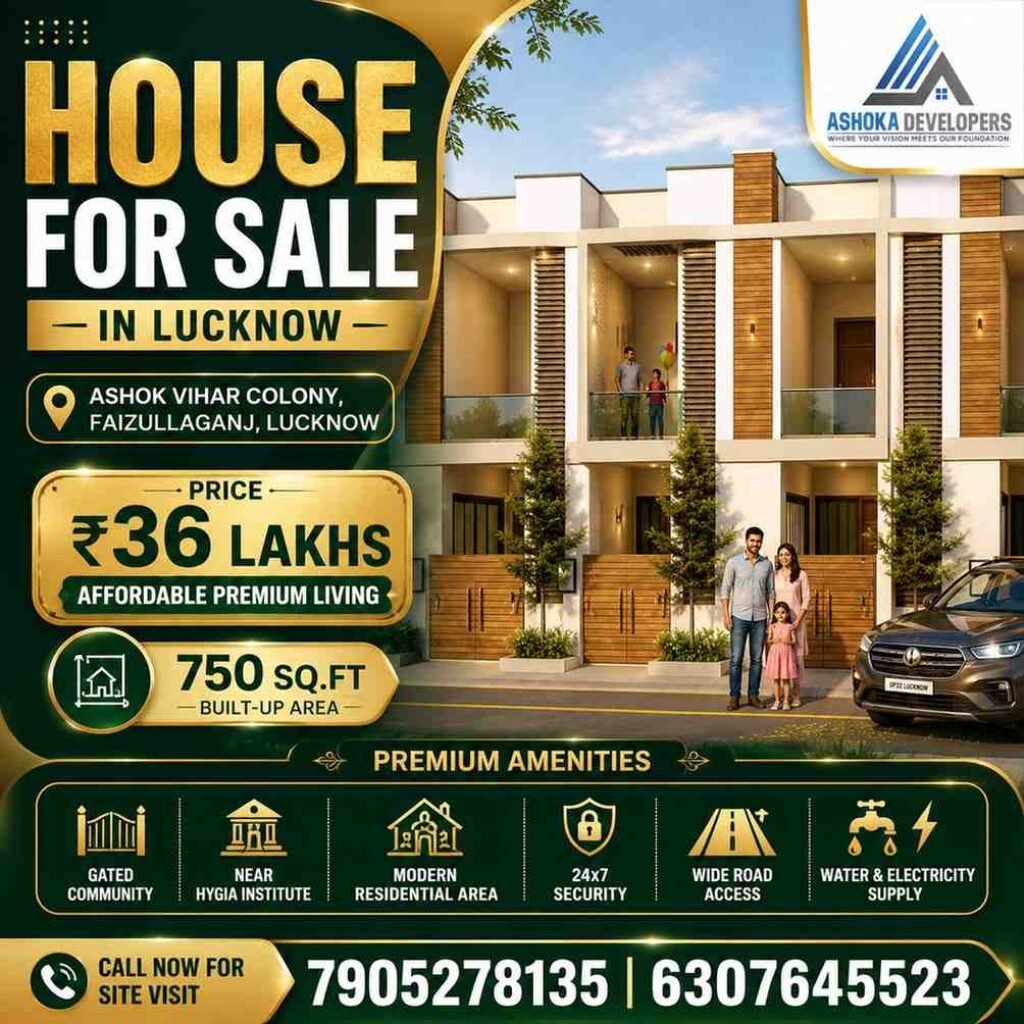
750 sq. ft. 2 BHK Independent Row House | Under Rs. 36 Lakh | Faizullaganj, Lucknow.
10 daily life advantages over apartment living — and all included at an affordable price.
Ashok Vihar Colony, Near Jaglal Petrol Pump | Peaceful gated colony | Green surroundings.
Modular kitchen | Vitrified flooring | Covered parking | 24-hr water | Solar provision | Gated entry.
By Ashoka Developer — quality, transparency, timely delivery. Contact: 6307645523.
📍 Ashok Vihar Colony, Faizullaganj, Near Jaglal Petrol Pump, Lucknow, Uttar Pradesh
📞 Contact: 6307645523 | Developer: Ashoka Developer
FAQ
Q: Is a row house difficult to maintain compared to a flat?
A: A row house requires you to handle your own maintenance — repairs, painting, and minor fixes — rather than delegating everything to a society. However, this also means you pay less in mandatory monthly charges and have full control over when and how maintenance is done. Most row house owners find the total maintenance cost and effort is lower than in a society apartment.
Q: Can I keep pets in a row house in Lucknow?
A: Yes. One of the clear advantages of a row house is pet-friendly living. There are no society restrictions on pet ownership, no issues with lifts, and the small compound area gives pets space to move. For families with dogs or other pets, a row house is a significantly better living environment than an apartment.
Q: Is a row house less secure than a flat in a guarded apartment complex?
A: Not necessarily. A well-designed row house colony with a compound wall and gated entry — like Ashoka Developer’s project at Faizullaganj — provides good perimeter security. Individual front door locks and grille doors add another layer. Many families feel that a row house with its own compound wall actually gives better privacy and security than a flat in a building with shared lifts and corridors.
Q: What is the resale process like for a row house?
A: Selling a row house is generally straightforward. The buyer purchases the specific unit with clear title documents. There is no need for society NOC as required in many apartment complexes, which simplifies the process. In Lucknow’s resale market, well-maintained row houses in organised colonies sell to a broad pool of buyers across the home-buyer and investor segments.