
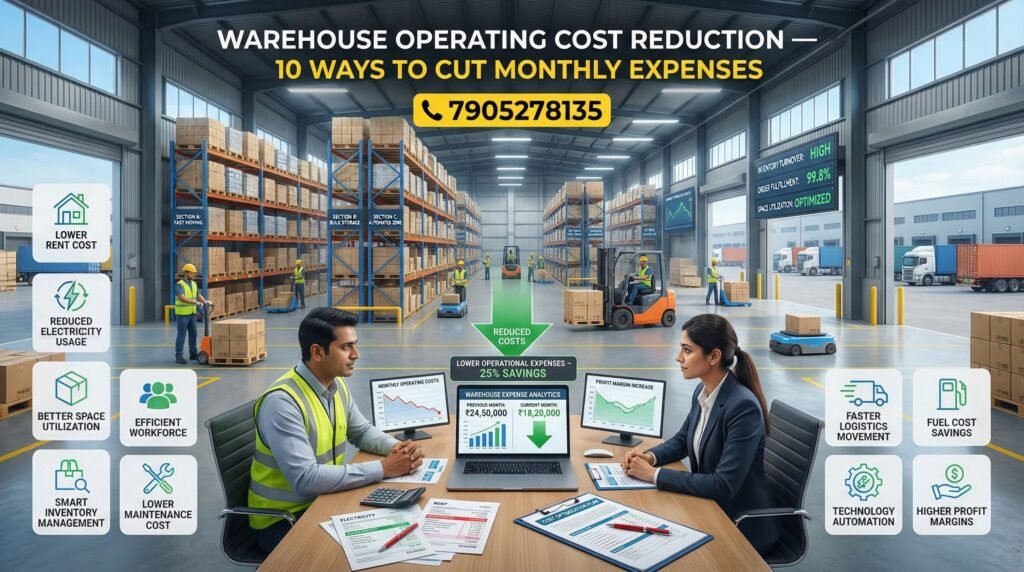
You Run a Small Business. Your Warehouse Is a Big Expense. Here Are 10 Practical Ways to Make It Smaller — Starting This Month.
Running a godown or warehouse as a small business in India feels like a constant balancing act. The rent is due every month. The electricity bill arrives and is higher than expected. The helpers’ salaries go out. Packing material runs out. The courier bill keeps growing. And somehow the profit margin keeps getting thinner.
The good news: a significant portion of this spending is reducible — not by cutting corners or reducing quality, but by being smarter about where the money actually goes. Most small businesses never do this review because it seems complicated. This guide makes it simple.
10 Ways — Explained Simply for Small Business Owners
Way 1: Pay Only for the Space You Actually Use
Look at your godown right now. How much of the floor is empty? If more than one-third of the space is consistently empty — you are renting space you do not need. At your next renewal, either negotiate a smaller space or ask for a lower rate on the unused portion.
Way 2: Stack Up, Not Out
Instead of spreading goods across the floor, buy basic steel racking and stack goods upward. Most Indian godowns have 10 to 14-foot height that is completely unused. Simple racking doubles your effective storage and means you need less floor area.
Way 3: Switch Lights to LED
This is the easiest and fastest saving available. LED lights use 50 to 60% less electricity than old tube lights or CFL fittings for the same light output. A godown running 10 old tube lights for 12 hours per day — switching to LED saves approximately ₹4,000 to ₹8,000 per month on the electricity bill. The LED fittings pay for themselves in 3 to 4 months.
Way 4: Buy Packing Material in Bulk
If you buy tape, boxes, and bubble wrap in small quantities from a local shop — you are paying retail price. The same material bought in bulk (a month’s supply in one order from a wholesale supplier or online bulk platform) typically costs 20 to 35% less. Find 2 to 3 nearby small businesses and pool your orders for even better bulk pricing.
Way 5: Ask Your Courier for a Volume Rate
Most small businesses pay the standard courier rate because they never ask for a lower one. Call your courier’s local hub or account manager and say: ‘I dispatch [X] shipments per month — what is the best rate you can give me?’ Any business doing 150 or more shipments per month has leverage. The saving is typically ₹5 to ₹15 per shipment — on 300 shipments per month, that is ₹1,500 to ₹4,500 saved monthly with one phone call.
Way 6: Organise the Godown to Save Staff Time
An organised warehouse saves money without reducing staff. Put fast-moving goods closest to the packing and dispatch area. Label every shelf clearly. Reduce the time each picker spends walking and searching. If each helper currently wastes 1.5 hours per day in inefficient movement — and you pay ₹15,000 per month per helper — you are paying ₹3,000 per month per helper in wasted time. Organise the space once and save it every single month.
Way 7: Check If You Can Claim GST Back on Your Rent
If your business is registered for GST, you are probably paying 18% GST on your warehouse rent. And if you are GST registered, you can claim that entire 18% back as a tax credit against your own GST. Ask your CA: ‘Am I claiming ITC on my warehouse rent?’ On a ₹50,000 monthly rent godown, this GST is ₹9,000 per month — ₹1.08 lakh per year — that you should be recovering if you are not already.
Way 8: Clear Dead Stock Every Quarter
Look at the goods that have been sitting in your godown for more than 3 months without moving. These goods are costing you storage space rent every single day. Discount them aggressively, return them to the supplier if possible, or sell them to a secondary market dealer. A godown that regularly clears slow stock needs less space than one that accumulates it indefinitely.
Way 9: Combine Small Inward Deliveries Into Bigger Less-Frequent Ones
If 5 small deliveries come from the same supplier in a month, each one takes receiving time and handling. Combine them into 1 or 2 larger deliveries. You pay less for inward freight on a per-unit basis and your team spends less time receiving and documenting.
Way 10: Use a Free App to Track Your Stock
Paper registers and memory-based stock management lead to errors — wrong items dispatched, stock differences at month end, expired goods not noticed on time. A free app like Zoho Inventory (free tier) or even a well-structured Google Sheet tracks your stock accurately, flags low levels, and reduces the errors that cost money in returns and corrections.
The First Step — Choosing the Right Warehouse at the Right Price
| 🏭 ASHOKA WAREHOUSING — LUCKNOW
Affordable Warehouse for Rent in Lucknow — Starting at Just ₹18 per Sq Ft 💰 Rent: Only ₹18 per sq ft — one of Lucknow’s most competitive warehouse rental rates 📍 Location: Sitapur Road, National Highway (NH-24) — prime logistics corridor, Lucknow 🚉 Connectivity: 20 minutes from Lucknow Junction — road and rail logistics access 🏢 Facility: Modern, secure, well-ventilated A-grade godown — designed for efficient operations 👥 Ideal For: Manufacturers · Importers · Exporters · E-Commerce Sellers · Wholesalers · Logistics Companies |
Before any of the 10 tips above can save you money, you need to start from a competitive base rent. In Lucknow, Ashoka Warehousing offers Affordable Godown for rent on Sitapur Road, NH-24 at just ₹18 per sq ft — one of the most competitive rates in Lucknow for a modern, well-maintained, highway-located warehouse. For small businesses that are currently paying above ₹20 to ₹25 per sq ft for space in a less well-located facility — shifting to Ashoka Warehousing at renewal time immediately saves ₹2 to ₹7 per sq ft on every square foot rented. On a 2,000 sq ft godown, that base rent saving alone is ₹4,000 to ₹14,000 per month — before any of the 10 operational tips above are even implemented.
FAQs for Small Business Warehouse Operators
Q: Is it worth investing in steel racking for a small warehouse in India?
Yes — for almost every small warehouse operator in India, steel racking is one of the best investments available. Here is the simple calculation: if proper racking doubles your storage capacity, you may be able to halve the floor area you rent — saving thousands per month in rent permanently. Or you avoid taking additional warehouse space as your business grows — saving the cost of expansion. The upfront cost of basic steel racking for a 1,500 to 2,000 sq ft warehouse is approximately ₹80,000 to ₹2,00,000 depending on height and load requirements. At ₹10,000 to ₹40,000 in monthly savings from avoided space expansion or rent reduction — this investment pays back in 3 to 12 months. After payback, it saves money every single month indefinitely.
Q: How much does LED lighting save in a typical Indian godown?
In a typical Indian godown of 1,500 to 3,000 sq ft running 8 to 12 tube lights or high-bay fittings for 10 to 14 hours per day, switching to equivalent LED fittings saves approximately ₹3,000 to ₹10,000 per month on the electricity bill. The saving depends on local electricity tariff, the type of old fittings being replaced, daily operating hours, and the quality of LED chosen. Premium industrial LED fittings from brands like Philips, Havells, Surya, or Wipro typically last 30,000 to 50,000 hours and come with manufacturer warranty. At current commercial electricity rates in UP (approximately ₹6 to ₹8 per unit), the energy saving of 40 to 60% from LED conversion translates directly into monthly bill reduction. Most small godown LED conversion projects pay back in 3 to 5 months at current electricity prices.